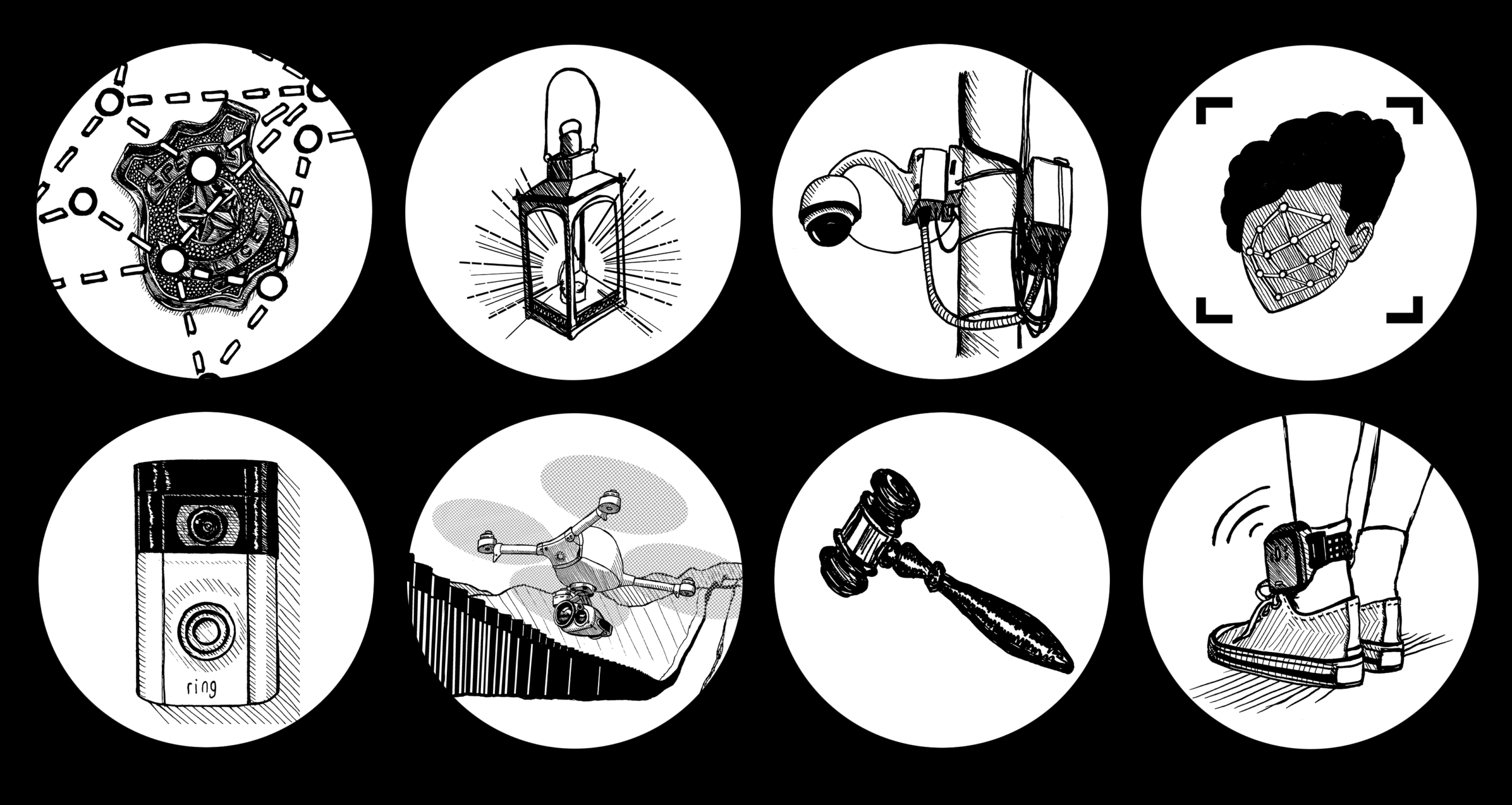
Today, incarcerated people in some facilities are being forced to wear hard plastic bracelets that transmit their live biometric data to the state. At the same time, algorithm-driven technologies are being used to predict who might commit a crime, to detain immigrants and identify sites for ICE raids, and to jail Black people misidentified by facial recognition systems.
It has become increasingly clear that we need a term for the insidious ways artificial intelligence is being used to criminalize society’s most vulnerable, while surveilling the rest of us on a daily basis—and generating billions of dollars in the process. Carceral AI, a term coined by researcher Dasha Pruss and a team of interdisciplinary scholars, captures this phenomenon. Pruss’s research serves as both the inspiration for, and first installment in, our own Carceral AI series, which will address an array of topics ranging from AI-driven facial (mis)recognition to efforts to use AI to justify the revival of so-called “predictive” policing.
The series will continue through 2026. To make sure you never miss an installment, sign up for our weekly newsletter.
Carceral AI is here. It’s time to fight back.
Facial recognition is just the tip of the iceberg. Today, AI is being used to monitor social media, track ICE targets, and classify swaths of the population as “future” criminals.
Dasha Pruss
Read More
Tech Won’t Fix Eyewitness Identification
Eyewitness identification is a deeply flawed practice. Adding facial recognition technology, with its veneer of objectivity, only worsens the crisis of mass incarceration.
Will Collins
Read More
Turning Death into a Commodity
ShotSpotter has leveraged gun violence into a multimillion-dollar business that promises safety but delivers only increased policing and drain on the public’s resources.
Ed Vogel
Read More
Safety from Surveillance
In their fight to get ShotSpotter out of Chicago, organizers have emphasized the ways that for-profit technology can never deliver on its promises to make communities safer.
Ed Vogel & Sharah Hutson
Read More
Borders and Bytes
So-called “smart” borders are just more sophisticated sites of racialized surveillance and violence. We need abolitionist tools to counter them.
Ruha Benjamin
Read More
Precrime Is No Longer Science Fiction
Biometric technologies are increasingly using facial expressions, eye movements, voice patterns, and more to predict whether someone has or will commit a crime.
Sarah Fathallah
Read More
The Algorithmic School-to-Prison Pipeline
With little transparency or oversight, technology is being used to flag youth as risks to public safety and deciding who is surveilled, arrested, and confined.
Nicholas E. Stewart
Read More
Art: Dasha Pruss