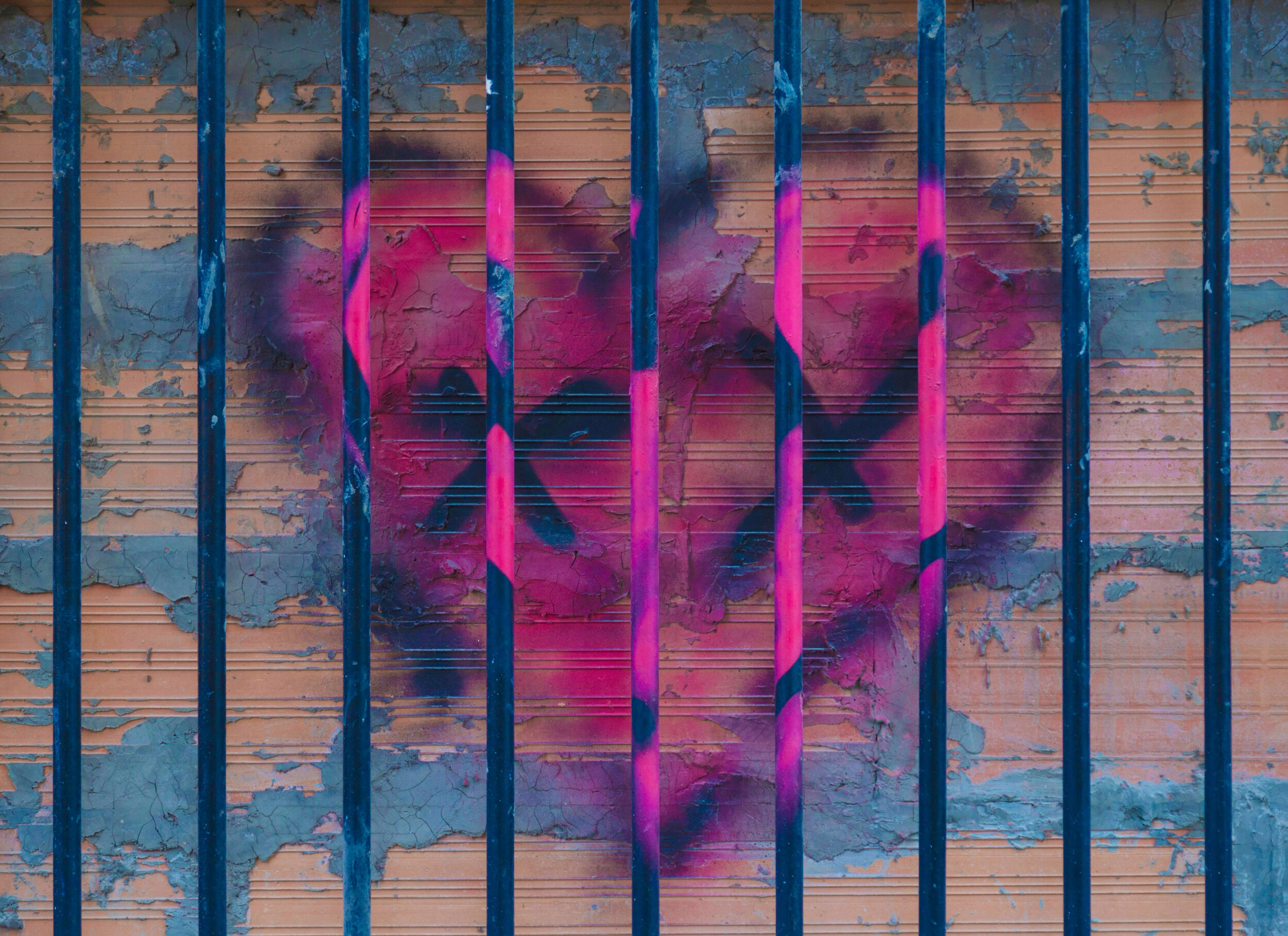
Ivan: Love Makes You Better
For decades, I treated love as a luxury I could not afford. Prison has a way of teaching you that tenderness is dangerous, that vulnerability is a weakness others will exploit, and that hope—especially the kind rooted in human connection—comes at too high a cost.
I was a country boy from Oklahoma who, after a rough childhood, landed in prison for the second time by the age of twenty-six. Over decades, the idea of partnership became abstract, almost theoretical—something other people lived, something I observed from a distance, never something I expected to reclaim. Then I met a French-Algerian woman named Halima.
Halima and I met not through romance, but through shared purpose. In October of 2021, I messaged her on behalf of the United Black Family Scholarship Foundation, a nonprofit I founded to expand access to educational programs in underserved communities. Halima had long been interested in disrupting the pipeline between poverty and incarceration, and I hoped she would be want to support our mission.
When we spoke on the phone to discuss the foundation, our connection was immediate. The conversation quickly moved beyond logistics, and we began to speak more personally. Her presence was unmistakable—direct, thoughtful, and grounded in conviction. Within days, I began to fall in love. At age forty-two, Halima was not searching for fantasy or rescue. She knew precisely what she wanted from life and love, and yearned for a serious relationship.
Yet she also carried a hard rule for herself—one she believed she would never break.
For years, Halima had corresponded with a close friend on death row in Pennsylvania. That experience shaped her worldview. She believed that she could never date, let alone marry, a man in prison. She could not understand how women entered such relationships or what sustained them. To her, incarceration was a barrier that love simply could not survive.
Two weeks after meeting Halima, I lost my cell phone. I could not stop thinking about her: the angel who had come into my life. At the same time, I prepared myself for the worst: that we would lose contact entirely. Imagine my surprise when a letter arrived from France soon after—with a U.S. phone number and message for me to call her.
That moment told me everything I needed to know. Within weeks of meeting each other, Halima asked me to marry her. She had decided to take the ultimate risk, facing her deepest fears in order to follow her heart. I said yes.
Halima and I had met during the pandemic, when in-person visits at many facilities—including Solano State Prison, where I was at the time—were not allowed. But the California Department of Corrections and Rehabilitation (CDCR) made video visits available, and we connected on a free one-hour video call each week. Soon after, free prison phone calls were introduced in California; each incarcerated person was given a GTL tablet to communicate with our loved ones. Halima and I began to build something real.
Despite the fact that we were engaged, I did not expect Halima to remain in my life for long. Prison relationships often come and go, especially when intimacy is involved, and there’s always the risk of a woman drawn to men behind bars for the wrong reasons. But over time—and to my surprise—I realized she was here to stay, bringing a much-needed sense of normalcy into a world defined by instability and deprivation.
In prison, we are taught a few unspoken relationship rules: Don’t ask questions, and don’t expect much. Much of the emotional and material labor of sustaining relationships—visits, money for commissary and communication, letters—falls on partners. Attachment is seen as a liability; survival requires letting go before you’ve ever really held on.
When I told Halima about these rules and how many prison relationships were built on them, she was furious. She let it be known in no uncertain terms that she refused to be reduced. She refused a relationship shaped by lack rather than love. That refusal changed me.
Her love made me better. As a man, she taught me that imperfection isn’t failure and that flaws don’t make us unworthy of love and respect. As a father, she made me face the years I’d missed with my daughter, who was six when I was incarcerated, urging me to call even when we weren’t speaking and to choose connection over pride. She shaped how I showed up as a mentor at the United Black Family Scholarship Foundation, teaching me to meet people where they were with grace. And as a husband, she taught me presence—listening without fixing, making her laugh, helping ease the weight she carried, and showing up for her mental and emotional well-being.
At Solano, our marriage would flourish. During our video visits, we came to know the visitation staff well. They started to understand the sacrifices Halima made when she visited me in person. Because she lived abroad and had limited funds, she could only come visit me once a year. To accommodate this, Solano granted us extended in-person visits. Our family visits—that is, our conjugal visits—were extended as well. Instead of one forty-eight-hour visit each quarter, we were granted two back-to-back sessions: four whole days and a wakeup.
During these days, we were granted something rare—privacy. In the special quarters reserved for these family visits, Halima marveled at my cooking skills. For the first time in twenty-four years, I got to access, and cook, real food: battered fried shrimp, steak sizzled in butter, pancakes topped with chopped strawberry and kiwi. For the first time in twenty-four years, I escaped the madness of prison: its pettiness; its constant demand for hypervigilance; its culture of hypermasculine postering; the daily sensory assault of alarms, stabbings, overdoses, counts, and lockdowns.
More importantly, I got to spend time with Halima. We got to discuss our inner worlds, our respective dreams, and our ideas of freedom. In those moments, I remembered who I was beyond my prison number.
All this sustained our marriage. Prison officials at Solano proved something critical: when the system chooses to support family connection, it can. Soon enough, this would all change.
More from our decarceral brainstorm
Inquest—finalist for the 2025 National Magazine Award for General Excellence & cited in The Best American Essays 2025—brings you insights from the people working to create a world without mass incarceration.
Sign up for our newsletter to get the latest in your inbox every Saturday.
Newsletter
Halima: Crossing An Ocean to Enter a Cage
I grew up between two cultures, two counties, two languages—France and Algeria. Very early on, I learned what it meant to navigate between identities, to constantly translate, to adapt, to understand without always being understood. This dual culture is part of me. It shaped me. It perhaps helped me understand Ivan’s complex life, caught between freedom and incarceration.
Ivan’s story moved me deeply. He did not have an easy life. In Wewoka, Oklahoma, his father was murdered when he was three years old. His mother suffered from mental illness and addiction. He had to take on the responsibility of caring for his younger sisters at a very young age—a responsibility no child should ever have to bear. He had to learn how to survive, to be strong before his time.
And yet, despite everything life has taken from him, Ivan is the most optimistic person I have ever met. I asked him to marry me because, very quickly, I realized he was my soulmate. Although I am an anxious person, this certainty came naturally, without any calculation.
I admire Ivan deeply. I am proud of the man he is today. Proud of his capacity to love, to hope, to still believe in goodness, in justice, in the future. Proud of his clear-sightedness without bitterness, of his strength without harshness. He would have had a thousand reasons to be broken. He chose—and chooses—to stand tall.
I live in the south of France, about an hour away from Spain, and a five minute walk from the Mediterranean. The first time I traveled from France to California to visit Ivan, I did not know what awaited me. I was terrified. I’ve traveled abroad—to Algeria, Morocco, Spain, Italy, Switzerland—but never alone. I did not speak English fluently. In fact, Ivan and I would later use a French–English dictionary to help us communicate during visits. I had never been inside a prison before and knew little about how one might look except from what I had seen on television.
Ivan had done everything he could to prepare me and give me courage to make this trip. He was my inspiration, believing in me more than I believed in myself. The love I had for him was stronger than anything, and it allowed me to go where I would never have dared. To this day, when I’m afraid, he holds my hand—even from a distance, even behind bars. When I doubt myself, he reminds me who I am.
In December of 2022, I set out to visit Ivan for the first time. I took a six-hour train ride to Paris, an eleven-hour flight to San Francisco, and an hour drive to Vacaville. My first visit to Solano prison felt overwhelming—nearly 4,000 men, layers of concertina wire, constant surveillance. There was an air of hostility all around me.
Before I even got to the prison, U.S. Customs held me for hours at the airport. They questioned me harshly, kept me in isolation, treated me like I didn’t belong. My “crime”? Loving someone who was incarcerated. I was not prepared for how dehumanizing the experience would feel. I remember thinking: if this is what families endure, no wonder so many give up.
But I did not give up. After my journey, I entered the prison’s imposing walls, passed through two security checkpoints, and waited nervously. The moment I saw him walk toward me was unreal, almost magical. Nothing around me mattered anymore. The noise, the walls, the rules, the guards—everything disappeared. There was only him. I studied every detail of his face, I touched his hair, his skin, like a blind person trying to memorize features so they would never be forgotten.
Loving a man in prison means making constant sacrifices. There are financial sacrifices: travel is expensive, and each visit requires significant planning. There are emotional sacrifices, too. Loving a man in prison means living alone every day, returning home without your partner. It means not being able to find solace in his arms when exhaustion becomes overwhelming and the weight of the world falls on your shoulders.
I am a mother, I work, and I care for my elderly parents. Sometimes I manage everything alone, without physical support or anyone around. Sometimes, during periods of confinement or lockdown at Ivan’s prison, I go days without hearing from him. But we do talk, our communication is constant and profound. We talk about prison, but also about many other subjects: Palestine, countries where genocide is taking place, the planet, animals—because I deeply love animals. He is a fellow thinker, and he makes me think differently about life, about injustice, about the world. We share the same passion for reading. We love to read, but also to laugh together. We joke often.
This April will mark one year since I last saw my husband. A visit had been scheduled and agreed to in advance, but was ultimately impeded in what we believe to be an act of retaliation. At this very moment, as I write this story, I should be with him. This was precisely the month that we were supposed to see each other.
Ivan & Halima: Retaliation by Bureaucracy
Our story is evidence—evidence that love can rehabilitate, that connection sustains life. That love can be built across languages, cultures, borders, and bars. But it is also evidence that when those forces threaten institutional power, they can be systematically obstructed.
Last June, Ivan was transferred to California State Prison, Sacramento (CSP-SAC), where he was supposed to enjoy greater access to rehabilitative programming and enhanced privileges. The reality was the opposite.
In a routine inter-prison transfer, years of relational stability were erased. The conditions that had allowed our marriage to exist—extended visits, staff discretion, recognition of love’s rehabilitative efforts—were soon under attack.
Before Ivan’s transfer, we had already been approved for an extended family visit at Solano this month. But when he arrived at his new facility, visitation staff told us that no such extended family visit would be allowed, though a regular forty-eight-hour visit could still take place. We filed a complaint to the warden, who simply rubber stamped the staff’s decision.
About five months later, and following several grievance reports we filed in November and December, visitation staff sent a notice requiring Halima, an already approved visitor, to submit an updated visitation questionnaire. She would be barred from visiting in any capacity until the application was processed and approved, a process that could take months. To us, the timing did not seem incidental. A delay like that could push us beyond our approved February visitation date and cause Halima to lose a long-planned vacation. We decided not to file the questionnaire and to instead protest the request.
We believe that CSP-SAC’s actions violated California regulations. According to Title 15, section 3172(g), once a visitor is approved, their visits “shall, absent information which would warrant immediate disapproval,” be allowed to continue. No such information, or evidence of a security threat, was presented to us. When this explanation was brought to the warden’s attention, his response was indifference, suggesting we file a grievance or a lawsuit if we remained dissatisfied.
This Valentine’s Day, millions of incarcerated Americans and their significant others will endure a paradox: Love is supposed to be a refuge, but in prison, it can become a weapon. Despite overwhelming evidence that sustained family contact supports mental health during incarceration and reduces recidivism after release, family connection is disregarded as a rehabilitative necessity.
Departments of corrections publicly claim to support family and community ties, yet their actions tell a different story. Many incarcerated people are housed hundreds of miles from home, making visits financially and logistically out of reach. Visitation is often restricted, delayed, or denied through shifting and unclear rules, discretionary enforcement, and opaque approval processes that vary by facility or staff member. Even when loved ones are approved, access can be revoked without explanation. As Ivan has seen firsthand, updated questionnaires are used as a pretext to deny visits over minor technicalities—like a missing Social Security number.
For those inside and their families, that dynamic can turn love into a bargaining chip, and family members into collateral damage. The message is clear: comply, avoid challenging authority, and the institution may appear “humane.” Resist—file a grievance, speak out—and access can disappear overnight.
Our story is one among many. Across the state, families face arbitrary restrictions, delays, and denials that strain relationships and deny basic human dignity. In our case, we felt we had few avenues of recourse beyond creating an online petition asking California governor Gavin Newsom to investigate the obstruction of visitation throughout CDCR, the misuse of staff authority, and the refusal of prison leadership to intervene.
We will still spend Valentine’s Day together—over the phone. We’ll sing to each other, tease each other for singing badly, and laugh together. Despite the distance, the obstacles, and the bureaucratic hurdles, we refuse to treat love as a liability. We are writing this article because our relationship exists, it endures, and it refuses to be erased.
We see our future clearly: living together in France, building and growing our organization, spending time in the United States with Ivan’s family, and one day traveling to Algeria, Halima’s country, where a house awaits us. Hope will carry us forward, unwavering, until we reach it.
Editors’ Note: Inquest reached out to the California Department of Corrections and Rehabilitation for comment but at the time of publication had not received a response.
Image: Karim MANJRA / Unsplash
Contributors