At thirty-six, incarceration severed my access to the worlds I had been living in. For two decades, I worked in HIV/AIDS services, competed in Philadelphia’s Ballroom scene, and organized in my community. Behind bars, I was suddenly cut off from the histories, movements, and bodies of knowledge I had long been a part of.
I quickly discovered that poet and activist Marilyn Buck’s statement—“Imprisonment is an extreme form of censorship”—wasn’t hyperbole. Research, reading material, and news reporting were difficult to come by. Censorship, like prison, is the forceful alienation and isolation of people and ideas. If reading is what Toni Morrison once called “one’s own mind dancing with another’s,” censorship tries to keep that dance still. It prevents people from getting to know one another and limits the possibility of collective action. At its most insidious, censorship becomes internalized—the surveilled mind learning to police itself.
In late March 2020, as COVID began to spread dangerously throughout prisons, I drafted a blog post expressing solidarity with incarcerated hunger strikers at Rikers Island, who were demanding PPE. I noted the irony that the strikers had to endanger their bodies simply to protect them. The draft was intercepted by my prison’s electronic messaging system. A week later, I was issued a misconduct report accusing me of encouraging unauthorized group activity.
I was thrown in solitary confinement for a month as punishment. When I was released back into the general population, I began noticing something odd with my communications: e-messages that typically arrived within twenty-four hours were now taking seven to ten days. The sudden disruption in communication—alongside repeated returns to solitary, which I understood as retaliatory—left me feeling more closely monitored than ever. Then, in the spring of 2021, I was transferred to another Pennsylvania prison more than 200 miles away.
Before my transfer, I encountered the most severe act of censorship and retaliation yet. Prison employees at SCI Fayette destroyed every scrap of paper I owned—what I understood to be the culmination of this wave of retaliation. This included all my books, journals, articles, essays, and manuscripts, as well as original photographs, legal documents, and irreplaceable keepsakes, such as funeral programs for the services of loved ones I could not attend. Roughly ten large cardboard boxes—each holding a cubic foot archive of my life—disappeared overnight. I received no compensation.
As a writer, the loss was incalculable. I had been journaling behind bars almost daily for over ten years—jotting down observations, making drawings, charting my growth, thinking through ideas, and reflecting on the abolitionist movement. I had also completed most of an essay collection, working meticulously through eight essays. One had taken five years to write. The emotional toll of writing that piece was so heavy that I still cannot imagine recreating it.
I had been targeted before for my work behind bars—writing, organizing study groups, engaging in political education—but this was different. Even now, thinking back to that moment breaks something in me. There is no way to fully explain what it means to lose that much of yourself. I think of Toni Morrison losing manuscripts in a fire at her home, and Ernest Hemingway losing a suitcase of his work on a train platform, and how devastating it can be to writers when entire bodies of work disappear. Their losses were tragedies; mine was an act of deliberate destruction by the state. But the specific devastation of watching years of thought and craft simply cease to exist unifies our experiences.
Prison censorship is often understood as applying to mail, books, magazines, and other already published materials. But it can extend to anything that can be written, stored, or otherwise preserved as thought or memory. Destroying written material is a way of erasing expression before it can reach an audience. It is not only the suppression of speech, but the destruction of the conditions that make speech possible.
After my work was destroyed, it took me nearly fourteen months before I could bring myself to write again. Even then, I was afraid that anything I put on paper could be taken and destroyed at any moment. The prison’s reach had extended far into my own mind, cultivating the fear it was meant to seed.
During the two years I spent at SCI Camp Hill, I scrambled to regain some of the materials that I had lost, which pulled me into a battle over books that I could not have anticipated. Pennsylvania Department of Corrections policy states that materials approved at one facility should remain approved after transfer to another—unless they had since been banned.
When publishers like Haymarket Books tried to send me copies of books I once owned, prison staff often denied me access. Even though I was just one person in SCI Camp Hill’s population of 2,327 in 2022—about .04 percent of the prison population—my reading material accounted for just over 10 percent of all reading material banned that year. While I successfully appealed and overturned nearly all of those bans, the sheer volume of censorship efforts underscores how aggressively prison officials sought to restrict my access to reading materials.
The stakes extended far beyond my own ability to read. In Pennsylvania, when a title is successfully “denied,” it is added to the department’s prohibited list and automatically banned for every other imprisoned person in the state. What was at stake was not just my access, but everyone else’s as well.
Although access to reading materials is protected by the First Amendment, courts have long allowed prisons to restrict that access in the name of so-called security. This was the reason used to deny me every book that mentioned the Black freedom struggle, especially those that mentioned the Black Panther Party. At various points, state departments of corrections have banned works by Toni Morrison, Paulo Freire, and Mariame Kaba (who has contributed to this magazine). Book titles alone can be enough to substantiate a ban. When I was sent The Revolution Starts at Home, an anthology that confronts intimate partner violence within activist communities, the DOC banned it on the grounds that it called for revolution. Evidently, they had never read it. (I was successfully able to appeal that ban.)
When my friends tried to send copies of my own work—articles I had published over the years—back to me, the department wouldn’t let me have them. Mailroom staff often rejected materials on the grounds that they appeared to come from another incarcerated person. I would respond that the work was mine, that my name was on it, that I was the author. Still, it was denied under policies restricting communication between incarcerated people.
The experience became disorienting in its circularity: my own writing had to be mailed back to me as if it were foreign in the first place, only to be rejected as impermissible correspondence. It felt Kafkaesque—caught in a system that could not reconcile what it was seeing with what its rules allowed.
I began to see this not as an isolated error, but as part of a broader system of deliberate fragmentation. Today, the department routes mail through multiple channels depending on format: unbound pages are sent to Smart Communications, the Pennsylvania DOC’s digital scanning vendor; bound materials (such as books) are directed to a security processing center; legal mail and other official documents are handled directly by the prison where an individual is incarcerated. Items sent to the wrong address are typically rejected rather than forwarded. Pieces of mail aren’t delivered directly anymore; we receive only scanned copies. As for books, a friend or family member cannot simply send a copy; publications must come directly from “original source vendors,” such as publishers or bookstores. To make matters worse, books are treated as personal property that cannot be gifted, lent, or exchanged between incarcerated people.
It is also worth noting that DOC policies limit the amount of personal property incarcerated people may keep, including reading materials. In practice, this means books are treated as a managed burden rather than a source of knowledge. At one point, imprisoned people in Pennsylvania were restricted to ten books; if they were at capacity, they had to discard one to receive another. Space, in practice, becomes another way of limiting access to knowledge.
More from our decarceral brainstorm
Inquest—finalist for the 2025 National Magazine Award for General Excellence & cited in The Best American Essays 2025—brings you insights from the people working to create a world without mass incarceration.
Sign up for our newsletter to get the latest in your inbox every Saturday.
Newsletter
One of my most persistent censorship battles at Camp Hill involved articles. In theory, they counted as unbound pages that had to be sent to Smart Communications, digitized, and then transmitted back to the facility for printing and distribution. In practice, this process broke down repeatedly. I spent nearly a year contesting inconsistent handling of articles. They would be routed to one address, redirected to another, or rejected entirely on the grounds that they should have been sent elsewhere, or that they didn’t come from an “original” source. At one point, the confusion became so entrenched that higher-level administrative guidance was issued instructing staff to accept the format as intended. Even then, implementation remained uneven.
Over the two-year period that I spent at Camp Hill, with the help of my legal team and advocacy organizations like PEN America, I filed hundreds of grievances—all related to wrongfully denied publications and mail.
When I was transferred to SCI Dallas in March of 2023, my struggles with censorship continued. The major conflict there involved copyright law—specifically, the Fair Use doctrine. Under federal law, there are clear exceptions for educational and scholarly use—exceptions that prison education programs themselves rely on. Despite this, the prison began treating materials sent to me as copyright infringement. Items sent to me for educational purposes, including essays and articles retrieved from JSTOR, were denied on those grounds.
At one point, I went to the law library and copied out the relevant sections of copyright law myself, including the Fair Use provisions and their exceptions. I underlined the language and submitted it through the mail system multiple times, trying to demonstrate the discrepancy between policy and practice. I also raised the issue through internal channels. The response did not change for months, until my lawyers got involved.
Deliberate fragmentation, I came to understand, was not the end goal. Isolation was. As Buck wrote, “The withholding and monitoring of mail is part of the program of isolation—silencing, censoring the ideas and voices from outside the walls.” In effect, this program also allows a state’s department of corrections to effectively circumscribe one’s understanding of the world.
Throughout my time behind bars, and across facilities, there were stretches when my mail simply never reached me. This insidious form of censorship is difficult to fight precisely because it leaves no trace. Because missing mail is not technically confiscated, there is nothing formal to appeal; to even raise the issue, an incarcerated person would need outside help, proof that a package was sent, and the resources to pursue a fight. Mail confirmed as delivered to a prison—through tracking data from vendors such as Smart Communications—may still never reach its intended recipient. Families and incarcerated people have increasingly reported this kind of nondelivery—also known as nondistribution—as well as mail that arrives missing entire pages.
Censorship—of mail, of words, of people—does not only affect knowledge acquisition; it also impedes knowledge production. Without connection to the world and access to its reading materials, imprisoned people remain ignorant of what has happened and is happening. They are also prevented from making visible what is happening inside. This also ensures institutional opacity, allowing the prison to obscure its own operations, to hide what it does and what it is. In effect, the prison denies itself.
Fighting censorship requires coordination on both sides of the walls. My legal team and advocacy organizations, such as PEN America, helped me document and challenge a system designed to exhaust those who resist it. But for every incarcerated person with access to legal support, many more are fighting alone. Exposing what happens inside depends on imprisoned people being able to communicate it—and on people outside being willing to listen.
The first and most important step, of course, is coming together. Censorship is violence, and the antidote to violence is care and connection.
On February 9, 2026, I completed my sentence and was finally released into the world. It wasn’t until then that I realized how much of a toll prison censorship had taken on me. When you are incarcerated for seventeen years, you learn to protect your thoughts, your words. You learn to say things without saying them. You avoid certain words, phrases, and sentiments automatically. Eventually, you self-censor without thinking—it becomes habit.
When I came home, having candid conversations about the prison–industrial complex with people felt revolutionary. It was profound, being able to call things what they were, and to access the abundance of sources and materials that people on the outside take for granted.
About a year before my release, I began filling a composition book with everything I wanted to research—topics I wanted to understand more deeply, questions I wanted to pursue, words I had been unable to look up or learn while incarcerated. I filled that composition book, and then another. When I came home, I was finally able to go online and chase the answers I was looking for, although it was difficult to navigate new technologies at first.
Today, I love the freedom to read what I want, when I want. I’m grateful not to have to wait three weeks, or two months, to get a book—assuming it was allowed in the first place. I’m also grateful to continue writing, journaling, and thinking about ways to end incarceration for everyone.
I’ve recently begun editing for the Abolitionist, which has helped me ease back into my own work. I’ve been trying to recover the stories I once lost. So each morning, I make a cup of coffee and make sure I’m at my desk by 6 a.m. I’m still an early riser; that’s the prison in me. I open my laptop and begin the day’s work.
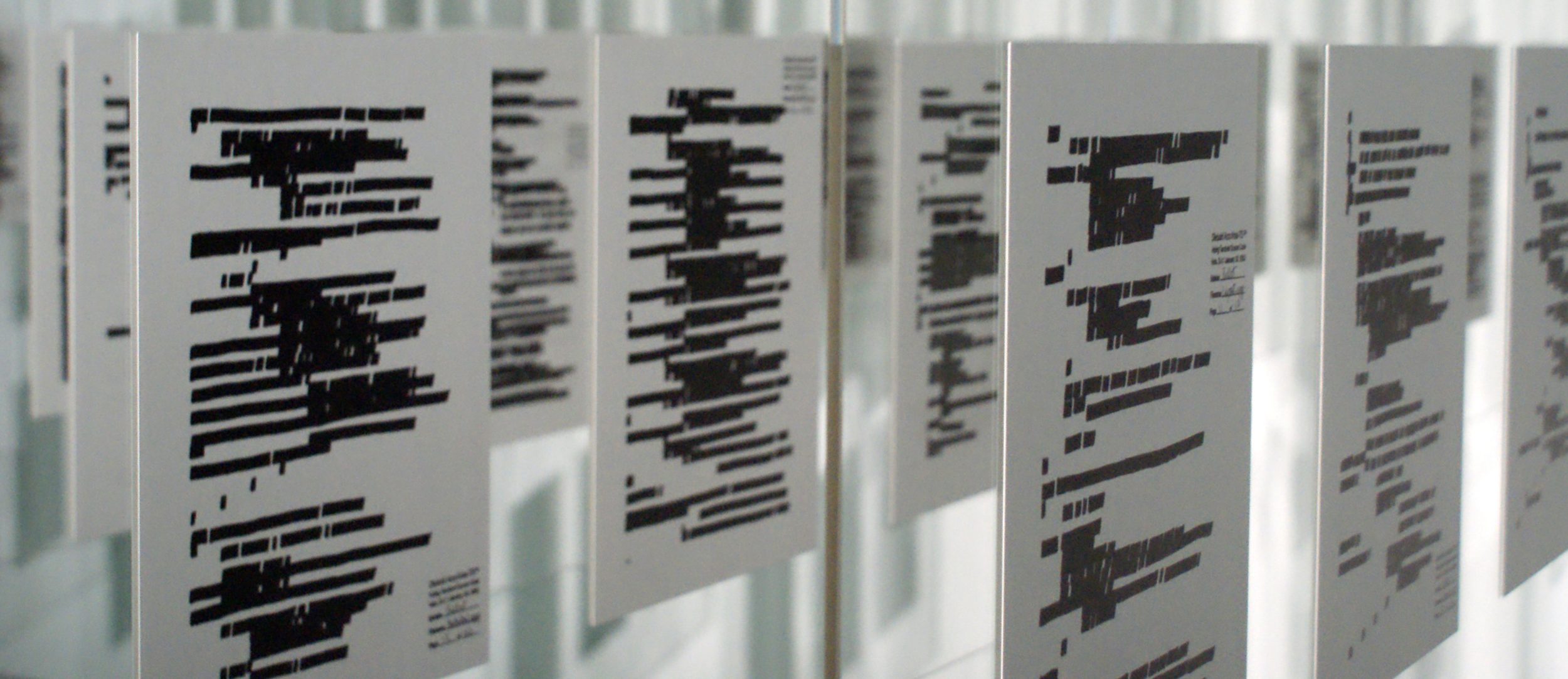
Image: Installation view of Ben Rubin’s Dark Source (2010), photograph by Marc Wathieu / Flickr.
Contributors