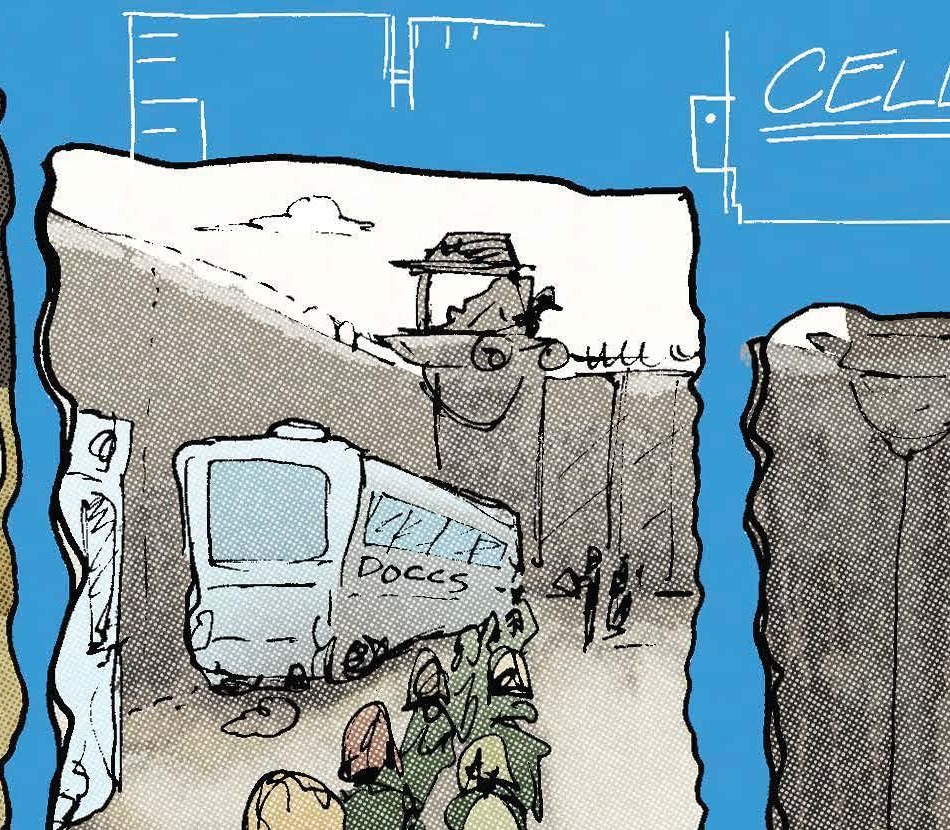
I drew a guard tower once, and then I ruined it on purpose.
This was at Auburn Prison, 2016 or so. I was practicing multiple-point perspective (imagine looking up at a building through a fisheye lens) to depict what the prison yard looks like from the ground. The tower was the anchor of the composition; it had to be there. It’s the thing you’re always under. But I got far enough into it to realize what I was making. Sight lines. Distances. The angle of the catwalk. Draw that carefully enough and it stops being a picture and becomes a document, and the wrong officer making rounds past me in the yard was going to call it an escape plan.
So I moved things. Softened the angles. Put the tower where it couldn’t be measured against anything real. I made the drawing worse so it would survive. So I would survive.
I’ve thought about that page for years, because it’s the whole problem in one sheet of paper. Everything I made inside that was true enough to matter also had to be vague enough to be allowed out of the building.
More from our decarceral brainstorm
Inquest—finalist for the 2025 National Magazine Award for General Excellence & cited in The Best American Essays 2025—brings you insights from the people working to create a world without mass incarceration.
Sign up for our newsletter to get the latest in your inbox every Saturday.
Newsletter
I came home in October 2025 after twenty-six years in New York State prisons. I wrote the entire time. Essays, a memoir, letters that ran longer than they should have. Writing is how I understood my own life. But I also made a lot of visual art during and about my time in prison, and the difference between how writing and art work on the audience is noteworthy.
A person who has never been inside reads an essay about prison and processes it as information. They agree or they don’t. They file it next to the other things they’ve read. There’s a distance built into the transaction, and the distance is the point. Prose gives the reader somewhere safe to stand.
Drawings don’t do that. A drawing lands before the argument does. You see the bunk, the shared toilet three feet from where a man eats, the tier stretching off past the edge of the panel, and you’re in the cell block before you’ve decided how you feel about mass incarceration. The reaction comes first. The politics come after, if they come at all.
I learned this from a professor named Karen Hall, who came in from Syracuse to teach a literature class at Auburn. She taught Art Spiegelman’s graphic novel about the Holocaust, Maus. She taught American Born Chinese, Gene Luen Yang’s graphic novel about self-acceptance in the face of racist stereotypes about Asian Americans. She taught March, John Lewis’s graphic memoir (made with artists Andrew Aydin and Nate Powell) about his life in the civil rights movement. Men who had spent their whole lives being told they weren’t readers sat with those books and argued about the Holocaust, about civil rights, about their own fathers. Nobody was performing. The pictures had gotten under the part of them that stays on guard.
I started making one-page comics after that. Small things. A single sheet about a housing unit argument over the TV. A slice of a mess hall line. Commentary on the ordinary, because the ordinary is what nobody outside prison can picture. I’d pass them around the unit. Guys who never once said a word about anything I’d written would stop me on the tier over a drawing. They’d point at a panel and say that’s it, that’s exactly it. Some of those pages are on my Instagram now, @adam_drawseverything.
That recognition is what testimony actually is. Not a report about a condition. The condition itself, handed over in a form somebody else’s body can receive.
Here’s the part that isn’t in most conversations about prison art. The censor reads text and images differently, and that difference is a door.
Written work about prison conditions gets read for content. It has a claim in it, and the claim can be assessed, disputed, flagged. Mail rooms are staffed to do exactly that. A grievance about the heat in a housing unit in August is legible as a complaint the second anyone picks it up.
A drawing of that same unit in August reads as a hobby. Somebody’s nephew draws too. The institution’s imagination for what a picture can do is small, and the smallness is the opening. You can put the broken window, the fan that doesn’t work, the towel over the face, the date on the wall calendar, and it goes out in an envelope as artwork.
So the medium isn’t a stylistic choice. It’s an infiltration strategy. Comics are how you get evidence past a censorship checkpoint that is mainly trained to search for troublesome words.
I want to be honest about the cost, though, because the guard tower is the other half of this. The censorship doesn’t just sit outside the work. It gets into the work. Every artist inside is making two decisions at once: what’s true, and what will keep the artist out of solitary confinement. I softened that tower before anyone ever asked me to. Nobody confiscated anything. I confiscated it myself, in advance, the way you learn to.
Which means the visual record coming out of U.S. prisons is already redacted. Not by the state, exactly—but not not by the state, either. Redacted by people who correctly intuit the state’s standard operating procedures. The archive we have is the archive that has been allowed to exist, and the shape of what’s missing tells you as much as the shape of what’s there.
In September 2024 Vera Institute of Justice published “Evacuation Plan,” an eight-page comic I made with Jared Bozydaj through Products of Our Environment, a working group of incarcerated and non-incarcerated artists and scholars. CM Campbell, a professor of comics at Columbus College of Art and Design with whom I’ve been working for years through the mail, brought the pages to their finished form. (Jared and I were both incarcerated when we made it, and we have both since been granted release.)
The story is set in a fictional prison called Terrapin. It asks one question: What happens to the people trapped in prison cages if disaster strikes? What is the evacuation plan for them? Is there even an evacuation plan?
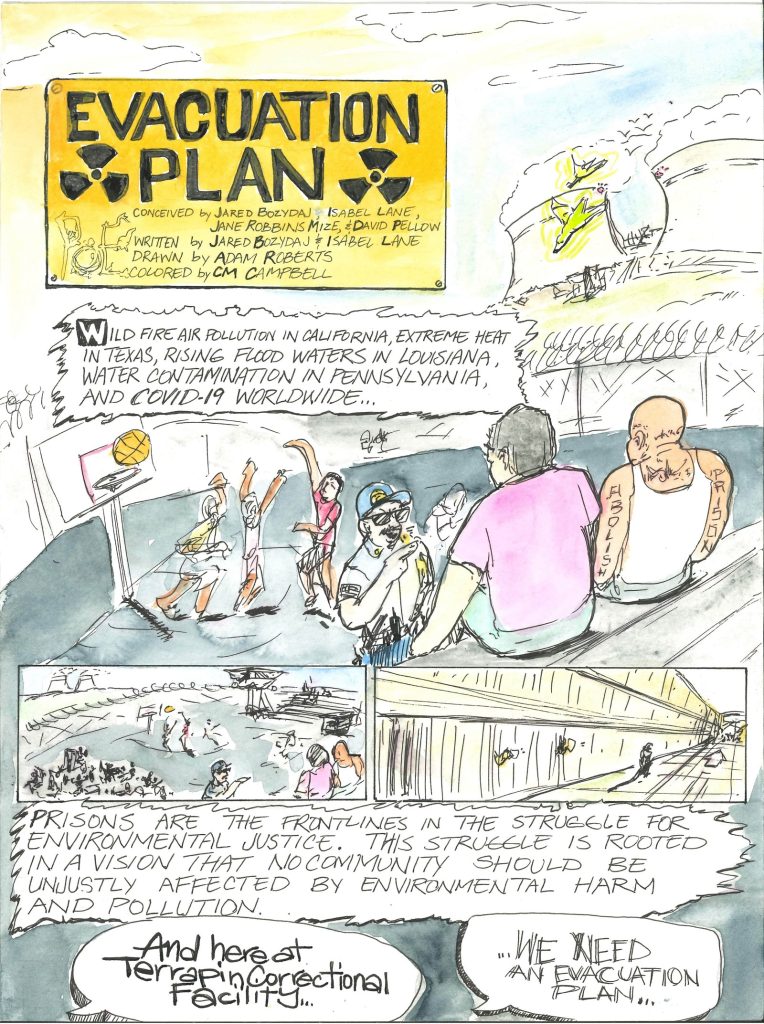
We drew it while I was in Fishkill Correctional Facility in Beacon, New York. The prison sits in the shadow of the now-closed Indian Point nuclear plant. But the comic talks about all sorts of other way that incarcerated people are subjected to environmental disasters. We drew the lead in the drinking water. We drew the heat, which kills people in prisons every summer in facilities with no air conditioning. We drew wildfire smoke and the lack of social distance and the flooding of New Orleans’s jails during Hurricane Katrina.
Every one of those facts had already been made publicly available in the dry language of official reports. They were sourced and footnoted and correct, and they had been correct for years, and almost nothing had happened.
Put a man in a panel lying on the cell floor in his boxers, a small fan meaninglessly blowing on him, the space he can’t leave drawn around him, and the fact stops being a finding. It becomes a thing occurring to a person. Readers sent us letters about the comic. The most common response we got was a version of, I didn’t know there was no plan. There is no plan. That’s a sentence anyone could have written. It took eight drawn pages for people to believe it.
None of this is mine alone. Fishkill had an inmate-run illustration group, the Artists in Residence, which I was pulled into within a week of landing there. It’s happening everywhere. Todd “Hyung-Rae” Tarselli paints on leaves, which are contraband in Pennsylvania prisons. Mark Loughney arranges his figures into rows and columns because prison is a place of rows and columns and the composition is the argument. Jesse Krimes printed an entire mural onto stolen bedsheets using hair gel and a plastic spoon, then mailed it home one panel at a time.
Across the country there are thousands of people making a visual record of a system that permits almost no images of itself.
That’s the piece I’d ask people to sit with. Prisons hold a near-total monopoly on their own visual record. The cameras belong to the facility. The footage is retained at the facility’s discretion and overwritten on the facility’s schedule. Journalists get in rarely, escorted, on a route. Incarcerated people are barred from possessing cameras almost everywhere.
So when an institution controls every lens, the hand-drawn record isn’t a lesser substitute for photography. It’s the only visual evidence the state doesn’t hold the negative of. A prisoner with a pencil is a documentary apparatus the facility cannot subpoena, delete, or claim to have lost.
I don’t think the response to that is more art programs. Art programs are good and I’ve been fed by them, and they can also be shut down on a Tuesday for any reason at all, which makes them a privilege and not a right. The reform that would matter is the boring one: the visual record of what happens inside should not belong exclusively to the people who run the place. Not their cameras alone. Not their retention policies alone. Not their judgment about which drawings are art and which are escape plans.
Until that’s true, the record will keep getting made in pencil and smuggled out in envelopes, by people who have already deformed their own work to get it through the censors.
I still have that guard tower. The bad version, the one I fixed so it would live. I’d like to draw it again now, correctly, from memory, and see what it looks like when nobody has to approve it.
Image credit: Jared Bozydaj, Adam Roberts, Isabel Lane, CM Campbell, Jane Robbins Mize, David Pellow / Products of Our Environment, Vera Institute of Justice