At eight years old, Adailton was walking to school with five other children from his favela in São Paulo’s southern periphery. They climbed the narrow streets beside an open drainage canal that carried rainwater and sewage. Halfway up the hill, they encountered a delivery truck that had been robbed. Police blocked one end of the street while the assailants leaned against the truck. Then the shooting began.
Caught in the middle of the crossfire, the children ran uphill as bullets passed around them. The police saw them, shouted for them to leave, yet continued firing. With nowhere else to escape, the children jumped into the sewage canal and ran through the drainage pipe until they emerged on the other side of the street, far from danger. They cleaned themselves as best they could and continued to school.
“After school we walked back home, and I don’t recall telling my parents about what had happened,” Adailton told me of his first brush with police violence. Adailton is an Afro-Brazilian psychologist, born and raised in one of the many favelas in São Paulo’s southern periphery. “It was just another regular day for a preto, pobre, periférico like us.”
This expression—preto, pobre, periférico (Black, poor, and from the periphery)—is commonly used among residents of São Paulo’s periphery. It describes the position that many occupy within the socioeconomic structure, a position constructed through violence, poverty, and exclusion, and reproduced through daily state practices. It is both an explanation and a justification for the violence they experience as part of a surplus population—sometimes necessary, sometimes expendable.
While Adailton’s story is from São Paulo, residents of South Los Angeles share similar experiences. “My first one-hundred-meter race took place in that park, running away from the police,” Mark, an African American resident of Watts, told me. He used to compete in track and field, but now works in public housing. “They [the police] are the best trainers around here. You better run like hell if you don’t want to get beaten or worse.” For Mark, growing up in this part of Los Angeles meant running from violence, poverty, and the police. “Being beaten by the police is like getting your ID,” Mark explained. “After that, you know you’re Black and from the projects.”
Separated by thousands of kilometers, Mark and Adailton share structurally similar experiences of policing that shape their identities and render them vulnerable to premature death. Analyzing Brazil and the United States together allows for a clearer understanding of how state violence—especially police violence—constructs and maintains social order. It also reveals how neoliberal governance depends on coercive practices that secure racial, political, and economic hierarchies, often in tension with democratic ideals.
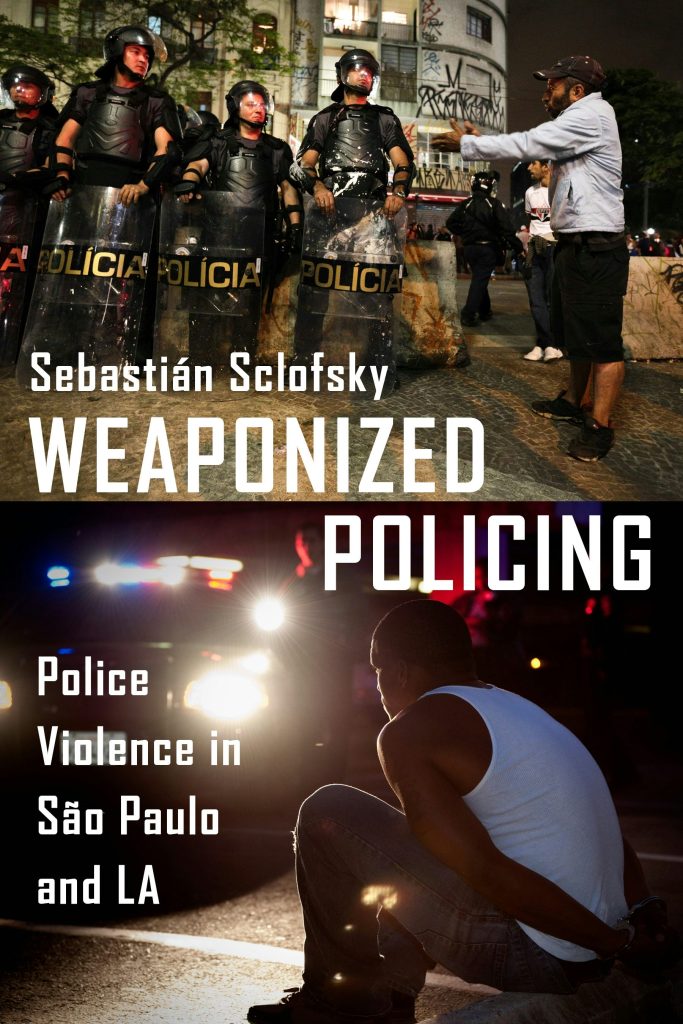
As major metropolitan hubs that began as peripheral colonial settlements, São Paulo and Los Angeles offer a comparative lens for examining how the contradictions of contemporary capitalism are experienced in everyday life. The research in my new book Weaponized Policing: Police Violence in São Paolo and LA draws on ethnographic interviews conducted in 2015 in São Paulo’s southern periphery and in South Los Angeles—highly segregated urban spaces where racialized surplus populations are concentrated and state violence operates as a governing mechanism.
Both São Paulo and Los Angeles share important historical parallels. Both experienced economic crises and neoliberal reforms that changed much of their landscapes. The reforms produced significant economic and social changes—particularly the loss of well-paid unionized industrial jobs, the rise and predominance of financial and high-tech industries, and the expansion of a low-paid service industry. While the reforms brought some macroeconomic stability, the benefits were skewed toward a small portion of the population. The heavy price of these transformations was borne by a racialized working class, who experienced an increase in violence and vulnerability in their communities.
More from our decarceral brainstorm
Inquest—finalist for the 2025 National Magazine Award for General Excellence & cited in The Best American Essays 2025—brings you insights from the people working to create a world without mass incarceration.
Sign up for our newsletter to get the latest in your inbox every Saturday.
Newsletter
As scholars such as Mark Neocleous have argued, the insecurities and instabilities produced by the capitalist system require a continuous pacification of populations who are being exploited by it. The police become a central player in this process, acting as a pacifying force; it is not a coincidence that the last half-century witnessed the rapid development of a carceral state both in the United States and Brazil, and the expansion of police power in both societies.
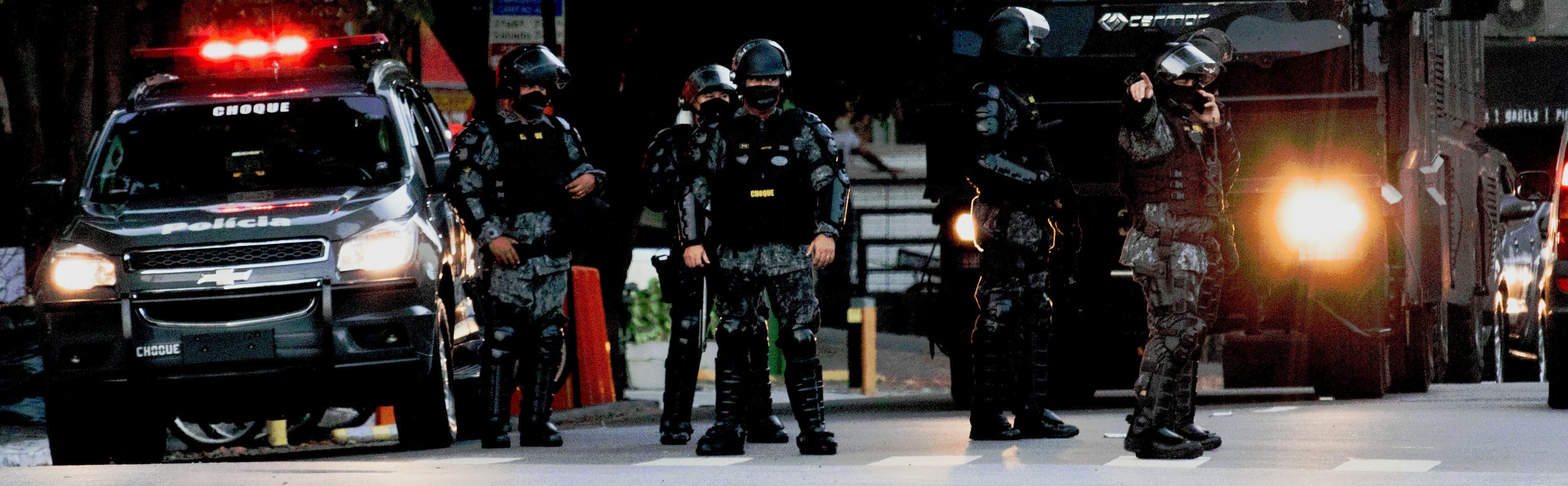
The police—who serve to contain the threat represented by residents of low-income communities—produce and reproduce the categories of Black, poor, and periphery. The rhetoric of policing, which portrays the periphery and its residents as a threat to the rest of the city, is followed by policies and violent actions that attempt to contain this marginalized population. These policies range from aggressive invasions of the favelas, deployments by the LAPD’s Metropolitan Unit, stop-and-frisks style initiatives, and seemingly benign community policing initiatives.
The police pacification process implies not only the control and surveillance of the population but the reshaping and reconstruction of the “dangerous classes” into a docile population—and the expulsion or killing of those who cannot be disciplined. It also transforms areas like South LA and São Paulo’s periphery into spaces where democracy and civic and human rights are severely undermined.
The rhetoric of security plays an important role in constructing the well-ordered community, as it establishes who is in and therefore deserves to be protected, and who is out and therefore can suffer violence. In São Paulo, this classification is determined through the rhetorical device of bandido versus trabalhador, bandit versus worker. The killing of bandidos is justified and even celebrated by the police and important sectors of society as they adhere to a security project that attempts to pacify these Black spaces, constructed as threats to the city. In the United States, the use of terms such as gang-related and superpredator—or when officers involved in shooting Black individuals describe their victims as animal-like or over-aggressive—reproduce the association of Blackness with threat and justifies the exercise of violence in a similar way as the concept bandido does in Brazil.
These facially race-neutral terms evoke historical images of Black individuals as being a threat to the nation who must be controlled and killed if necessary. Those seen as “respectable others” may be temporarily protected from the most extreme forms of state violence, but this politics of respectability makes the killing of those who are not seen as “proper” victims illegible.
The combination of security and racism leads to the systematic exercise of violence against Black and Latino residents of low-income communities, who suffer the brunt of neoliberalism and police power. In constructing and enforcing this social order, the police play a central role in the construction of racialized identities in South LA and São Paulo’s periphery.
Excerpted from Weaponized Policing: Police Violence in São Paulo and LA by Sebastián Sclofsky, reprinted with permission from NYU Press.
Image: Marília Castelli / Unsplash