The second Trump administration has been relentless and often surprising in its use of visual culture. The social media accounts of Trump himself are rife with AI-generated images ranging from racist (the Obamas as monkeys) to grandiose (himself in the style of Jesus). In this context, it’s easy to overlook how shocking the Department of Homeland Security’s (DHS) Instagram account is, both politically and aesthetically, in its marshalling of images to campaign for ethnic cleansing.
Under the Biden administration, DHS’s Instagram account made sporadic posts for holidays and memorials for law enforcement officers, but the account did not have a distinctive brand. But the tone of DHS posts changed dramatically after Trump’s second inauguration in January of 2025. While the department-wide DHS social media account doesn’t post much in the way of updates on, for example, ICE or Border Patrol activities, it does offer a frightening perspective on how the agency understands itself.
For example, on July 14, 2025, DHS’s account shared a painting by Morgan Weistling, a contemporary painter of stylized Americana, titled “New Life in a New Land.” The painting depicts a young white couple, the mother with babe in arms, in the back of a stagecoach. The caption appended the slogan “Remember your Homeland’s Heritage.” (It is worth noting that Weistling made a public statement that the use of his painting by DHS was unauthorized.) This and a number of other pieces of visual art posted by DHS’s account in the past eighteen months fit the category of what I have elsewhere called settler kitsch.
More from our decarceral brainstorm
Inquest—finalist for the 2025 National Magazine Award for General Excellence & cited in The Best American Essays 2025—brings you insights from the people working to create a world without mass incarceration.
Sign up for our newsletter to get the latest in your inbox every Saturday.
Newsletter
Totalitarianism and kitsch go well together. Both Hitler’s and Stalin’s propaganda operations leaned heavily on a kitsch aesthetic, and Soviet kitsch did not die with Stalin. In The Unbearable Lightness of Being, Czech novelist Milan Kundera offers an extended discussion of kitsch in the context of the Soviet domination of Czechoslovakia after 1968. For Kundera, totalitarian kitsch is art in which “answers are given in advance and preclude any questions.” This sensibility informs the DHS Instagram page. For DHS, kitsch offers a way to use images to say the quiet part out loud.
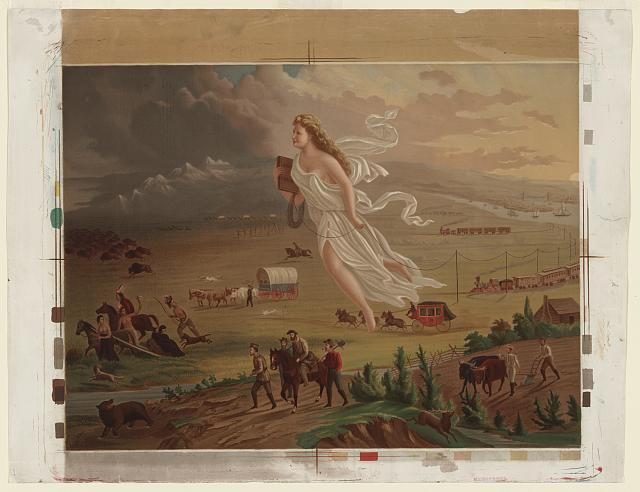
One of the most jarring settler kitsch images that DHS has shared is John Gast’s American Progress, which was used as a July 2025 Instagram post and which someone at DHS captioned, “A Heritage to be proud of, a Homeland worth Defending.” Gast’s 1872 painting, which became one of the most widely distributed lithographs of the late nineteenth century, features an enormous figure of Columbia (a personification of the United States) striding westward, Bible in hand, trailing a telegraph wire behind her, and scattering Indigenous people in her path. As a teacher of U.S. history, I have used this image many times to illustrate to my students the logic of Manifest Destiny (the nineteenth-century political philosophy that the United States was ordained to control the continent from shore to shore). Historian Donald Yacovone even used it as the cover for his 2023 book Teaching White Supremacy. DHS looked at Gast’s painting and decided it was aspirational.
DHS continued its celebration of Manifest Destiny in a September 4, 2025, post, sharing George Caleb Bingham’s Daniel Boone Escorting Settlers through the Cumberland Gap (1851–52), with the caption, “Pioneers, not illegals.” In his canvas, Bingham shows the folk hero Daniel Boone bravely leading his party of settlers. From the perspective of the original inhabitants of that land—ᏣᎳᎫᏪᏘᏱ Tsalaguwetiyi (Cherokee, East), the Shawandasse Tula (Shawanwaki/Shawnee), and S’atsoyaha (Yuchi)— the DHS-supplied caption is nonsensical. But in the DHS version of U.S. history, Indigenous people do not count.
The DHS engagement with kitsch operates across a broad spectrum of nostalgia.
One sort of nostalgia manifests as a doubling down on Christopher Columbus. In October 2025, DHS shared a painting of the landing of Columbus, with a simple caption of “Happy Columbus Day!” Over the last few decades, support for this holiday has waned, with many states and municipalities no longer observing the holiday, or substituting an Indigenous People’s Day. In Boston in 2020, protesters decapitated a statue of Columbus in the wake of George Floyd’s murder. The city of Boston decided to remove the statue for an indefinite period. Other statues of Columbus met a similar fate. The popular and municipal responses to these memorials indicate prevailing sentiment that Columbus is not someone to celebrate. Nonetheless, in February of 2026, Donald Trump announced a plan to install a statue of Columbus outside the White House. This regressive veneration of Columbus speaks to the petty and contrarian sensibility that animates much of DHS social media. It is an ethos similar to a comedian who leans into being “politically incorrect,” because the frisson of transgression generates a cheap buzz.
Another sort of nostalgia is exemplified by the many posts melding Christmas themes with obsession over purifying the homeland—for example, posts that riff on “home for the holidays” to promote the program that will fly non-citizens out of the country if they surrender to DHS. There is a DHS Instagram post of a video showing this process, with Perry Como’s “Home for the Holidays” as the soundtrack. A similar post from December 21, 2025, shows an illustration of an airliner labeled “ICE AIR” being pulled by Santa’s reindeer. ICE AIR also appears in a Christmas Day post, featuring a crude digital animation and an 8-bit version of Mariah Carey’s “All I Want for Christmas Is You.” A more ominous iteration of the same theme comes in a December 18 photograph of a Santa standing in front of a cargo plane, captioned “Tis the season for mass deportations.”
The DHS Instagram reflects the values of an agency that finds not only pride but also joy in the work it does. Of all the functions of government, deporting fathers, mothers, sons, and daughters would seem like one that is the least compatible with a lighthearted, breezy social media strategy—and yet a pre–World Cup post touted DHS as “America’s Goalkeepers.” A post from June 5 has footage of detainees being put on a plane, set to the NSYNC song “Bye Bye Bye.” Several posts from this past spring copied the style of vintage travel posters to promote the DHS self-deportation program. Some of the countries, such as Bangladesh, Algeria, and Haiti, might be likely ICE targets, but they also did these retro posters for England, Canada, and France. Somebody thought of making these posters, and someone else appears to have enjoyed creating them.
There is some consolation that what works for authoritarian regimes works for resistance as well. You can fight kitsch with kitsch. Unfortunately for Homeland Security, ice is a vulnerable material. Ice disappears in the presence of hot water, as items like this peeing Calvin T-shirt remind us. Snowplows can remove ice, as many Chicagoans referenced in a contest to name the city’s trucks. This is to say nothing of the cottage industry of printed items riffing on the ICE logo.
Parody is a natural response to the nightmarish deeds and images the Trump administration hurls at us every day. But the accretion of riffs like “Make Fascists Afraid Again” and “Make Orwell Fiction Again” can desensitize us to what “Make America Great Again” means. As a slogan, it exemplifies the classic Puritan trope of the declension narrative, or in essence: our forebears were strong and good, and we are weak and bad, and we need to be strong and good again. On a more immediate level, Trump’s slogan rallied U.S. citizens who had spent the previous eight years upset by the very thought of a Black president. Many heard Trump’s slogan as telegraphing “make the presidency white again.” Trump’s political mission began as a project of ethnically cleansing the White House. In his second term he has expanded that remit to deploy Homeland Security agents to ethnically cleanse the United States itself. The DHS Instagram page legitimizes ethnic cleansing by weaponizing nostalgia. In Trump’s America, kitsch kills.
Image: George A. Crofutt, American Progress, ca. 1873. Library of Congress, Prints and Photographs Division.
Contributors