
There was a time when some county jails turned to local caterers, cafés, and restaurants to prepare their meals—businesses that were visible to the communities they served and relatively easy to replace when the food fell short. In the mass incarceration era, those providers and some publicly run jail and prison food services have been supplanted by national prison-food and commissary conglomerates that collectively receive billions of dollars while disclosing little about their costs, contracts, or operations.
Aramark Correctional Services, for example—the scandal-prone food services company that, according to one market analysis, controls 35 percent of the U.S. correctional food-service market—provides limited public information about its costs and business practices, even as it repeatedly fails the incarcerated communities it serves. Yet even Aramark’s secrecy pales in comparison to that of Keefe Group, the industry-leading giant that dominates prison commissaries.
Unlike the publicly traded Aramark, the St. Louis–based Keefe Group is a privately held business that, since 2016, has been owned by H.I.G. Capital, a private equity firm that manages $75 billion in assets. Even before Keefe was absorbed into the notoriously opaque world of private equity, precise financial information about the company was difficult to access. In 2013 business journalist Adam Davidson described Keefe as “a company that generally avoids the press.” As Davidson recounted, “When I arrived at its convention booth [at the American Correctional Association’s 143rd Congress of Correction] and announced I was a reporter, two staff members insisted I leave.” A 2015 feature article on Keefe in the St. Louis Post-Dispatch similarly highlighted the company’s aversion to the media, noting that the company “seldom has dealings with the public or the media and doesn’t have its own [public relations] staff.”
More from our decarceral brainstorm
Inquest—finalist for the 2025 National Magazine Award for General Excellence & cited in The Best American Essays 2025—brings you insights from the people working to create a world without mass incarceration.
Sign up for our newsletter to get the latest in your inbox every Saturday.
Newsletter
Lack of public information about Keefe is particularly notable given that Keefe is the most powerful player in the commissary business—the industry that partners with jails and prisons to sell food, grooming products, and everyday essentials to incarcerated people. The extent of Keefe’s control of the commissary business was revealed when it bid for the Wisconsin Department of Corrections commissary contract in 2012. In its bid, Keefe said that it was “five times the size of its nearest competitor” and that it provided commissary services to 98.4 percent of incarcerated people in facilities that had fully privatized their commissary operations. (Some commissary services are publicly managed by corrections departments, so this figure does not mean that Keefe operated all but 1.6 percent of all prison commissaries in 2012; a 2013 survey by the Association of State Correctional Administrators estimated that roughly a third of states had “some level of commissary privatization.”)
Compared with state-run commissaries, private commissary operations provide strikingly little public information about their finances. In the Association of State Correctional Administrators’ (ASCA) 2013 survey—the most recent known survey of its kind—thirty-three states reported on their commissary operations. Most states that ran their own commissaries reported precise dollar amounts on their profits. Figures ranged from $27,100 in Tennessee to $11,279,498 in Texas.
By contrast, only three states and one locality with privatized commissaries reported profit figures. Of the eight jurisdictions with fully privatized commissary operations, only the Philadelphia Department of Prisons, Virginia, and West Virginia provided information on commissary sales and profits. Massachusetts provided its net commissary profits but provided no data on net sales.
Aramark’s repeated refusal to release detailed financial information—or its insistence that such information remain confidential—Keefe’s extreme secrecy, and the limited disclosures from privately run commissaries illustrate how the privatization of prison food renders the already arcane business of prison food even more hidden. What makes this particularly troubling is that Aramark, Keefe, and other prison food services and commissary companies operate under publicly awarded contracts worth hundreds of millions of dollars. That U.S. taxpayers cannot access adequate information about the finances of the companies hired to provide public services—such as how much they actually spend on food for incarcerated people relative to what they are paid by states and localities—raises serious concerns about whether the reliance on private prison food companies is compatible with democratic principles of accountability and transparency.
Lack of transparency is also hardly the only troubling consequence of prison food privatization. The privatization of prison food exemplifies historian Bryant Simon’s contention that “cheap food” is not actually cheap, often carrying hidden and potentially catastrophic costs. In the case of prison food, when correctional food services companies promise to feed people for less than what it costs states and localities, the result has often been shrinking portion sizes, food of dubious quality, and a raft of problems with food hygiene and prison safety linked to the companies’ inadequate wages and training of kitchen staff. This has led some incarcerated people to opt out of regular meals in favor of foods purchased from prison commissaries, which may save prison food services companies money on their food expenditures if they prepare fewer meals. These companies also stand to profit if they hold both the regular food services contract and the commissary contract at the same carceral institutions; the arrangement is a financial win–win for these companies when incarcerated people left hungry by regular rations buy commissary items to quell their stomachs. Prison food contracts, then, incentivize correctional food service companies to serve deficient meals.
That the same companies are often behind both regular prison food services and prison commissaries within jails and prisons is a function of increasing corporate consolidation in the corrections industry. This corporate consolidation has also affected local farmers and food suppliers who once did business with corrections departments when prison food services were publicly run, as prison food services behemoths tend to buy from national or multinational suppliers, processors, and distributors. With a dwindling number of prison food services and commissary companies, local and state corrections departments have had fewer options when considering bids for contracts. And when corrections departments award contracts, they often choose companies that offer the most generous revenue-sharing arrangements with states and localities.
Revenue sharing between commissary companies and the governments that award them contracts has benefited corrections departments while exacting greater financial costs from incarcerated people and their loved ones. This is because commissary and other prison services companies that share revenue with corrections departments make up that cost of doing business by charging ever-higher prices and fees to incarcerated people and their families on the outside—segments of the U.S. population that can least afford to absorb such costs. Though corrections departments’ share of commissary revenue is supposed to fund programs to support “inmate welfare,” since the 1990s some states and localities have used commissary revenue to fill gaps in corrections budgets and fund law enforcement personnel, equipment, or training. This is a part of a broader development in the U.S. criminal legal system whereby some states and localities charge people a raft of new fees associated with their own prosecution and incarceration. Those unable to pay can be jailed and then charged additional “room and board” fees to subsidize their own detention.
Notably, consequences of recent developments in the financing of the carceral state and the privatization of prison food services in particular are not limited to the financial extraction of incarcerated people and their loved ones. By exacerbating incarcerated people’s hunger and amplifying the importance of commissary, the privatization of prison food fuels divides, resentments, and tensions between incarcerated haves and have-nots. And as in society, greater inequalities in prison can contribute to more violence.
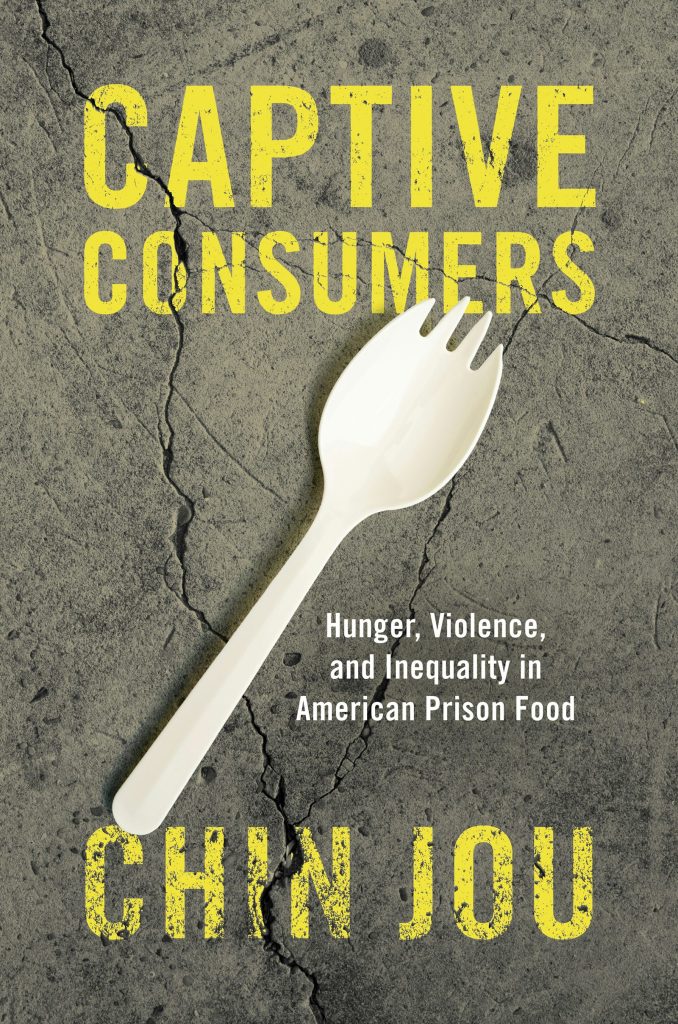
From Captive Consumers: Hunger, Violence, and Inequality in American Prison Food by Chin Jou. Copyright © 2026 by Chin Jou. Used by permission of the University of North Carolina Press.
Image: “Copie de rp lettre” by patricia m / Flickr