In an influential 2017 article, Joe Soss and Vesla Weaver declared that “police are our government.” Most social scientists, it turns out, hadn’t thought about it this way. According to Soss and Weaver, ignoring the police as a governing institution had led to impoverished accounts of U.S. democracy, or perhaps we should say its absence. They urged their fellow researchers to take more seriously the relationship between policing, governance, and citizenship, particularly in what they call race–class subjugated communities.
Historian Stuart Schrader has both answered and complicated their call. Schrader’s first book, Badges Without Borders: How Global Counterinsurgency Transformed American Policing (2019), situates U.S. policing in the global contexts of U.S. empire and the Cold War. In that account, U.S. policing is not a problem confined to local communities. It is inextricably tied to the growth of the national security state.
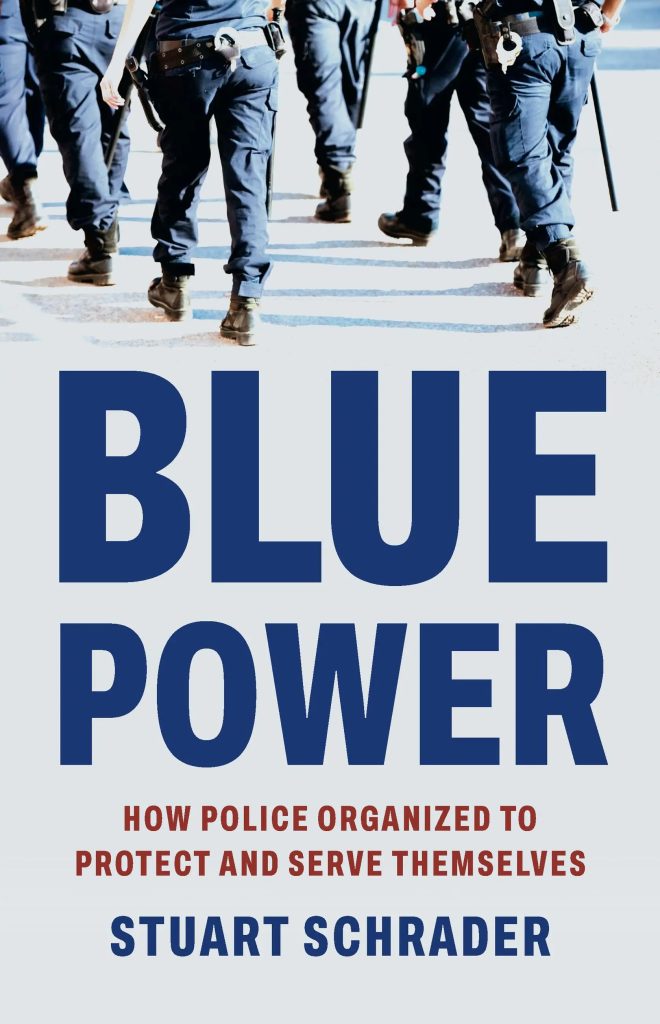
Schrader’s latest book, Blue Power: How Police Organized to Protect and Serve Themselves, now illuminates underexamined aspects of the domestic picture. This urgent book offers a critical history of the police union movement, tracing how it emerged as a profoundly anti-democratic institution that routinely acts to suppress progressive social movements. Indeed, Schrader shows this function was baked in from the beginning.
The story of Blue Power begins in Detroit. During the “long, hot summer of 1967,” rebellion consumed the city. The uprising against entrenched racism, inequality, and police brutality, part of a pattern of rebellion across the country, was, Schrader notes, “a turning point.” It ushered in “the end of the ameliorative promise of the Great Society and [spurred] white reaction against civil rights in the name of law and order.” The rebellions were thus a turning point, too, for a burgeoning police union movement.
Schrader emphasizes, however, that Detroit police “not only took advantage of the rebellion’s destructive consequences.” They “created the conditions for it to occur.” Indeed, the precipitating event for the Detroit riots was a police raid of a popular, unlicensed after-hours bar. Police thus drew in support not because they “were protectors of order but because they could prompt disorder.”
In other cities, like Philadelphia, union efforts played out similarly, through extended police confrontation with movements for civil rights and Black liberation. Relatedly, efforts to install civilian oversight further fueled officer organizing. Unionizing and resisting public accountability were thus joint projects. Taking advantage of longstanding racial anxieties, police seized openings, often of their own creation, to build union power throughout the turbulent 1960s.
Prior to the uprising, Detroit police had made demands much like other workers. When they didn’t get what they wanted, they protested. Sometimes, protest meant ordinary picketing. But given the nature of policing work, the kinds of strategies they were able to leverage as protest were quite different than those available to other kinds of workers.
For example, to stress the city’s solvency, Detroit police might slow down the writing of citations. To anger resident voters, on the other hand, they might issue even more citations than usual. When such strategies failed, police withdrew their labor altogether by calling out sick en masse. This tactic, known as the “blue flu,” was in fact being deployed when the 1967 rebellion ignited. After law enforcement violently quelled the uprising, police not only won their demands, but cops suspended for falsely calling out sick as the city imploded were reinstated, with backpay.
Other legal developments—notably, the emergence in the 1970s of a national campaign to pass state-level law enforcement officers’ bills of rights—aimed to make it increasingly difficult to discipline officers or otherwise achieve public accountability and transparency. To institutionalize impunity, it helped to have a national spokesperson. Once former police officer Mario Biaggi became a New York congressman, he made passing a federal version of the bill his priority throughout the 1970s and ’80s. But despite cynically analogizing the substance of the cop-protective law to landmark civil rights legislation (thus suggesting cops should be treated as a protected class), Biaggi repeatedly failed to convince his colleagues to get on board. Still, his efforts were not in vain. His federal pushes promoted the idea and drove action within two-dozen states to adopt versions of the model legislation.
Throughout Blue Power, Schrader probes connections to labor more broadly. Police unions rode the wave of the wider public sector union movement in the 1960s. And they learned the essentials of organizing and engaging in political activity from the rest of organized labor. Despite this, police unions, historically and to the present day, have tended to have politics opposed to those of other unions. And, not infrequently, they have served as disruptors of labor organizing and collective action. Some police organizers nonetheless have made efforts to be embraced within the broader labor movement.
For example, in the mid-1970s, components of the International Conference of Police Associations sought to affiliate with the AFL-CIO. But the group ultimately splintered over the effort. This episode revealed great hostility and skepticism among police toward labor. A much smaller organization, the new International Union of Police Associations (IUPA), was formed from this schism and did, in fact, join the AFL-CIO in 1979—an affiliation that remains contentious.
The timing of IUPA joining the AFL-CIO is notable from the broader labor movement’s perspective. The 1970s saw the crushing defeat of attempts at union-friendly federal labor law reform. The decade concluded with the so-called Volcker Shock, a 1979–82 monetary tightening instituted by Federal Reserve chairman Paul Volcker which sacrificed millions of workers to unemployment in the battle against inflation. These years marked what would be a decisive turn toward neoliberalism. In short, this 1979 marriage between the AFL-CIO and a national police organization arrived as labor was desperate.
Yet it’s far from clear that organized labor, on the whole, appreciates this history. Schrader notes that when union activists recently attempted to push the IUPA out of the AFL-CIO, they “faced a ‘chorus of boos’ before being voted down on the convention floor.” For about 80 percent of the convention voters, police were fellow workers, if not quite comrades.
For Schrader, today’s police unions are obviously not part of any broader, solidaristic labor movement. Police, unionized or not, break strikes, protect capital, and target working-class and poor people. This is no revelation. As I too have written, criminal system jobs more generally depend on the persistence of economic precarity, rather than its elimination. In Schrader’s extensive reading of sources such as police trade periodicals, and study across a variety of local contexts, a consistent picture emerges: Police almost never express solidarity with other workers and expect their own labor to be treated preferentially.
Police unions did not only build power through a frontlash against external groups, however. Internal struggle also generated momentum. Throughout Blue Power, Schrader highlights the recurring fractures between rank-and-file officers and chiefs. Indeed, the overbearing, top-down style of many chiefs, who tend to be concerned with professionalism and discipline, spurred organizing among cops. As more officers formed unions and successfully bargained for favorable contracts, chiefs saw their power drain away.
From early on, such power struggles could go public. In 1968, Schrader documents, a Baltimore police union leader went on television to publicly criticize the commissioner, in clear violation of department policy. After the officer was disciplined, he sued and won. The ruling was part of an emerging body of case law “enshrining the speech rights of officers to appeal to the public with a rejection of top-down reformism.” Not surprisingly, there were racial limits to this principle. When a Black and Latino officer each criticized San Francisco police practices as racist in the late 1970s, the Ninth Circuit upheld their punishment.
In documenting such intra-police conflicts, Schrader persuasively shows that it’s important to disaggregate “the police” as an institution. Police unions are potent centers of political power in their own right, whose interests and ideologies are overlapping with, but still distinct from, police departments. Telling their story is vital to understanding how police across the country became so politically powerful, and so unaccountable.
More from our decarceral brainstorm
Inquest—finalist for the 2025 National Magazine Award for General Excellence & cited in The Best American Essays 2025—brings you insights from the people working to create a world without mass incarceration.
Sign up for our newsletter to get the latest in your inbox every Saturday.
Newsletter
At the same time, one shouldn’t simply understand unions and chiefs as competing fractions of police power, working at odds. Their differing orientations can be complementary. Across Blue Power, Schrader gives examples of police unions militantly making demands, as chiefs express support for professionalism and reform. In this way, one group aggressively asserts claims on budgets, refuses oversight, and promotes rightwing politics while the other shores up legitimacy. That disaggregated, but still unified, picture helps in part to explain the apparent bipartisan consensus—that policing is an unquestionable public good—better than the idea of a monolithic police.
Consider, as a recent example, the differing law enforcement reactions earlier this year during the occupation of Minneapolis by U.S. Immigration and Customs Enforcement (ICE) and Customs and Border Protection (CBP). Most visible to the broader public was Minneapolis police chief Brian O’Hara, who frequently appeared on television as a voice of reason, especially after the shooting deaths of Renee Good and Alex Pretti at the hands of ICE and CBP, respectively. Before that, the Minnesota Fraternal Order of Police had put out a statement noting “FOP Stands with ICE,” and condemning “hateful and anti-law enforcement rhetoric” by local elected officials. For the non-critical observer, O’Hara presented an image of local police as something quite distinct from immigration policing, even as the statewide police association gave its full-throated endorsement to authoritarian projects of occupation and mass deportation.
As much as Blue Power is a story of police unions’ rise, it is just as much a story about the relative recency and contingency of their power. In fact, one might even read Schrader’s account as a story about the limits of police union power. The most important of those limits has been the inability of police unions to collectively tap federal fiscal power.
One significant exception Schrader notes is the infamous 1994 crime bill, which police unions across the country coalesced around to push through Congress. Then-Senator Joseph Biden, often credited as the bill’s architect, explained to fellow lawmakers that, to construct the legislation, he had simply “called the cops.” The bill’s signature promise was federal funding to support the hiring of 100,000 police officers. According to one study Schrader cites, within four years of the bill’s passage, $3.5 billion “had been distributed to hire or redeploy 61,000 officers.”
For the most part, however, accessing the federal money spigot to directly pay officer salaries has been off limits. This was true during the height of Ronald Reagan’s War on Drugs. It was true, as well, during the decade and a half of spending through the Law Enforcement Assistance Administration, a supposed high watermark of federal spending on local law enforcement that in practice barely made a dent in state and local spending on police.
This lack of access to federal funds, however, has consequences for local democracy. It means that, for police unions, maintaining power over state and local politics is an existential matter. As the federal government has withdrawn further from various forms of social insurance spending, even more pressure has been placed on state and local budgets. An economic downturn would only make things worse. States and localities can only spend so much on the police if they are to still finance other forms of urgent social spending. Something will have to give. Political struggle involving police unions, in other words, is structurally guaranteed. Of course, such dynamics will play out differently across the country.
Schrader, notably, does not conclude by prescribing a set of disempowering reforms. Those are easy enough to find. The book is about the far messier questions of political and cultural power, how they are built and reproduced over time, which defies easy analysis. Any prescription would have to be provisional. The book is nevertheless an impressive contribution. Schrader allows us to consider anew how police built their power over time, stretching back to the civil rights era, transforming U.S. politics along the way. This is a truly fresh addition to the combination histories of U.S. policing and politics. But more importantly, Blue Power is invaluable for anyone thinking and working toward racial and economic justice today. Knowing what you’re for is important. But so is knowing what you’re up against.