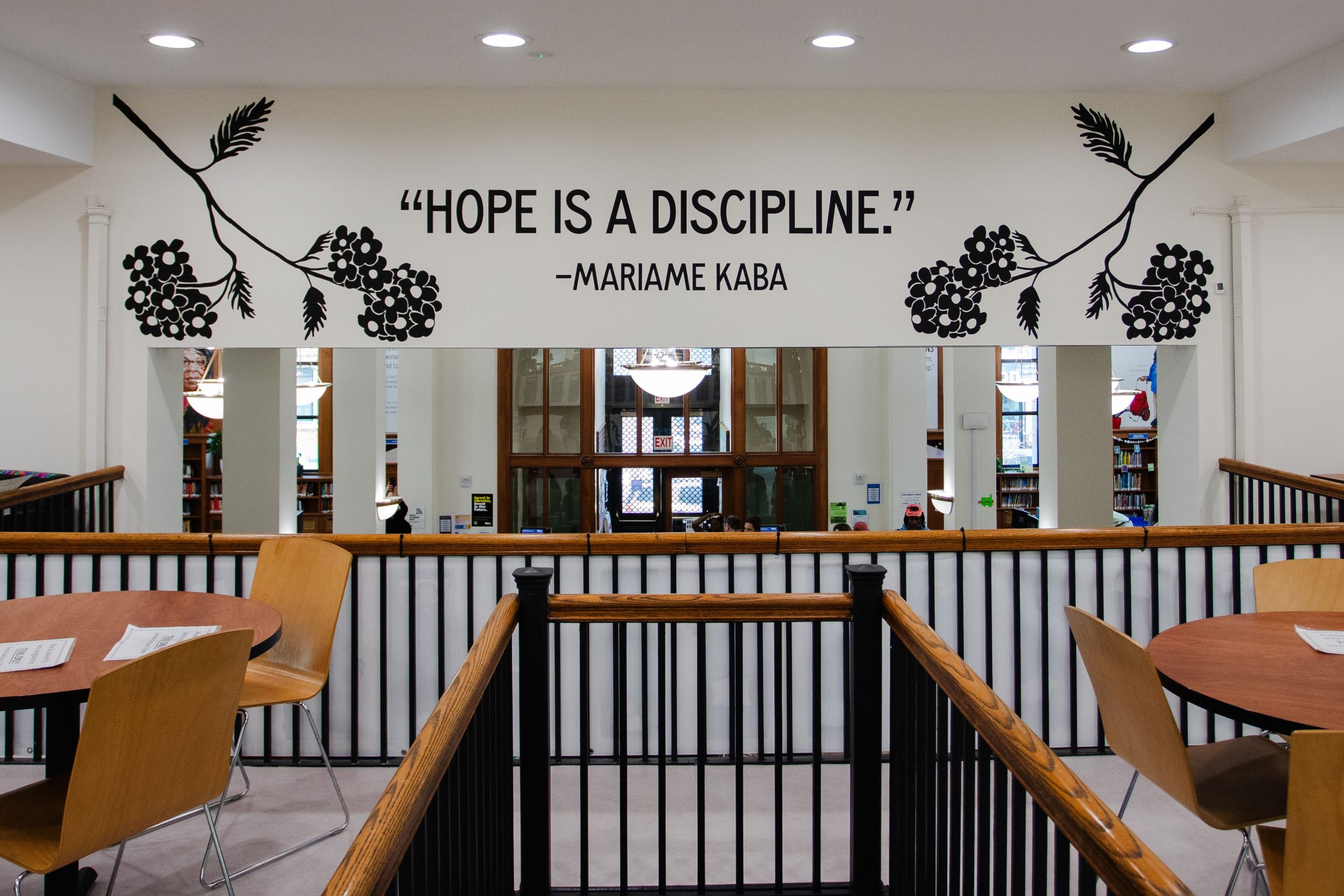
The Warehouse, an abolitionist art installation installed in Bedford Library (a branch of the Brooklyn Public Library) from April through June of 2026, was a collaboration between artist and writer Vic Liu and organizer Mariame Kaba. Inspired by Liu’s book The Warehouse: A Visual Primer on Incarceration (cowritten with James Kilgore), the exhibition spotlighted twenty-four new paintings that examined survival and resistance within prison walls, the emotional distance between “inside” and “outside,” and what the abolition of prisons could look like in practice.
The exhibition also served as a locus for an ambitious series of public events focused on helping participants to imagine abolitionist horizons. Because the site is a public library, events targeted various ages—from children to adults—and activities ranged from crafts and docent tours to film screenings and discussions.
In the following conversation, Liu and Kaba talk with Inquest about the genesis of the project and how it helped to center abolitionist conversations in the community served by the library.
Inquest: How did your collaboration start?
Vic Liu: When Mariame saw a 2024 installation I did based on my book with James Kilgore, The Warehouse, at the Philadelphia Public Library, her immediate reaction was, “We need to bring this to New York!” A year later, I got an email in my inbox that she had secured funding for doing just that. We had never worked together previously. I am still blown away by the extraordinary trust that Mariame demonstrated in that moment. I have become used to the slow uncertainty of funding in the arts world, where you spend years chasing maybes. It brings to mind how she always says that abolition moves at the speed of trust. It is a rare and revolutionary way of moving through the world.
Mariame Kaba: My comrade James Kilgore asked me to blurb The Warehouse. When the book came out in 2024, I shared information about it in my newsletter and made some social media posts about it. James reached out to me to thank me for those and also to tell me that Vic had turned some of the images in the book into an exhibition at the Parkway Central branch of the free Philadelphia library. This is how I came to be connected with Vic via email.
I asked Vic if they were planning to bring the exhibition to New York City. They said they would love to but would need to find a home for it. I said that I would put feelers out and be back in touch in a few weeks if anything panned out. I reached out to some people and those connections never materialized. In 2025 I reached out to Vic to discuss collaborating more formally on bringing a version of The Warehouse exhibition to NYC and that I would fundraise to make this possible. I secured funding for the exhibition and we were off to the races.
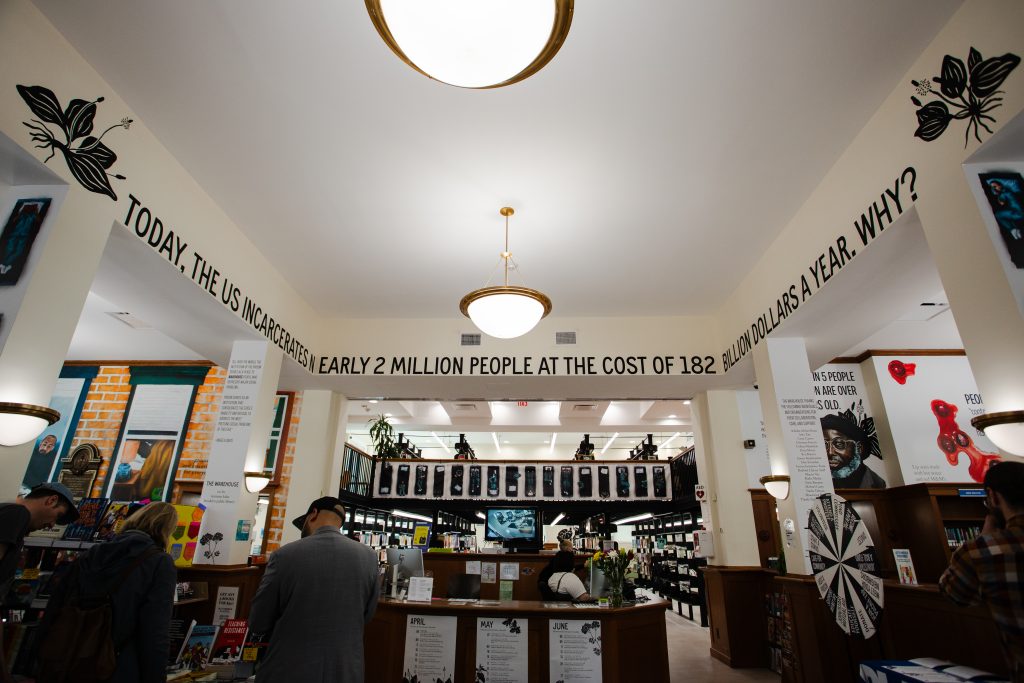
Inquest: What was your thought process behind putting together this specific project? And why do it in a public library (and maybe, also, that particular public library)?
VL: I wanted to create the container for a microcosm where we collectively imagine and practice a world without prisons. The artwork on the walls serves as a container for this space, and our incredible collection of community events provides the moments where we come together to exercise world-creation.
I have always believed that the project needed to be in a public library. The Warehouse seeks to break down the barrier between the world inside prison and the world outside, to elevate the responsibilities and connections we have to each other, and to celebrate human resilience and dignity amidst the darkness and horrors.
It needed to exist within community, as part of our everyday lives. A public library is one of the rare few public spaces where people don’t need to pay money to exist amongst each other and where everyone is welcome. Furthermore, by housing The Warehouse at a public library, we juxtapose the very best that the government does with the very worst.
The Warehouse’s home is the Bedford Library—the founding branch of the Brooklyn Public Library. It is so special to center an exhibition that looks to a future beyond prisons from within Brooklyn’s oldest public library. I am ever grateful to Adeeba Rana, branch manager of the Bedford Library, and her staff for their care and dedication in stewarding the exhibition and its many community gatherings.
MK: Public libraries are institutions that we’ve made together over generations. They are essential. Libraries offer us a canvas for practicing new worlds while we inhabit the current one. Many libraries across the country host exhibitions of different kinds. Vic was keen to create an immersive experience using their art as a catalyst. They had already exhibited a version of this exhibition in the Free Library of Philadelphia so it made all the sense in the world to do it in a NYC public library as well.
Inquest: What do you hope that this exhibition contributes to the cultural conversation or understanding of prison abolition?
VL: Abolition takes practice. I hope that the exhibition welcomes people to the practice of rethinking and unlearning what we have been taught about each other and the society we live in. I hope it expands our awareness of the choices and possibilities we possess. I hope that people begin to understand that abolition is normal and accessible, that it can happen in every bit of our lives, from the personal to the public. So often people fixate on the question of “Should we have prisons?” This exhibition reminds us to ask: “What could we use more of? What could we be doing instead?”
MK: Criminalization is fascism’s indispensable fuel. And since criminalization determines people’s fates, we are all vulnerable to it in different ways. I hope that this comes across to everyone who visits The Warehouse. If it does, then perhaps they will find themselves more willing to entertain the idea of prison–industrial complex abolition.
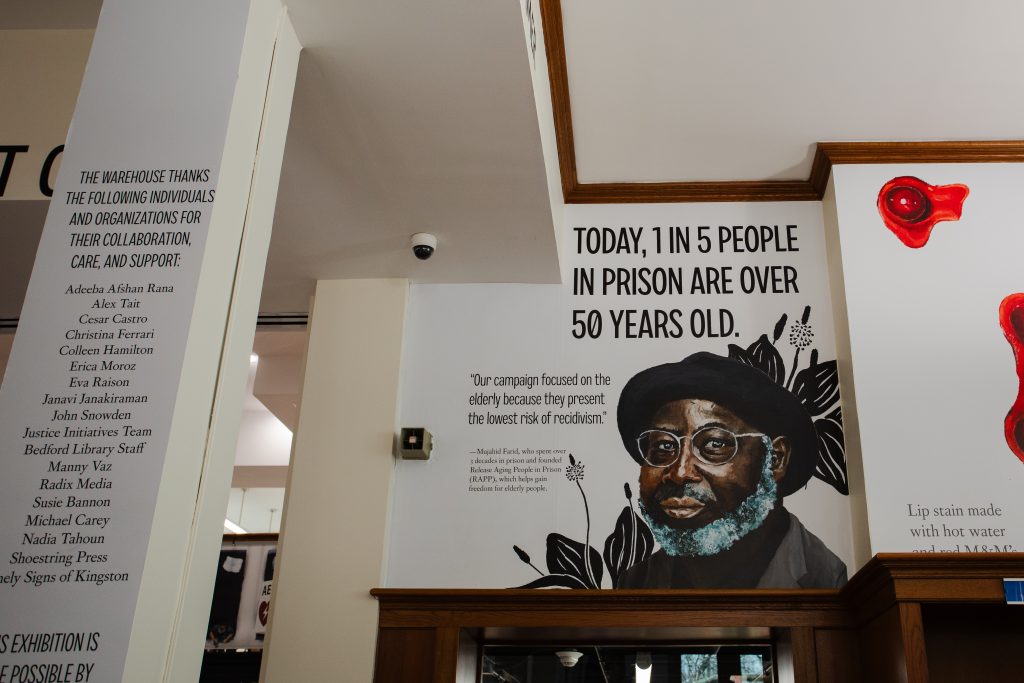
Inquest: What is the role of art in the abolitionist movement? Put differently, you’ve planned a whole series of abolitionist events to go along with the art exhibition—so why not just plan a series of events? What about orienting it around public art changes and enhances the scope of what is possible?
VL: Art is conversation made visual. One of the core beliefs that shapes my work is that text is elitist. In a country where our average literacy level hovers around the sixth grade, where 70 percent of incarcerated adults read below the fourth-grade level, we cannot rely on text as a mode of communication.
Art makes information and ideas accessible—not less complex, just less exclusionary—widening the range of people able to participate in the conversation.
Prison and the impact of incarceration are experienced in the body. Text alone cannot communicate the viscerality. Art uses intuition and observation to bring the viewer viscerally into the world of prison. It closes the distance between the viewer and the impact of incarceration.
MK: My friend, abolitionist organizer and scholar Erica Meiners, has written, “Liberation under oppression is unthinkable by design.” This is why it’s so important to cultivate imagination. Oppression has an awful way of putting a ceiling on our imaginations. Artist and filmmaker Chris Vargas talks about the fact that one of the most destructive aspects of the prison–industrial complex is that it creates “occupied imaginations.” Fascism does this too. So we need to consistently grasp for ways to unleash our imaginations in the face of oppression. Art has a way of removing the ceiling from our imaginations. In the words of my friend Amisha Patel, who recently passed away and was one of the best organizers and people I know: “Many of us feel like we have to negotiate an unworkable system. Art, making things, is about unlocking what we can create, not just managing an unworkable system. Our creative power is at the center of our organizing for justice and liberation.”
I would love it if the people who visit the exhibition leave with a desire to engage in more creativity because we know that creativity increases our well-being and can also increase positive emotions. If this happens, those people might be encouraged to strengthen their relationships with people in their communities, to be more generous, and perhaps also to consider ways of taking constructive action in the world.
More from our decarceral brainstorm
Inquest—finalist for the 2025 National Magazine Award for General Excellence & cited in The Best American Essays 2025—brings you insights from the people working to create a world without mass incarceration.
Sign up for our newsletter to get the latest in your inbox every Saturday.
Newsletter
Inquest: Planning this in a moment of rising authoritarianism and fascism, not just in the United States but globally, how do you see prisons fitting into that ecosystem of the far right? And in the United States in particular, how are you helping people to connect the dots between the things that are really dominating the new cycle—violent immigration enforcement and global, genocidal war-making, in particular—and criminal-legal system mass incarceration, which unfortunately is just not receiving a lot of mainstream attention right now?
VL: It has become obvious over the past few years that the news cycle is primarily concerned with maintaining our attention. It does not empower us to prioritize issues in importance. It does not prepare us with an understanding of the systems of power around us. Prisons are no longer fresh and new fodder for headlines, but they are incredibly pertinent to the power dynamics of our current times.
Prisons serve as fascism’s sandbox. All social communications—phone calls, emails, and mail—are monitored by the prisons, and can affect an individual’s application for parole. Visitors and incarcerated people are at the mercy of the mood of the guards on duty. All materials—books, TV, music—accessible by the incarcerated people have to be approved by the guards. Recently, many correctional facilities have stopped allowing physical mail through; instead, they scan all handwritten letters or drawings and send in only digital images. Similarly, some facilities have stopped in-person visits altogether, “replacing” them with video calls, which are also monitored and recorded. Whether or not you spend time in solitary is entirely up to the guards. Inside prisons, you can witness the state experiment with methods of control.
Fascism is when the government deliberately shrinks their definition of personhood. It creates enemies out of marginalized groups as a way to keep everyone else under control. Right now, we can see this in the government’s attempt to de-person immigrants and queer people. Where prisons come in, both historically and today, is as the weapon they use to do so. Today, we see this happening with ICE detention centers, as well as in the proposal for increased institutionalization of people with conditions like depression, autism, and ADHD. Currently and historically, prisons and police were used to criminalize Black and brown people. By imprisoning people based on their identities, their financial situations, their mental health conditions, and their race, the government clearly defines for the whole of society who “matters” and who “belongs”. Abolition believes that everyone matters and everyone belongs.
MK: I think that Vic said it all.
All images: Installation photos of Vic Liu and Mariame Kaba’s The Warehouse NYC at the Bedford Library, Brooklyn Public Library, April 4–June 28, 2026. Photos courtesy of Jam Verona/Human Flower Productions.
Contributors