In 1994 the Federal Bureau of Prisons (BOP) opened United States Penitentiary, Administrative Maximum Facility—better known as ADX—a prison in Colorado that was designed and built entirely to hold prisoners in twenty-four-hour lockdown. A prison that could not be escaped from or overtaken by prisoners. ADX was sold to the public and to Congress as a prison designed to secure the worst of the worst.
All units in ADX are oppressively restrictive, but some more so than others. The most restrictive unit within the most restrictive prison in the entire country is H-Unit, where every occupant is subject to Special Administrative Measures (SAMs). SAMs are a type of communication restriction that can only be placed on a prisoner by the U.S. attorney general. SAMs restrictions are personalized and vary by person, but all of them are unbelievable in their scope. Every person on SAMs restrictions is generally prohibited from writing letters to anyone except their parents, spouse, or children. Some cannot even write to their stepchildren or stepparents. These letters take ages to reach their recipients due to being closely monitored.
This applies to books or media as well. It is required that all books or magazines be approved by the FBI or other authorities and can be rejected without cause. One Egyptian person on SAMs was not allowed to receive Jimmy Carter’s book about Israel and Palestine. These same restrictions apply to phone calls. Prisoners typically are allowed only two or three phone calls per month and these phone calls are monitored live by the agents and/or interpreters. Same for visits.
SAMs restrictions are powerful and overtake any other designation within the prison system. For example, Dzhokhar Tsarnaev, who was convicted of the 2013 bombing of the Boston Marathon, is technically on death row and should be held at FCI Terre Haute in Indiana; instead, because he is on SAMs, he must stay in ADX until the restrictions expire.
The point of SAMs restrictions is to cut off the prisoner completely from the outside world. SAMs exist to bury the prisoner and limit any influence they may have on the free world. In theory the SAMs are to be reviewed every six months, but in reality, these restrictions can last for decades. Oftentimes prisoners will sue the U.S. government to get their SAMs modified or removed, and sometimes these lawsuits will work, only for the government to immediately place them right back on for some frivolous reason. Many of the people on SAMs at one point in time were incredibly infamous for their actions: 9/11 planners and fighters, Ramzi Yousef, El Chapo. Those are the big names that everyone associates with ADX.
More from our decarceral brainstorm
Inquest—finalist for the 2025 National Magazine Award for General Excellence & cited in The Best American Essays 2025—brings you insights from the people working to create a world without mass incarceration.
Sign up for our newsletter to get the latest in your inbox every Saturday.
Newsletter
That isn’t the entire story of H-Unit though. This unit is rife with brutality, racism, and disregard for human life. The majority of people on SAMs restrictions are Muslim. The U.S. government says it doesn’t discriminate regarding these measures, but the population of H-Unit strongly disagrees. Many of the people in H-Unit are not U.S. citizens and had never been to the United States prior to being stolen from their home countries and placed in our prisons. They were fighting either their own governments or a military invasion of their own country. Many of them speak little to no English. This unit is a U.S.-soil Guantánamo Bay. People are taken from their nations, tortured brutally, and then dropped in a box for the remainder of their lives.
The men in H-Unit do not have showers in their cells and are only allowed to shower three days a week. Shower availability is controlled by staff, who walk each prisoner to the shower in their underwear, time them, and then walk them back. It is degrading. Often, staff will claim that the men can’t shower that day because the prison is understaffed or too busy. This is a tactic to degrade those who have nothing by those who control everything.
Outside and inside recreation is often delayed or just flatly denied by staff and canteen is incredibly limited in H-Unit. They do not have access to the same food, drinks, or clothing, and are not allowed to spend nearly as much as other ADX prisoners. Mail is delayed for so long that men have found out they have grandchildren before ever finding out their daughters were pregnant. This creates an atmosphere of both sadness and loneliness, but also of solidarity amongst each other.
Although these men are under restrictions designed to isolate them from their entire world, and break their spirits in the process, the highest concentration of resistance within ADX comes from H-Unit. Hundreds of lawsuits against the BOP and the federal government have come from within H-Unit. The men have literally all day to sit and think and talk amongst themselves (if they feel like yelling); they are voracious litigators.
There have also been some very serious hunger strikes within the ADX, and almost all of them have come from within H-Unit. When the prison took away communal recreation, thus preventing communal/group prayer, the men went after it. They tried first to talk with administrators, then they tried to use the internal BOP grievance forms. After that they attempted lawsuits against both the BOP and the U.S. government for denying them access to their religious rights. When that was shut down, they took it to the next level. Dozens of men went on hunger strike with no intention of giving it up. In some instances, they achieved their goals, before the government would go back on their agreements and everything had to start over.
These strikes have not garnered as much attention as the 2013 Pelican Bay hunger strike in California, which was mostly because there was no way for anyone to find out. Even the lawyers representing these prisoners are legally restricted from talking about their conditions or what is happening in the prison. In 2005 radical attorney Lynne Stewart was found guilty and sentenced to ten years in federal prison for transmitting messages from her client, the Blind Sheikh Omar Abdel-Rahman, who was on SAMs. That is one of the most devastating aspects of these restrictions. Not only can the prisoners not speak with anyone or seek help, but their lawyers are severely constrained as well. Fortunately, when lawsuits are filed the information becomes public knowledge and that is the only way we were able to learn what was happening.
H-Unit is not acceptable in any way. It is a posturing political weapon. It is a device used to beat these men’s psyche every single day. It is abusive on micro and macro levels. From the small indignities like having to strip naked before recreation, to the massive pain of losing all contact with your family, it is the absolute worst that ADX has to offer and if it wasn’t for the prisoners and lawyers filing those lawsuits, we would never know of the horrors happening there.
Today, in 2025, there are only thirty or forty people still on SAMs, and I pray that number never increases.
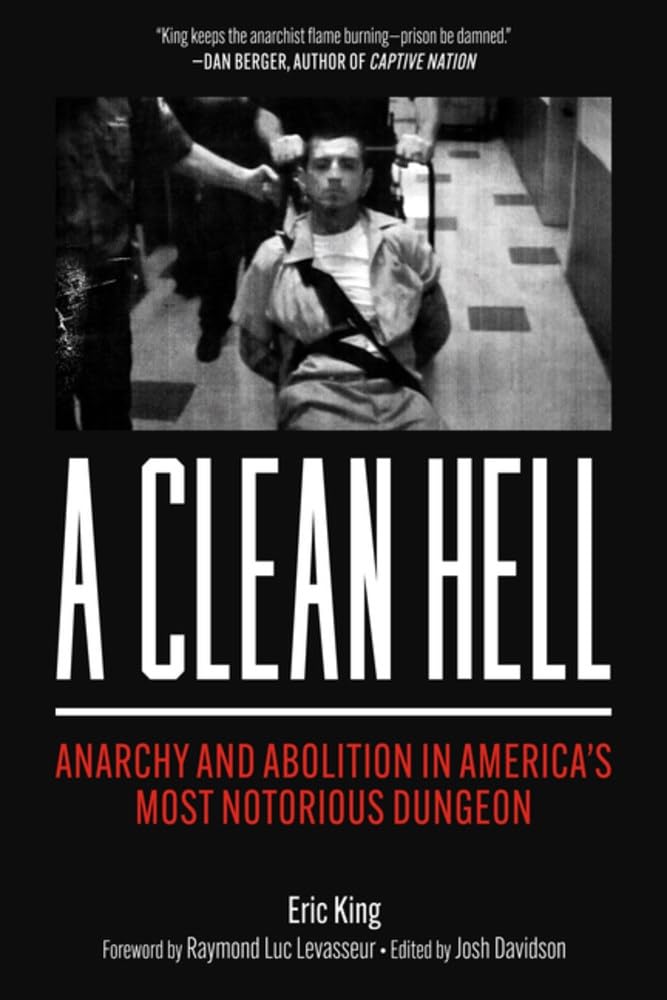
Excerpted from A Clean Hell: Anarchy and Abolition in America’s Most Notorious Dungeon by Eric King. It appears here with permission from PM Press.
Source image (adapted): Dean Hochman / Flickr, licensed under CC 2.0