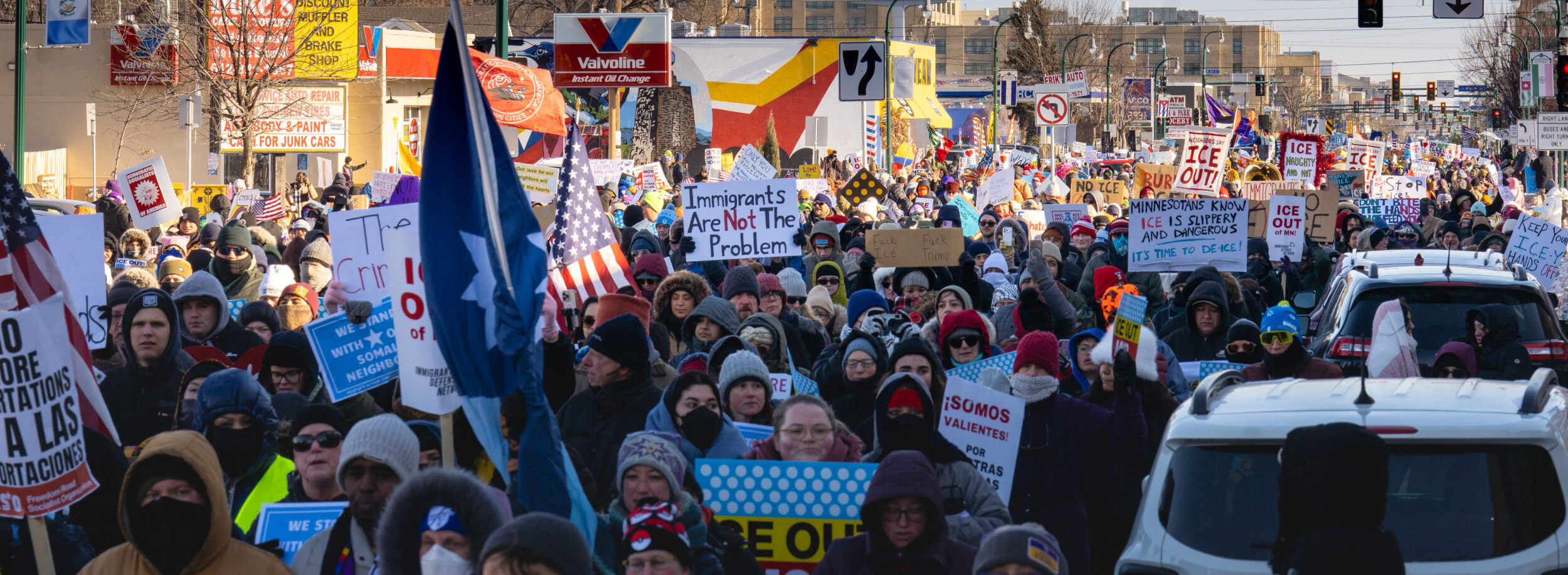
I am in the streets of Minneapolis and the protest is electric. Sirens in the distance. Helicopters overhead. People chanting, crying, demanding justice. Tens of thousands of voices lifted as one.I see signs that said: “Quit Killing Us!” I see others that say: “ICE = Terror.” “ICE out NOW!” I feel the pulse of democracy on the edge of a knife, and I am proud to be playing a part.
Only three years ago, I walked out of Louisiana State Prison after forty-seven years of incarceration. It was a place where time moved like molasses and steel doors whispered secrets of the forgotten and the lost. Over the decades, I lost track of the seasons. I watched men come and go—some broken, some reborn, some buried under prison soil. Then the law—old, rusted, Jim Crow–era law—opened a crack in the walls they built around me and I crawled through.
I was already a senior citizen when I was released, and what little reentry support was on offer hadn’t been designed for someone like me, past working age and unlikely to ever be able to support myself. I wrote about this experience for Inquest, then published in Inquest again as I undertook through writing to understand my long incarceration. My experiences protesting in Minneapolis have been so unlike what I think many people imagine the life of a long-term releasee would hold, and it felt vital to share them.
I’ve survived two wars—one overseas, one at home. Vietnam taught me how bodies break; the U.S. criminal (in)justice system taught me how spirits do. Both demanded endurance. I knew I needed to be punished for my crime. In fact, only after spending around twenty years inside did I begin to question if my sentence was excessive and to challenge the legal basis for it.
Today, many decades later, I stand free in Minnesota. I am fighting a different struggle altogether: the ongoing struggle for democracy and justice in our streets. I stand amidst a sea of people, their fists pumping in the air, their chants rising like smoke. Clouds of tear gas surround us. When I was in prison I learned to resist, sometimes alone and sometimes with others. It is from others that we draw our strength. I did not want them to feel alone; I wanted them to know that they matter, that their voices matter.
Soon after going to Vietnam—at the time, I believed the lie that I was needed “to fight communism,” to keep the hordes at bay—I landed in prison. I went to war as a young kid and returned as a young man, angry and hardened. I came back from my tour carrying an addiction and a desperate need for attachment—for validation that war had not stripped me of my humanity. My addiction overcame me, and I ultimately went to prison.
Midway through my sentence, I decided to fight for my freedom. The warden at the Louisiana State Penitentiary was corrupt, a petty tyrant who thought cruelty, infused with “Christianity”, was discipline. The system he ran thrived on silence and fear. In the face of his tyranny, I learned the law, studying it like scripture. I became an inmate counsel, first on the civil litigation team, then on death row. I fought for my clients and for myself, filing suit after suit, each one more precise than the last. I sued the warden twice for violating my rights: once for operating an illegal private business inside the prison, and once for punishing me for speaking to a reporter about his corruption. Later, I challenged my conviction under a Jim Crow–era law that allowed Louisiana to imprison people without a unanimous jury, a law designed to dilute the influence of Black jurors. When the Supreme Court ruled that practice unconstitutional in Evangelisto Ramos v. Louisiana, my case reopened. I won. I was freed the same day my court hearing was held.
Today, I know that Evangelisto Ramos—the man whose case helped overturn the law that had imprisoned me for decades—had fought for my freedom, and I should fight for Minnesota’s freedom. I owed that simple debt. It’s a part of the prison code.
Standing shoulder to shoulder with protesters in Minneapolis, I know that the years I spent fighting were not in vain. Because I am still fighting. Today, I face armed federal agents, fully aware that escalation could turn deadly at any moment. And, for what? The irony is palpable. The same government that once sent me to kill brown men now stands armed before me, prepared to use deadly force at a moment’s notice, democracy be damned.
And amidst the sea of faces, I meet two people who will stay with me forever, Ruby and Jack. They are like me: old and way past their time, not a part of any group or organization. They just want to be here right now, part of this moment. Ruby is all fire—flaming red hair, a voice that cuts through the crowd. A megaphone in one hand, a pocket Constitution in the other, she calls me “Old Iron” because she insists I am tough. “Iron never bends,” she says. “And it don’t break.”
Her husband Jack is quieter. He is ex-military like me, and carries himself like a man who’s seen things and buried them deep. We talk between chants: about war, about freedom, about loss. “You remind me of someone I served with,” Jack says. “Guy who never stopped fighting, even when the fighting turned inward.” Like me, Jack served in Vietnam, in his case with the Big Red One, an infantry unit that saw some of the worst jungle fighting. I feel an unbreakable bond with him, a tie that will never bend. I nodd. “I think the real war starts when the shooting stops.”
We finally face our real fears when we’re freed from the fears of sudden death. A new fear takes hold—the fear of tomorrow, the fear of what’s to come, the fear of what we can no longer control.
Ruby grabs our arms, pulling us toward the front. “C’mon, Old Iron. Time to raise some hell.” And we do. We march. We stand in front of ICE officers. We face riot gear and tear gas threats. We hold the line. And in that moment, I am not an ex-con. I am not a statistic. I am not forgotten. I am part of something. And I am alive.
People ask me now, three years since my release, what freedom feels like. I tell them it’s complicated. It’s not just sunsets and soft beds and good food. It’s responsibility, grief, and memory. It’s standing in the middle of a protest with tears in your eyes because you know—you know deep down—that your voice still matters. Vietnam doesn’t matter anymore. Prison doesn’t matter anymore. None of it matters anymore. What matters is this moment, this community, this demand that we bring the best out of ourselves and stand up for what is right, for what we believe in.
I look at my hands now—wrinkled, scarred, unchained. I think of the steel bars that once defined me. I think of the law that freed me. I think of the nightmares I endured for years. Vietnam no longer haunts me because facing death again has finally freed me. I think of Ruby’s laugh and Jack’s steady gaze. I think of the protest chants echoing through downtown streets. And I think of freedom and its price. My debt has been paid, in full, and I am at peace. Thank you, Evangelisto Ramos. Thank you, Minneapolis. Thank you for freeing me. I hope Minneapolis finds peace.
More from our decarceral brainstorm
Inquest—finalist for the 2025 National Magazine Award for General Excellence & cited in The Best American Essays 2025—brings you insights from the people working to create a world without mass incarceration.
Sign up for our newsletter to get the latest in your inbox every Saturday.
Newsletter
Image: December 20, 2025, protest against ICE in Minneapolis. Credit: Chad Davis (licensed under CC)