Part of the Twenty-Five Years Since 9/11 series published in collaboration with Acacia magazine.
After 9/11, there was an eruption of knowledge that sought to understand what violence and discrimination against Muslims meant and how best to theorize it. Was it a problem of religious, racial, or religio-racial discrimination? Was it a case of orientalism? Was it a problem of capitalism or imperialism? All these options—in various combinations and with different approaches—were offered up in the important work of many scholars.
To the question of how to understand what the war on terror meant, race rose as a winner.
Knowledge producers in the halls of universities, at marches, in nonprofit organizations, and increasingly in policy circles argued that Muslims’ experiences, in the United States and around the world, bore some relationship to race. Some argued that Muslims who previously experienced the comforts of whiteness in the United States no longer did. Some argued that while 9/11 intensified discrimination, “the Muslim” had long been a racial or racialized category in the West.
The crown jewel of the evidence marshaled to support the race argument is the stereotypical image of the Muslim terrorist. This reading has its merits. It rightly recognizes the lumping together of people who are otherwise connected to very different religions (Sikh, Hindu, and Coptic, for example) and geographies (Italian, Syrian, Bosnian, and so on). Similarly, the word brown appears in literature on post-9/11 surveillance in connection with some hazy sense of Muslim-looking.
A theoretical shorthand—“the racialization of Muslims”—permeated debates and analysis that had little to do with criminalization. It also traveled to scholarship not centrally about Muslims. For example, Ruth Wilson Gilmore and Angela Davis use this phrase to refer to post-9/11 violence against Muslims in their work on prisons. The dizzying array of definitions of racialization notwithstanding, this concept was adopted to theorize the relationship between race and Muslims, again, both inside and outside academe.
The argument seeking to establish that Muslims are a race or racialized intends to make the case for people to seek redress for actual harms, and this argument can be seen in scholarship coming out of sociology, anthropology, legal studies, women’s studies, American studies, and English.
Where legal redress is connected to being defined as a race, this amalgamated group that goes by many names and acronyms—SWANA (South West Asian and North African), MASA (Muslim, Arab, and South Asian), AMSA (Arab, Muslim, and South Asian), BAMEMSA (Black, Arab, Middle Eastern, Muslim, South Asian), Arabs and Muslims, Arab and South Asian Muslims, and so on—is unable to traverse what would appear to be an otherwise obviously useful path to redress. In this way, one might benefit from having a defined race. In the absence of an official race designated by the Office of Management and Budget—at least until the 2030 US census includes a new racial category called “Middle Eastern or North African”—the argument that this amalgamated group is racialized has served other useful political purposes.
The argument that Muslims are racialized is a political claim, which means that its politics are to be considered. It is worth considering, then, whether making a case for Muslims as racialized is doing the work of race, whether the reliance on racial blackness is doing the work of sustaining racial blackness, and whether such work cannot be vindicated by the otherwise reasonable goal of redress.
This is precisely the argument of Karen E. and Barbara J. Fields, who argue that belief in race is like belief in the geocentric model of the universe: it is either true, or it is not, no matter who holds this belief or what causes they put it toward. Although arguments can be made applying Fields and Fields’s analysis to demonstrate Muslim racialization after 9/11, we may also ask if we are unwittingly colluding in the work of something like proving that the geocentric model is true because enough people believe it. As many thinkers have shown, it is perfectly possible to show the negative impact of a concept without agreeing to operate within it.
What other paths may be possible if the work of providing proof of racialized identity is replaced by shattering the logic of race that creates the very conditions for which redress is sought? Is it possible that the former is not just a quicker and thus more desirable means of pursuing relief in the face of immediate threat, but that it is also actively deepening the problem?
This line of argument may sound like the rightwing campaign against diversity policies and any sort of power gained by people of color, but my argument could not be more different. In other words, this is not to say that there is a privilege afforded to Black people in the United States that must be stripped bare for the sake of equality, per the conservative arguments; it is to say that Black has become a sign, among many signs, under a neoliberal order that profits (socially, economically, and politically) off the production of marginality as desirable. If those of us against racism can face this fact, we can deal with some of the contradictions under which we struggle and try to find a way out that does not just lead to a more attractive version of the same problem.
More from our decarceral brainstorm
Inquest—finalist for the 2025 National Magazine Award for General Excellence & cited in The Best American Essays 2025—brings you insights from the people working to create a world without mass incarceration.
Sign up for our newsletter to get the latest in your inbox every Saturday.
Newsletter
Eqbal Ahmad, a formidable critic of imperialism, is useful here, particularly in his famous speech, “Terrorism: Theirs and Ours,” delivered at the University of Colorado Boulder in October 1998.
There is much to admire about Ahmad’s speech, starting with the title’s “theirs” and “ours.” They do not refer to actions called terrorism taken by either them or us (whomever that may be). In fact, “theirs” and “ours” do not rely on fixed groups of people called them and us at all. Instead, the title’s “theirs” and “ours” refer to two different views of terrorism. Theirs is the official view, and ours is what he explicates over the course of the speech. Ours seeks explanation and analysis in order to establish the nature of the problem called terrorism and determine what is to be done about it.
As Ahmad explains, ours seeks to develop revolutionary goals and the discipline to carry them out. This requires clear and consistent thinking. The point is to “analyze and exploit the contradictions and vulnerabilities” of the oppressive force while not succumbing to their view, repeating their repressive tactics, or capitulating to their power.
Theirs and ours are not inverses of one another, nor are they two sides or poles on a spectrum; rather, they represent different terms of thought. This distinction is especially useful for summarizing the central tensions and debates in my argument against relying on racialization as the primary framework for understanding the experiences of Muslims twenty-five years into the war on terror—and for determining what is to be done. It also helps characterize what could be called race: theirs and ours.
As Ahmad’s theirs is the official view of terrorism, race-theirs is the official view of race. It is the view that race is a natural and reasonable way to organize human difference, perhaps even a necessary evil. Race-theirs is man: an epistemology that overvalues one way of being human at the expense of all others, treating race as the distinction through which the world is known or knowable.
Race-ours seeks explanation and analysis to build a foundation for other ways of understanding, producing, and organizing knowledge; for other ways of understanding human difference; and for other ways of understanding the violence committed in its name. It begins with the understanding that such violence can be opposed without reproducing the terms through which it is organized.
This is a foundation built on a commitment to good-faith attempts to perceive material reality rather than locate convenient falsehoods. It understands the task as the development of alternative terms of description, as Sylvia Wynter argues: a new science. Since race is epistemological, structured by the subject-object relation, it is the very terms of description, not merely their deployment, that is the problem.
Race-ours is not a given but an ongoing project built on earlier efforts. The point is to continue in the tradition of those who understand that the urgent problem before us is not just the application of concepts such as race but the very terms of description that constitute them. In this sense, race-ours is less a stable category than a practice of developing other ways of describing the world, which means other ways of living in it. To think in this tradition is to understand that ours cannot operate within the terms of theirs and expect different results—and that the struggle for ours continues.
Adapted excerpt from No God but Man: On Race, Knowledge, and Terrorism by Atiya Husain. Copyright Duke University Press, 2025.
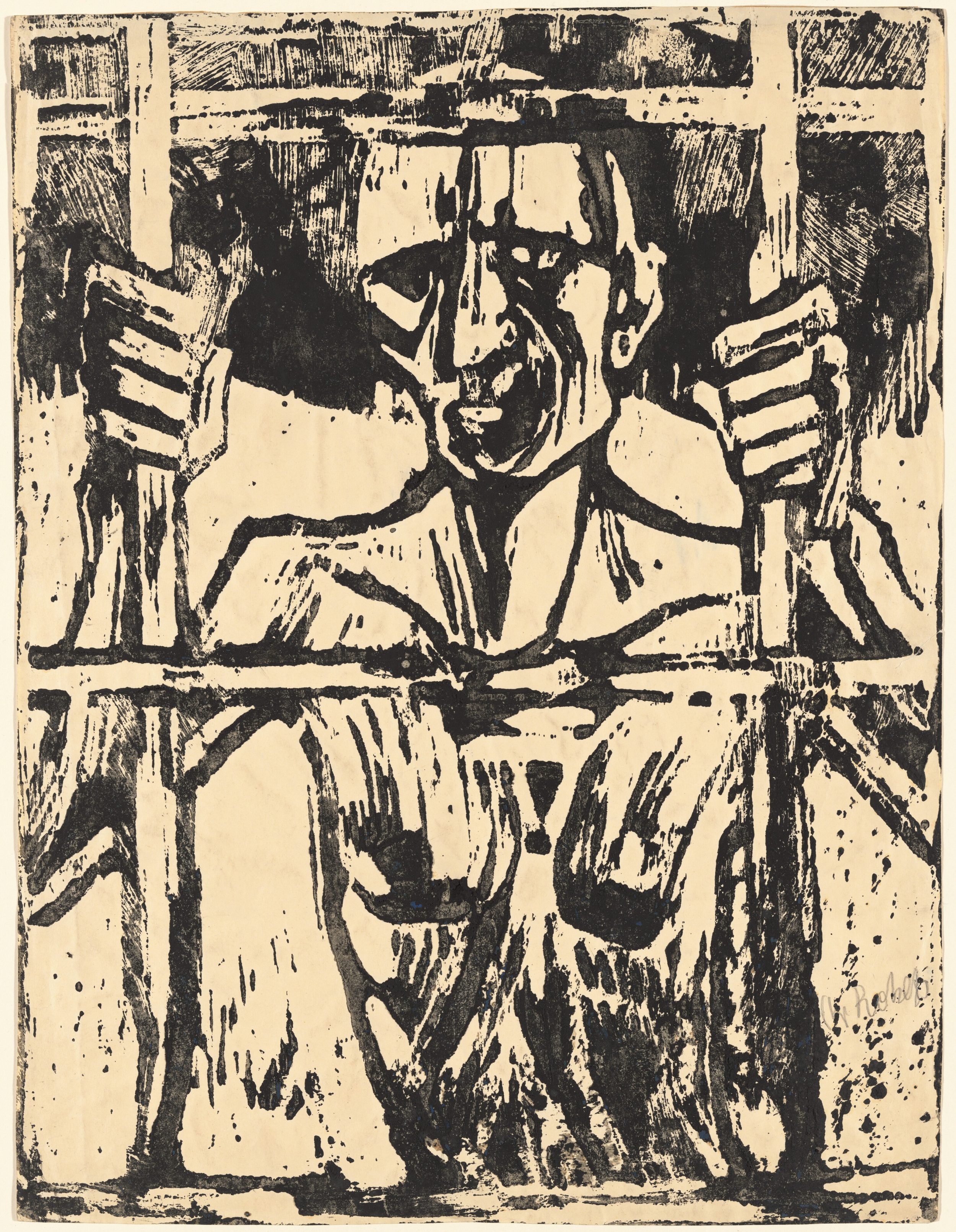
Image: Christian Rohlfs’s The Prisoner (Der Gefangene) 1918 / National Gallery of Art
Contributors