Part of the Twenty-Five Years Since 9/11 series published in collaboration with Acacia magazine.
On the morning of September 11, 2001, a clear blue day in the nation’s biggest city, a passenger jet slammed into the North Tower of the World Trade Center at 8:46 a.m. Not many images in U.S. history conjure more disbelief or emotional gravity than that first fireball, or the eerie column of smoke that chased it into the sky.
At around the same time, thirty-seven-year-old Darrell Powell was being processed at Downstate, then the reception facility for newly incarcerated New Yorkers awaiting their long-term prison assignments. Powell had been convicted of murder and still faced a slew of federal charges. He was looking down the barrel of a life sentence and didn’t think there was anything left that could surprise him.
About seventy miles to the north, in Stormville, the clear September morning felt unseasonably warm to twenty-seven-year-old LaMarr Knox. He was circling the battered concrete walkway of Green Haven Correctional Facility, one of New York’s largest maximum security prisons, when his attention shifted to a crowd swelling in the weight yard. “Everyone began converging on the bleachers around the TVs,” he recalled. “It was quiet because everyone was trying to figure out what happened.”
Then, the second plane hit.
Sitting in the housing unit’s day room—which held a table for card players, a TV, and one phone—he watched the same horrifying report on every channel. “I was in shock,” he said. Speaking with me at Shawangunk Correctional Facility in Ulster County more than two decades later, Powell’s face still holds the emotion of that moment.
A few minutes after 9 a.m., thirty-two-year-old Michael Campbell shifted on his stiff mattress as he took in the news. Listening through headphones connected to an audio jack in the wall, he still wasn’t convinced. The reporting seemed like an Orson Welles stunt. “None of us believed it. We thought it was some kind of entertainment program,” he said. Serving his sixth year of a 100-to-life sentence, Campbell was, like every other resident in the now-closed Southport Correctional Facility, condemned to permanent solitary confinement.
Southport was infamous for its long-term residents, some of whom had devolved into acts like feces-slinging and nonstop screaming. Campbell had spent nearly two years there, experiencing twenty-three-hour-a-day lockdowns every day. For him and his peers, the line between horror and reality had become dangerously thin.
That morning, Knox, Powell, and Campbell were, in their different ways, cut off—from the city, from their loved ones, and from any certainty about what was happening. Their isolation made it difficult to process the news. But as the day progressed, reality settled in. In some facilities, residents returned from family visits with personal confirmation of what had been reported. The twin towers were really gone.
All three of the men I spoke to, like many of the roughly 67,000 people incarcerated in New York State prisons on September 11, were deeply connected to New York City. They were born there, or grew up there, or had families there—or, often, all three. It was clear that their city and their country were under attack. And as Muslim men, they knew their identities soon would be, too.
In the weeks following 9/11, President George W. Bush informed the country, and the world, that the attacks had been masterminded by Osama Bin Laden, leader of the radical Islamist group Al Qaeda. Less than a month later, on October 7, Bush announced Operation Enduring Freedom, the U.S. military campaign in Afghanistan, where Al Qaeda was based. It was met with overwhelming bipartisan and civilian support.
For decades before the global war on terror was launched, Islam had been cast as the antithesis of the U.S., and Western, way of life. Foundational aspects of the religion like the Shariah—a code of laws derived from Islamic texts—were framed as a threat to democracy. After September 11, that suspicion hardened and became more deeply racialized. Inside prison walls, predominantly Black Muslim communities that had spent decades building respect, unity, and moral authority suddenly found themselves targeted, divided, and feared.
“Muslims were the enemies at that time,” Knox remembers. “It was rough.” Knox and I are in the shack, a gated section of Shawangunk’s prison yard with dumbbells, barbells, and other workout equipment. As Knox prepares to do another set, his expression grows more serious.
Some prisoners at Green Haven believed that the facility’s Muslim community supported the attacks. “It was really some of the guards that fueled it. I feel like prisoners were just ignorant of what was going on,” Knox recalled. Though there were no explicit threats, he noticed the tensions growing at Green Haven. Along with four other Muslim residents, he went table to table to clear up any misconceptions “before things got out of hand.”
“We had to go to all of the gangs in the yard and tell them we weren’t on that,” he said.
More from our decarceral brainstorm
Inquest—finalist for the 2025 National Magazine Award for General Excellence & cited in The Best American Essays 2025—brings you insights from the people working to create a world without mass incarceration.
Sign up for our newsletter to get the latest in your inbox every Saturday.
Newsletter
Knox had been Muslim for only a few months when 9/11 happened. Before that, he had been a high-ranking member of the Crips. Wanting a change from the lifestyle that had led him to prison, he decided to embrace Islam in 2000, while already incarcerated. “My great grandmother was happy that I was doing something other than gangbanging,” he said, smiling. Some of his closest peers had already made the transition to Sunni Islam, and Knox decided to do the same.
Born in Kingston, a small city in New York’s upper Hudson Valley, Knox didn’t grow up religious. But after he was imprisoned for murder in 1995, Islam became his way of stepping away from the gang life he’d brought into prison. He took his shahada in 2000.
At Green Haven, Knox has held a job at the medical clinic, where he witnessed post-9/11 Islamophobia firsthand. “Everyone in the infirmary shunned this [one] brother,” he said. “Nurses, doctors, officers—they just stopped talking to him.” Knox was confused. When he asked the staff why they were ignoring him, the answer was blunt: “Because he’s a Muslim.”
Knox was puzzled. He attended the mosque in the facility. He prayed shoulder to shoulder with the man who was now being vilified. When he told the staff that he, too, was a Muslim, it didn’t seem to change anything. What mattered to them was appearance: the man they were shunning was Muslim and looked Arab, like the terrorists behind the attacks. “I told them that he was from Guyana and then things slowly went back to normal,” said Knox.
The experience opened Knox’s eyes to Islamophobia. “I equated his experience with racism. We [prisoners who were Black] experienced that all the time, but that was something new,” he said. “I didn’t know there was a distinction until that moment.” Even as a Black man long familiar with racism, he now felt newly threatened because he was Muslim.
What Knox witnessed in the infirmary echoed what was happening outside prison walls. On September 15, 2001, Balbir Singh Sodhi—a Sikh man—was murdered in Arizona by someone who believed he was Muslim and a supporter of Osama bin Laden. Being Muslim was already a risk. Now, you couldn’t even look like one.
In one of Shawangunk Correctional Facility’s small day rooms, at a long metal table bolted to the floor, I break the seal on a bottle of Zam Zam water and pour half of it into a cup for Michael Campbell.
“Before the attacks, the Muslim community was stronger,” he recalled.
In the mid-1990s, Muslim prisoners—predominantly Black men who had converted to Sunni Islam or the Nation of Islam—occupied a singular position inside U.S. prisons. Prison staff, other inmates, and gang rivals all recognized Muslim communities as organized, disciplined, and morally grounded. Michael Campbell was part of that tradition.
“Guys would inform us if there was any issue and, a lot of times, we’d handle it in house,” Campbell remembers. “We were the vanguards. We used to squash beefs and we were respected.”
Even prison staff often reflected this respect for Muslims. In the mid-nineties, when Campbell was housed in Elmira Correctional Facility, tensions flared after a guard began to enter the facility’s mosque with his shoes on. For Muslims, who pray on the floor and press their foreheads to the ground, tracking dirt from prison boots into that space is a serious sign of disrespect. Campbell and the other Muslims immediately formed a human barricade. The guard retreated and called for backup. Moments later, a lieutenant returned with reinforcements.
Instead of just forcing his way into the mosque, the lieutenant placed shoe coverings on his boots before coming to speak to the men. Such a capitulation in a prison environment, where guards and prison staff are used to acting with impunity, was meaningful. “He told us that the officer was in the wrong but that we’d have to go back to our housing units. There was no retaliation—we just left.”
There was a seriousness that came with being Muslim—a code of ethics and discipline that was unmatched in the prison system. Islam became a path for incarcerated men who were desperate to escape their detrimental lifestyles. For many Black men, Islam offered more than a way to escape destructive patterns; it provided a language of identity, dignity, and brotherhood. Conversions behind bars were so significant—first to the Nation of Islam, then to Sunni Islam, following the broader shift beyond bars—that the FBI kept tabs on them.
Campbell discovered Sunni Islam behind bars in 1992. Before then, he was a part of the Five-Percent Nation, or the Nation of Gods and Earths, a Black nationalist group with historic roots in the Nation of Islam. He also grew up in the Pentecostal church, where he’d kneel all night in prayer with his family. “My mom always used to tell me: ‘Ask God, call on God,’” he said. Still, Campbell knew he wanted something different. After visits to churches and a Nation of Islam temple, he was introduced, and converted, to Islam. “It just spoke to me. Any question that I wanted answered was already there.”
For years, like Campbell, my father had been a follower of the Five-Percent Nation. Although the group had roots in Islam, many of its members were still entrenched in street culture. My father was no exception. During his incarceration, while housed at Washington, a medium-security facility in upstate New York, the facility’s imam took a liking to him and hired him as a clerk. While under his tutelage, my Dad embraced Sunni Islam.
After my father returned from prison in 2004, he was forever changed. His physique was different—he had become a hulking figure in two years—but so was everything else: his walk, his words, his whole manner. Gone was the man who’d leave home in the afternoon and return late at night. There was no more drinking or bouts of unexplained anger. He talked in a calmer tone and expressed a desire to be better for my Mom and me.
Not long after he came home, I became a Muslim, too.
What my father brought home was, as I’d later understand, part of a broader current moving through the New York prison system. During the height of the Black Power movement, which corresponded to the heyday of the Nation of Islam, large percentages of the nation’s incarcerated Black people joined the religion. By the 1990s, the influence of the Nation of Islam had significantly waned, and many incarcerated people converted yet again, this time to a more orthodox form of Sunni Islam. In the years after 9/11, yet another shift occurred.
“There was more dawah [active outreach and religious guidance] after 9/11,” Campbell said. “It’s like we had to defend Islam because of what was taking place.” The rise in hostility toward Muslims demanded a response; for many, it took the form of a turn to new conservative trends in global Islam that frame themselves as a return to tradition.
The post-9/11 hostility being faced by incarcerated Muslims was not abstract. After being processed at Downstate on 9/11, Powell moved through multiple facilities—Auburn, Attica, Green Haven—and encountered animosity at each one. Like Campbell, he became increasingly aware of the growing resentment from prison guards and peers. Many began to view Muslims as another prison gang hiding behind religion, which added to increased resentment and violent confrontations. He remembers that guards began to delay services like Jumuah and Eid prayers. “I wasn’t afraid,” he said. “But I was definitely more conscious of voicing my views because of the stigma.”
During his time at Attica, Powell heard repeated accounts of the Islamophobia endured by Zakaria Gasmalla, a Sudanese imam living in Buffalo who would drive to Attica to serve the men in the prison. When I was incarcerated in 2018 at twenty-six years old, Attica was the first maximum security facility I was sent to. To me, Imam Gasmalla was a breath of fresh air. I hadn’t had a stable religious figure in my life for years. He was welcoming. He was understanding. He was patient, even when some of us struggled to be. “It was well known that he experienced acts of harassment like slashed tires,” Powell told me.
Despite this adversity, Gasmalla continued to serve the Attica community—a beacon of support for the Muslim community, and for the wider incarcerated population.
By the time I arrived at Attica—seventeen years after 9/11—the worst of what Knox and Campbell described had passed. But Islamophobia was still a reality for incarcerated Muslims.
In 2019, after leaving the facility gym after Friday services, a group of us walked through an empty corridor with a guard escort. As we approached a gate, another officer intercommed our cellblock to inform his colleagues that we were returning. “C-Block,” he said. “Al-Qaeda returning.”
For a moment, no one spoke. It took time to process what we’d heard. Then, in unison, we started to protest the officer’s ignorance. The man who brought us back from our rage was the incarcerated facilitator of our Muslim community. “Just write it up, brothers. We let him know how we feel, just write it up,” he said. Aggression would get us nowhere, nor would hurled insults. There was a process for filing grievances against staff and that was the right way forward. It was the mature thing to do. It was the Muslim thing to do.
I honestly didn’t expect anything to come from our efforts. But a few weeks later, at the same gate, the officer apologized. The history of Attica has been extremely grim for prisoners. While conditions have improved after the 1971 uprising, it remains one of New York’s most dangerous facilities. It was almost liberating to hear the officer’s apology. It felt like a win for the incarcerated and for Islam.
It’s hard to believe that it’s been twenty-five years since the United States was so drastically changed. I think about the victims and their families often. As someone who took the life of an innocent person, I have learned to empathize with anybody who has experienced tragedy. An integral part of that growth has been Islam. Whenever I ignored religion in the past, I often made life-altering decisions for the worse. Being Muslim is a part of my identity that I don’t shy away from.
When it comes to practicing Islam, Shawangunk is an outlier to most other state prisons. Here, we have our own mosque, which is accessible on weekdays for nearly eight hours each day. The large room with thick black carpet is a reprieve from some of the monotony that comes with serving a long sentence. We have our own area with sinks for wudu (ritual purification), an extensive library, and an imam who is dedicated to our rehabilitation through the learning of the religion. Our community is small, but that makes the bonds of brotherhood that much stronger. While the prison’s Muslims don’t enjoy the same respect and unity that Campbell experienced back in the nineties, many of us are still noticed by guards and peers for our commitment to change. I believe in that commitment.
As decades of U.S. history have shown, Islam—especially for Black Muslims—has at various turns meant a progression toward civil rights, a commitment to discipline and mutual aid that contributed to important liberation movements, and a reclamation of pride and identity in spaces designed to strip them away. For countless individuals—Campbell in the 1990s, Powell in the 1970s, my father and Knox in the early 2000s, and me in recent years—it has meant a complete rejection of violence and a commitment to something better.
The Quran teaches that “whoever kills a soul—unless for a soul or for corruption in the land—it is as if he had slain mankind entirely; and whoever saves one, it is as if he had saved mankind entirely” (Quran 5:32). That principle stands in direct opposition to terrorism and the murder of civilians. Just as I have criticized our administration for anti-American policies, I will criticize terror in the name of Islam.
That is a part of being unapologetically American. That is a part of being unapologetically Muslim.
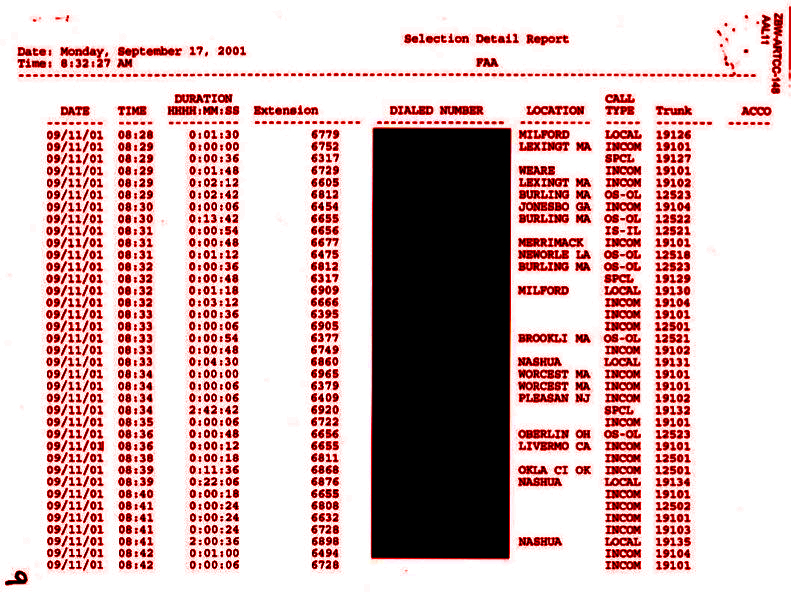
Image: Federal Aviation Administration / National Archives Catalogue