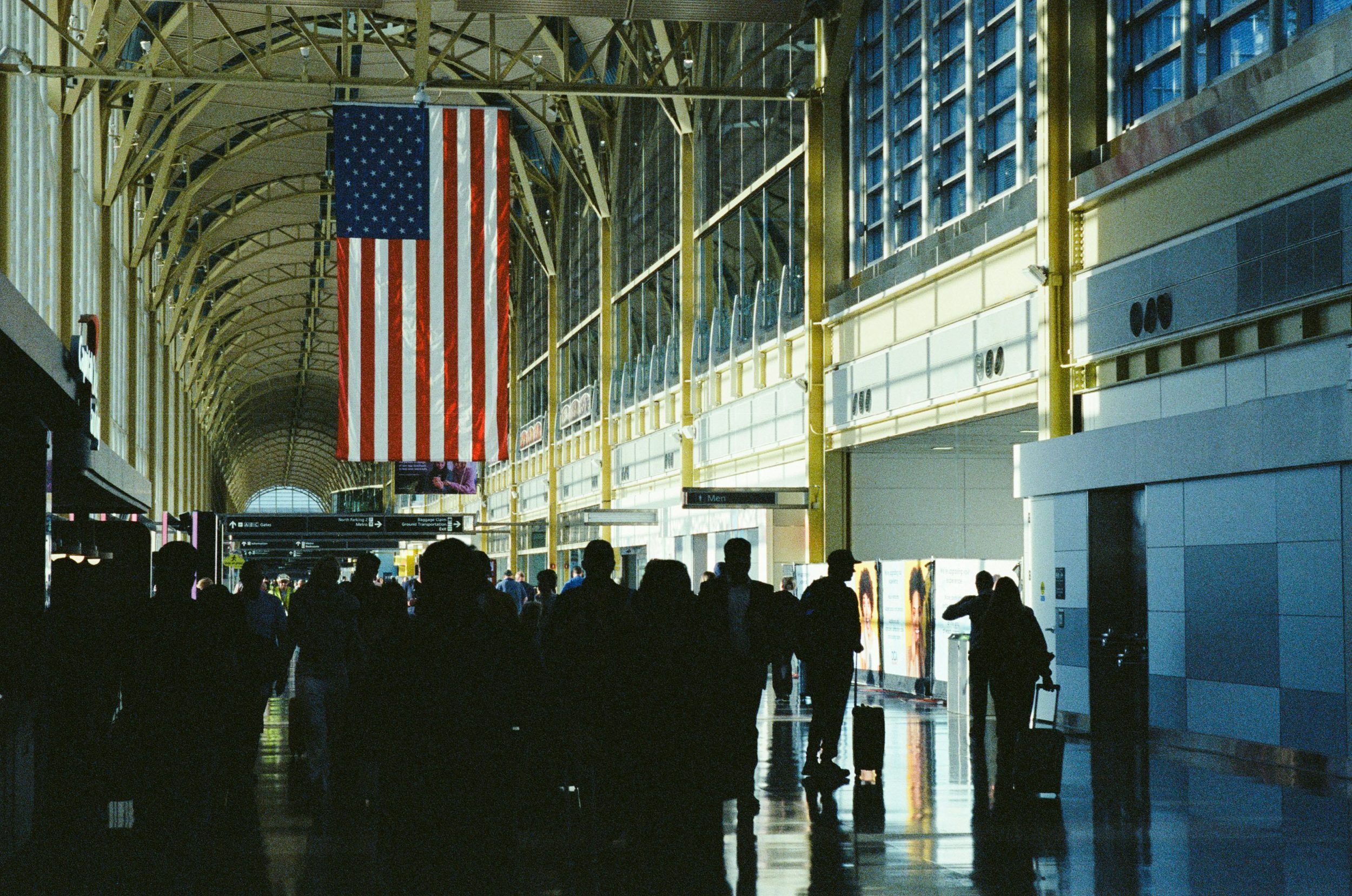
As the congressional impasse continues over the funding of the Department of Homeland Security (DHS), Donald Trump last Friday signed a presidential memorandum directing DHS to pay Transportation Security Administration (TSA) agents anyway (backpay, at least). His administration has also dispatched Immigration and Customs Enforcement (ICE) agents to airports—seemingly purely to menace.
Throughout this upheaval, news coverage of immigration policing—and the congressional standoff over the funding of it—has been dominated by stories of partisan conflict, including last week’s revolt of House Republicans in response to the Senate’s attempt at compromise. To an extent, this is understandable; this latest dispute between the two major parties has had important consequences, most visibly the massive inconveniencing of flyers. But by overemphasizing partisan conflict, news accounts have minimized what should be the main story of immigration policing: a story of bipartisanship. Over the past several decades, Republicans and Democrats have cooperated to build a brutal, lawless immigration regime.
In the aftermath of ICE’s killing of Renee Good and Customs and Border Protection’s (CBP) killing of Alex Pretti, news coverage often focused on immigration policing atrocities that have happened since Trump was inaugurated, ignoring similar atrocities under previous, often Democratic, administrations.
Certainly, important changes in immigration policing have happened in the past year. ICE, for example, has grown dramatically and is now better funded—its budget has nearly tripled—and its agents are now routinely masked. Many argue that immigration police now function as the president’s personal army, weaponized against his political enemies. Furthermore, the symbolic cruelty of immigration policing, or what philosopher Olúfẹ́mi O. Táíwò has termed “vice signaling,” is more extensive than in times past, and is often streamed on social media.
These changes deserve discussion. But so do continuities between immigration policing in the past and in the present. As historian Adam Goodman explains, the U.S. “deportation machine,” the origins of which lie in the late nineteenth century, was built, reinforced, and refashioned by a wide range of stakeholders, including political leaders from both major parties. In addition to this system of deportation, the United States also runs “the world’s largest system of migrant incarceration,” in historian Brianna Nofel’s words. Her research shows that this system developed over the course of a century through exchanges between the criminal legal system and the immigration bureaucracy.
In recent decades, the scope, scale, and brutality of the U.S. immigration system have dramatically increased. But this is not due to Republican victories over Democratic resistance. Rather it marks an escalation of what journalist Daniel Denvir rightly identifies as our country’s longstanding “bipartisan war on immigrants.” Indeed, Democratic contributions to the metastasis of our crimmigration system are not difficult to identify.
More from our decarceral brainstorm
Inquest—finalist for the 2025 National Magazine Award for General Excellence & cited in The Best American Essays 2025—brings you insights from the people working to create a world without mass incarceration.
Sign up for our newsletter to get the latest in your inbox every Saturday.
Newsletter
In 1994, for example, President Bill Clinton created Operation Gatekeeper, which instructed Border Patrol to endeavor to prevent immigrants from crossing high-traffic areas of the border; over the following decades, this operation led to thousands of deaths and disappearances. Legislation passed by Congress and signed by Clinton in 1996 criminalized immigration further, requiring incarceration for a broader variety of offenses, increasing the range of offenses for which an immigrant could be deported, and enlisting state and local police in national immigration policing.
Under President Barack Obama, removals of noncitizen immigrants increased relative to the George W. Bush and Clinton administrations (although overall deportations decreased), earning Obama the moniker of “deporter-in-chief” from immigration rights groups. The annual budget of ICE and CBP increased by billions of dollars during Obama’s two terms.
The administration of President Joseph Biden, in turn, continued the policy of family separation (albeit in modified form) that had attracted so much outrage during Trump’s first term. It further expanded the scope of expulsions of asylum seekers under Title 42 (a component of a 1944 public health policy that Trump’s administration had weaponized against immigrants during COVID-19), and made the process of applying for asylum more difficult. Over the course of Biden’s presidency, the annual budgets for ICE and CBP increased yet again by billions of dollars. As political geographer Reece Jones explains, “The tactics in Minneapolis have been used both on the border and beyond—against immigrants and citizens alike—during the Bush, Obama, Trump and Biden presidencies.”
What, then, are we to make of Democrats’ claims that DHS “appears to have strayed far from its original purpose”? In their estimation, what, exactly, was its original purpose? According to Keith Wilson, the Democratic mayor of Portland, Oregon, DHS “was designed to protect Americans from threats, and what we’ve essentially done is, in some cases, we’ve turned that agency on Americans. . . . It’s deeply unsettling.”
But this, of course, is a convenient fiction. From its very start, the agency was turned on many Americans, particularly Muslims as well as dark-skinned non-Muslims—and Democrats share the blame.
In 2002 the Homeland Security Act, which established DHS and subordinated immigration policing to the agency, passed the Senate by a vote of 90–9; only 8 Democrats voted against the bill. The Patriot Act—which, in the words of legal scholar Khaled A. Beydoun, “devastated the civil liberties of Muslim citizens and immigrants”—likewise received 48 of a possible 49 Democratic votes in the Senate. These developments followed an Islamophobic logic that treated Muslim Americans as what political scientist Nazita Lajardi calls “outsiders at home”— criminal terrorists branded, in Maha Hilal’s formulation, “innocent until proven Muslim.” Bipartisan Islamophobia legitimized landmark expansions of both executive power and the criminalization of immigration. And now the country is reaping what it sowed.
Today, as unprecedented numbers of immigration police patrol the streets of cities across the country, news coverage continues to overstate Democratic resistance. One headline in the New York Times claims that “Democrats want to limit” the “slush fund” for ICE created by the One, Big, Beautiful Bill Act of 2025. But as it turns out, the story is not actually about Democratic proposals to decrease funding but instead about Democratic arguments for procedural restrictions on the use of the funding. As Adam Johnson observes, “progressives in Congress aren’t even advocating DHS’s budget return to its 2024 levels,” indicating “just how far to the right the Overton window is.”
Even after the January killing of Good, seven House Democrats voted to continue funding ICE at its current level; House minority leader Hakeem Jeffries (D–NY) decided not to whip votes against the measure. All this at a time when a plurality of U.S. residents, according to one recent poll, support abolishing ICE altogether.
The immigration policing reforms that Democratic political elites tend to support are mostly minor and proceduralist. Worse, Senate Democrats’ push to include millions of dollars for more body cameras for ICE in the budget has been touted as a victory. And in recent negotiations, leaders from both parties have indicated that they support body cameras. But this proposal again fails to come to terms with its own history. As the work of movement lawyer Alec Karakatsanis has shown, body cameras were originally proposed not by critics of police but by police themselves, along with the private corporations that manufactured and sold them.
Police sought out body cameras because of their potential to increase the institution’s surveillance power, in turn facilitating speedy prosecution, protection from liability, and the repression of protests. For years, police were unable to convince government to pay for body cameras at scale—but this all changed starting in 2014, when Michael Brown was killed by police officer Darren Wilson in Ferguson, Missouri. As pressure to reform the police mounted, police strategically portrayed body cameras as a means to provide police accountability to the public. Just over a decade later, their plans have come to fruition; body cameras have resulted in more money in police budgets and a massive expansion in the surveillance infrastructure of policing, while the number of police killings appears to increase every year, even against the backdrop of a nationwide, dramatic drop in violent crime.
Will the capacity, authority, scope, and scale of immigration policing decrease if the reforms preferred by Democratic politicians in this current standoff are implemented?
To date, there is little evidence for an optimistic answer to that question. Indeed, there is not even overwhelming reason to trust that that is the Democrats’ aim.
But a clear-eyed view of the failures of the two major parties should not lead one to believe that all is lost. Massive, organized resistance is building and exerting power—leading to crucial victories—on a regular basis. Join it. Join us.
Contributors