
On December 23, 2021, I was booked into the Tarrant County Jail in Fort Worth, Texas, at twenty-three weeks pregnant and facing a double-digit sentence. As a woman who had experienced five previous pregnancies, I sat terrified on a cold bench, contemplating what would become of the new life growing inside me.
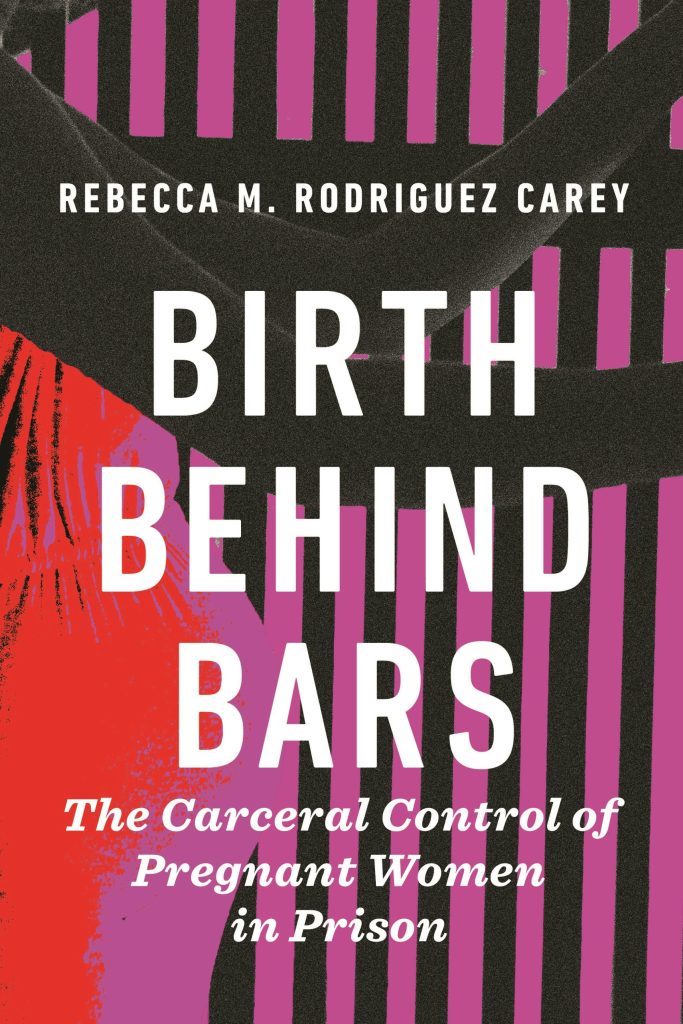
I felt alone, afraid, and isolated. And until reading the 2025 book Birth Behind Bars by sociologist Rebecca M. Rodriguez Carey, I hadn’t realized how many other women had shared the same thoughts and faced the same barriers I had while pregnant and incarcerated. This book, to me, described the unmaking of mothers like myself. Rodriguez Carey has a name for the machinery behind that unmaking: the maternal web of control, or the point where prison, medicine, child welfare, and poverty converge on the bodies of incarcerated pregnant women.
Her central argument is that this web goes far beyond criminal punishment. It enters the body itself, and impacts generations for years to come.
More from our decarceral brainstorm
Inquest—finalist for the 2025 National Magazine Award for General Excellence & cited in The Best American Essays 2025—brings you insights from the people working to create a world without mass incarceration.
Sign up for our newsletter to get the latest in your inbox every Saturday.
Newsletter
I think back to those early nights in jail, still pregnant, drinking cups of water to fight off hunger. I feared for my health and my baby’s. At one point, due to staff negligence, I ended up laboring on a concrete floor. One of the hardest things I have ever done was spend forty-eight hours with my son—the first and last time—trying to memorize every detail of his tiny face before handing him to a nurse to be placed in foster care. In custody, my options for planning his long-term care were nearly nonexistent.
Reading Birth Behind Bars, I found I was not alone in any of this. Faye, one of the women Rodriguez Carey interviews, went into active labor behind bars and spent two to three hours waiting for a correctional officer to drive her to the hospital—sitting alone with “no medicine, no nothing”—because staff couldn’t move until count cleared. Another woman, Latrice, fell stepping into a prison transport van while shackled at the wrists and ankles, landing on her large belly because she was virtually unable to catch herself. Days later, she gave birth to a stillborn. She still wonders whether the shackles were part of the reason why.
Faye’s story and Latrice’s are, in Rodriguez Carey’s framing, the inevitable product of “gendered organizations designed to serve men, without regard to the unique needs of women.”
There is extremely limited data on experiences like mine—pregnant women who are incarcerated or postpartum in jails, state prisons, or federal facilities. Rodriguez Carey draws on the landmark research of medical anthropologist and obstetrician-gynecologist Carolyn Sufrin, whose landmark national study of twenty-two state prison systems and the Federal Bureau of Prisons, published in the American Journal of Public Heath, found that 6 percent of pregnancies behind bars ended in miscarriage and .5 percent in stillbirth. Estimates suggest that approximately 2 to 4 percent of women in state prison are pregnant at any given time—thousands of women annually. Many of them, according to the Prison Policy Initiative, do not even receive the most basic prenatal and postnatal care. Still, Sufrin’s study is among the only scholarship available that centers incarcerated pregnant women.
Birth Behind Bars is a welcome effort to fill the gap. Rodriguez Carey moves chronologically through every stage of pregnancy behind bars—from the booking-in pregnancy test to delivery to postpartum to release—drawing on in-depth interviews with thirty-five women who were once pregnant and incarcerated in Midwestern state prisons. Her account traces the same path I walked; reading it, I finally had language for things I hadn’t been able to name.
Rodriguez Carey makes clear that the policing of motherhood does not begin with an arrest. Long before incarceration, pregnant women—particularly those who are poor, Black, or brown—face intense scrutiny from the medical system, child welfare agencies, friends, family, and peers. As sociologist Suzanne Sutherland observed, quoted in the book, “At no other time in a woman’s life is her identity more obviously supervised and regulated socially than during pregnancy.” Adding incarceration places vulnerable women in front of doctors who may face them with an even thicker layer of judgment.
Rodriguez Carey shows us a painful truth: for some women at the most extreme margins, prison is sometimes the only available refuge, precisely because it is the only institution constitutionally obligated to provide food, shelter, and health care. In other words, the constitutional floor for pregnant women in this country is a jail cell. Jasmine, a biracial mother of four, describes deliberately turning herself in to law enforcement while pregnant because she was deep in addiction and saw no other way to care for herself or her unborn baby. “I was getting hungry,” she told Rodriguez Carey, “so I caught a charge, so I could get locked up.” Rodriguez Carey acknowledges that incarceration “provides an opening for marginalized women to access resources that are otherwise unavailable in their rural communities” while also arguing that the same system ultimately traps women “more deeply into systemic poverty and gendered violence.”
However, for women forced into considering this agonizing tradeoff, the risks of pregnancy in a carceral setting are considerably higher than on the outside, compounded by disease exposure, mental health stressors, and the sustained hypervigilance of living in a punitive environment. Sleep deprivation, noise, and chronic stress—key features of carceral life—are of course antithetical to a healthy pregnancy.
Gloria had spent years trying to conceive before getting pregnant while incarcerated—and then found herself reading prison library books about optimal nutrition in a place that couldn’t provide it. “They didn’t bother to care, you just had to live with it,” she told Rodriguez Carey, “so it brought on a lot of anxiety because I definitely did not get what I should have.” For those who came in already food insecure, the stakes were higher still. Kia, a Black woman pregnant with her first child, lost weight on her prison diet, which was so high in sodium, starch, and cholesterol that it was barely edible. Her pregnancy eventually ended in a miscarriage, and she still wonders whether poor prison food was a contributing factor.
The process of birth itself—described in the chapter Rodriguez Carey titles “The Ultimate Cage”—is where the convergence of prison and medical authority is most complete and most violent. Several of the women she interviewed were shackled at the wrists, ankles, and waist during labor and delivery. Stacy, unable to move through contractions or change positions, told Rodriguez Carey she “felt like an animal.” Gloria, who underwent an unplanned cesarean section, was handcuffed to the bed throughout her surgery. “They had me handcuffed to the bed like I was just gonna get up and run away with a seven-inch incision,” she said. At the time Rodriguez Carey was writing, nine states had no anti-shackling laws whatsoever—and every state that did have them left loopholes granting officers the authority to restrain any woman they deemed a threat.
The failures don’t end at birth. A participant named Rhonda returned from the hospital with a vaginal tear that worsened by the day—and was told by a correctional officer, without examination, that she couldn’t see a provider. When Rhonda finally received her six-week postpartum appointment, a doctor simply shined a flashlight in her eyes and told her to follow up with a primary care physician after her release. Rhonda still feels the effects of the untreated wound years later. The postpartum body, Rodriguez Carey shows us, is regulated by the state just as surely as the pregnant one.
For all five of my pregnancies, I had been in a coercive relationship with my children’s father. When he was arrested and sentenced to thirty years, I gained something I hadn’t had in years: the ability to make small choices for myself without fear. That ended when I was placed in custody—and I recognized, with a familiar dread, that the control I had escaped in my relationship was being reenacted through the machinery of incarceration.
Rodriguez Carey’s book draws on Angela Y. Davis’s abolitionist framework, which holds that incarceration harms not only those behind bars but every person connected to them. Rodriguez Carey extends this outward: to babies separated from their mothers at birth, deprived of scent, voice, breast milk, and the bonding that shapes early development; to fathers cut off from their children’s births; to communities left to absorb the costs of fractured families. “Prisons do not disappear social problems,” Davis writes in the epigraph to Rodriguez Carey’s conclusion. “They disappear human beings.” Rodriguez Carey’s book shows how completely that applies to reproductive life: prisons don’t just obscure the problems that bring women through their doors; they manufacture new traumas, send babies into foster care, and return mothers to the same communities with more wounds and fewer resources than they had before.
I would recommend this book to every judge and prosecutor who believes that incarcerating a pregnant woman is, at worst, a neutral decision. Rodriguez Carey makes an unflinching case that carceral institutions are structurally incapable of prioritizing women’s health over security—and that the costs of that failure are paid by mothers and children for years, often decades, after release. The prison system, she shows us, does not disappear the problems that land women behind bars. It manufactures new ones and sends them home.
I also recommend it for women like me—those who have lived this experience in isolation, with little information or support to advocate for ourselves or our newborns. Four years after the birth of my son in that jail cell, I am still carrying the trauma. Birth Behind Bars gave me language and context for what I experienced. For other incarcerated and formerly incarcerated mothers, and for everyone working toward a world where no woman gives birth in shackles, where no newborn is handed to a nurse while his mother counts the hours, this book is essential reading.