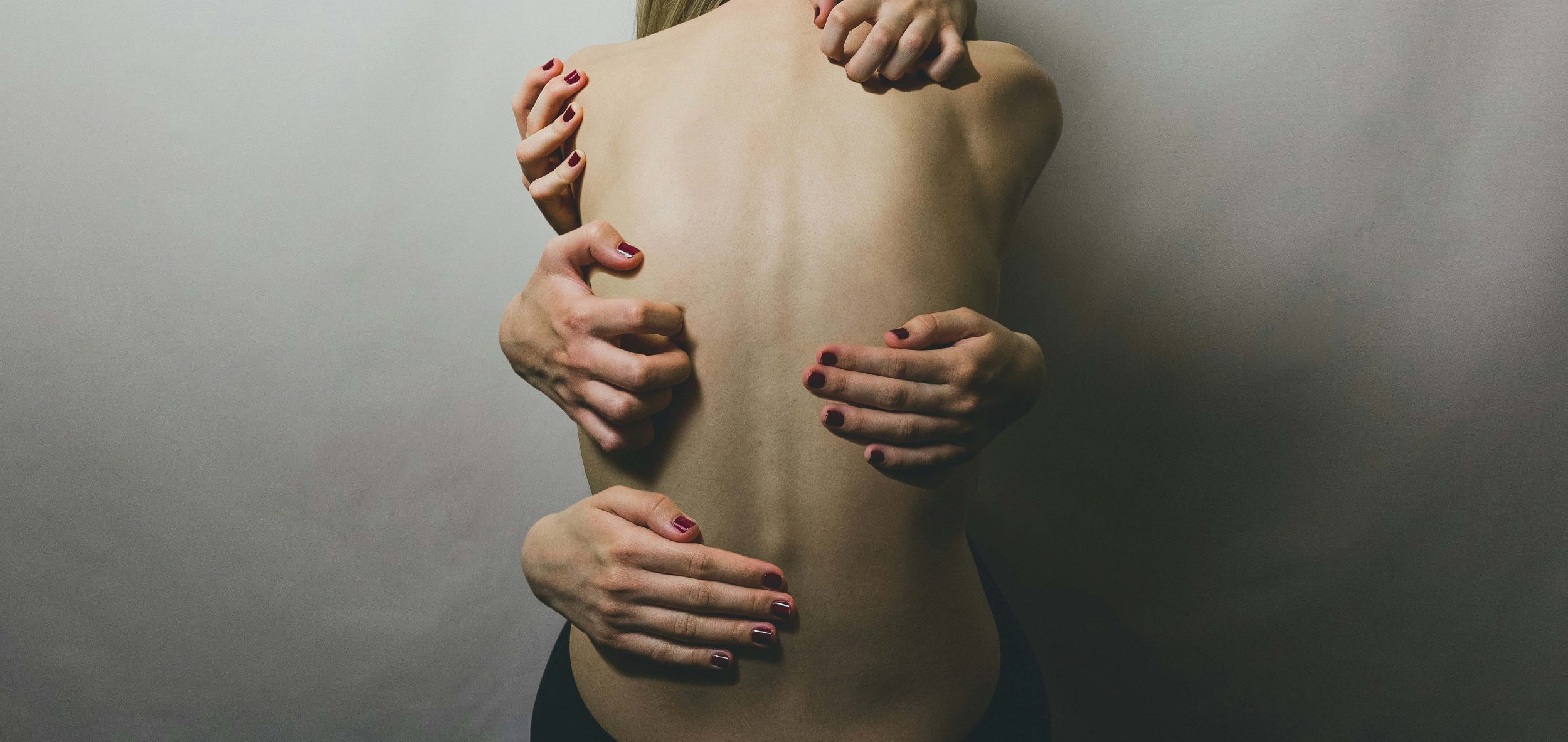
The blinking green light of the officer’s body-worn camera taunts me in this small room. The cold, clammy, dirt-crusted floor grates against my bare feet as I stand there in nothing except my bra and panties. I’m aware of the yellow cage a couple feet away, always ready in case the officers need it. The officer looks at me and says, “This is a full strip search. Remove everything.”
My natural instinct is to refuse. Then I remember that if I refuse this order, I’ll get a first-class ticket straight to segregation and possibly lose future visits with my family.
This isn’t my first strip search during my incarceration. They’re conducted regularly: on arrival, before and after in-person visits and in-prison job assignments, sometimes for punishment—whenever they deem fit, really. This, however, is the first time it’s being filmed. I am incarcerated in Women’s Huron Valley Correctional Facility, Michigan’s only women’s prison. At the time of the events I have just described, it is January 2025 and the Michigan Department of Corrections (MDOC) has just implemented a new policy mandating that correctional officers use body-worn cameras except during certain qualifying events—and though those events include “any place where a reasonable expectation of privacy exists,” it does not specifically spell out strip searches. And so here we are.
I comply, officially starring in the most awkward sex tape ever recorded as I remove my bra and panties, placing them on the chair in front of me with all my other clothing. Next is the part where the officer feels along every seam and stitch of my clothing. They get a disgruntled look on their face, like I’m the one who ordered them to do it. I stand there, naked the whole time. When they turn back to me, they order, “Turn around, bend at the waist, and cough.”
With a heavy sigh I turn and face the bathroom, bend at my waist and cough. My emotions switch between rage and humiliation. Do they really think I’m going to cough and contraband is going to fall out of my vagina? I hold in the tears burning my eyes, begging to be set free. I realize the officer directing this doesn’t even see that they’re raping my spirit. When will the stripping of my dignity end?
I was sentenced to prison to repay my wrongdoings, not create nonconsensual pornographic material. Yet this private, degrading task has been captured on video. Now that video can be legally reviewed by any number of prison and justice officials for any number of permitted reasons, including simply to complete a report. And I have no way of knowing or trusting that its viewing will be limited to official uses. Any sense of confidence or dignity I had has been extinguished. The shame will stay with me, able to destroy me for years. This is state-sanctioned sexual assault.
Humiliated, I turn around to start redressing.
More from our decarceral brainstorm
Inquest—finalist for the 2025 National Magazine Award for General Excellence & cited in The Best American Essays 2025—brings you insights from the people working to create a world without mass incarceration.
Sign up for our newsletter to get the latest in your inbox every Saturday.
Newsletter
You may not be feeling much pity; maybe you’re thinking: So what? They’re inmates paying for their crimes. To that, I say you’re forgetting a couple things. Incarcerated people do technically have limited rights—but limited doesn’t equal zero. We still have rights as humans. Humanity isn’t a sweater that can be confiscated, thrown in a closet to be forgotten, then pushed back on us years later. As a human, the U.S. Constitution dictates that I have a right to be protected from harassment and sexual abuse. These act are never acceptable, even if condoned by the prison.
Ordinarily, when a violation happens to an incarcerated person, our only remedy is the grievance process. But I filed a grievance and it was ignored for months. This denied me any recourse, which is a common tactic used by the administration to argue that the inmate failed to exhaust all administrative remedies or failed to do so in a timely manner. But their failure to initially even acknowledge the grievance also sent a clear message about my worth: I didn’t matter.
In the meantime, in response to publicity that advocates such as the American Friends Service Committee were able to create about the filming of strip searches, the MDOC issued a revised policy in March that clarified that cameras should be switched to sleep mode during strip searches. Though this stops normal recording, it is still conceivable that footage could be recovered through “video recall” mode—a failsafe made infamous when footage of correctional officers beating Robert Brooks to death in New York’s Marcy Correctional Facility was able to be recalled despite the cameras being in a non-recording mode.
In the end, twenty women incarcerated in Huron Valley elected to file a lawsuit against the state. We sought $500 million in damages for violating the rights of the hundreds of women incarcerated in the prison. In October 2025 the judge dismissed the case on the grounds that, as incarcerated women, we had reduced expectation of privacy and had not received any physical injury. By this way of reckoning, we thus lack standing to sue.
We disagree with the judge’s decision and our attorney immediately appealed. The results of that appeal are still pending. In the meantime, we continue to make our case to the public that these kinds of violations are unconstitutional and have already done lasting harm.
Being forcefully removed from society, ripped from our families, and thrown into terrible living conditions is already hard enough, both mentally and physically. Adding invasive strip searches and filming them is unreasonably cruel. It is possible to punish without taking a person’s dignity or denying them safety.
Statistics paint a bleak picture of our incarcerated population. Almost 80 percent of women who are incarcerated come to prison as survivors of abuse already. Many have been raped or exploited, robbing them of their identity, confidence, and sense of safety. This environment is already littered with triggers to those traumas, but with the adoption of body-worn cameras, new wounds have been inflicted. It is a feeling Toni Morrison captured in an oft-quoted passage from her novel A Mercy: “There is no protection. To be female in this place is to be an open wound that cannot heal.”
What does a lawbreaker deserve? Historically, the main mission of incarceration has been centered around rehabilitation. This is defined as restoring to good condition or health. Incarcerating already traumatized women, only to retraumatize them, directly contradicts this aim, instead adding to the devastation of lives. Inflicting torture upon fellow citizens who will be released back into communities sounds like a carefully calibrated act of destruction. Shouldn’t people be treated as people? What is enough?
If you foolishly believe this couldn’t happen to you, make sure you never have an accident or make a wrong choice. If you do, you might be led to join me at Huron Valley. You will be housed in an eight-foot-square concrete cell, all your autonomy will be taken, and when you visit with your family, you will be forced to get naked in front of someone who is wearing a camera. You’ll be in the position I and many others are in, fighting for our civil and constitutional rights as we endure cruel and unusual punishment.
The MDOC’s way of implementing body-worn cameras continues to have a dramatic cost in the prison. Some women have cancelled visits, while others quit their prison jobs just to avoid strip searches on camera. Some, like myself, are unwilling to give up the limited time I’m allowed to spend with my children, so I suffer through the indignity of stripping in front of a (now ostensibly sleeping) camera. My family and kids visit once a month, driving over two-and-a-half hours for a two-hour visit that is regularly cut short. They sacrifice their time, so I will endure the painful ritual if that’s what is necessary to maintain a relationship with the two halves of my heart.
Nobody is truly strong enough to get through all of this; you just do your best. I’m doing my best. That, of course, doesn’t mean I’m not feeling any effects. Since January 2025, I have had severe anxiety about in-person visits, including horrid dreams, insomnia, and panic attacks. I already know all about shame, and I drown in it most days. Now I don’t feel worth anything. I’m confined inside my body, constantly tormented by the feeling that I’m disappearing.
The worn-out practice of using sexual abuse to assert power has a way of somehow always feeling brand new. Incarceration, with the extra burden of strip searches in front of cameras, reproduces the position of women at the bottom of the social structure.
While incarcerated, finding ways to maintain even a sliver of dignity is crucial. It is constant work, finding ways to exist in a world that denies my humanity and fails to acknowledge the harsh realities of my current existence. I maintain my autonomy by writing, having a strong relationship with my family, reading, and journaling. I have decided to not only live through this hell, but do something with it. I am choosing to be brave enough to talk about my reality in hopes of making change.