The history of policing in the United States has always been part of the history of labor. In the nineteenth century, police departments developed and grew in large part to manage the problem of industrial labor conflict. In Boston and New York, Chicago and Baltimore, police departments broke strikes, monitored working-class neighborhoods, and attempted to cultivate a docile, compliant industrial workforce. In other words, labor discipline was always one of the principal functions of policing. It is no surprise, then, that city officials and propertied interests panicked when rank-and-file police attempted to form their own unions. These attempts, which began in the early twentieth century, seemed to cede the institution of policing to the very forces it was supposed to control. When a police union drive arrived in Philadelphia in the 1920s, for instance, a city councilor fretted that an organization “filled with communists and racketeers” was trying to seduce the city’s cops and helped establish a ban on police membership in “any state or national organization.” That the union in question, the Fraternal Order of Police, was a conservative, staunchly anti-socialist organization that denied unionism altogether did nothing to allay these fears. Bans like these would crop up in cities across the country, and Philadelphia’s would last seven years.
While the literature on American police unionism often begins with—and focuses on—the period following World War II, police unionization efforts stretch back to the 1890s, when police membership associations (whether or not they identified as unions) began to push for higher pay and shorter working hours. The police unionization efforts of the 1960s were simply the latest of many waves of police organizing, not the origins of the movement. And contrary to popular understanding, police unions were not simply extensions of elite political authority or supporters of the status quo. Police formed unions as a counterweight to the authority of their bosses in government, and they often did so in moments of political crisis, when political hierarchies and lines of authority were in flux and their future uncertain.
More from our decarceral brainstorm
Inquest—finalist for the 2025 National Magazine Award for General Excellence & cited in The Best American Essays 2025—brings you insights from the people working to create a world without mass incarceration.
Sign up for our newsletter to get the latest in your inbox every Saturday.
Newsletter
In fact, despite their history of anti-labor policing, police unions were in many ways remarkably similar to their counterparts in other workplaces. They fought for higher wages and shorter hours, for job security and improved working conditions. They faced tremendous hostility from the brass. Neither the law nor city agencies recognized their status as collective bargaining agents—a status officers themselves often disavowed. Police officers in some cities developed a sort of labor consciousness, even petitioning for inclusion in the American Federation of Labor (AFL). And while labor officialdom quite reasonably remained wary of these petitions, often opposing them, officers sometimes found their interest reciprocated by labor organizations at the local level.
This web of complex influences meant that the broader significance of police unions in relation to the U.S. labor movement would remain unsettled for decades. As police officers organized to advocate for their interests and their vision, it was not always clear who their allies and enemies would be. Over time, however, organized labor’s skepticism of police unions, coupled with government officials’ breaking of police-labor linkages, won out. In the second half of the twentieth century, police unions would develop as militant, independent organizations that operated largely outside the labor movement. Any early feelings of solidarity with the broader labor movement atrophied over time, a process strengthened by police officers’ anticommunism, racism, and antipathy to the radical wings of the labor movement.
The Patrolmen’s Benevolent Association (PBA)—founded in 1894 as a mutual aid society that paid burial expenses for families of deceased officers—was one of the earliest rank-and-file police organizations in the country. Today, it is the largest police union in New York City and the country, with over 20,000 active members. From the beginning—and despite the way the group identified— critics suspected the PBA of being a stealth union, and there are good reasons to think they were correct.
To understand the PBA is to understand the political context in which it formed. By the 1890s, the police department in New York City had been completely co-opted by the local Democratic political machine, the infamous Tammany Hall. Far from operating independently, the New York Police Department was an instrument of the machine. Tammany supporters stood to receive patronage positions on the police force and in other city government positions. In turn, they carried out the wishes of machine politicians and party officials. They looked past crimes perpetrated by machine supporters, cracked down on the machine’s political opponents, and helped rig the vote in Tammany’s favor during election season. These networks of corruption also encompassed a vice protection racket: officers tolerated the operation of illegal bars, brothels, and gambling establishments in return for payoffs. The livelihood and professional advancement of an officer in New York City thus depended on their loyalty to their machine patrons and their receipt of graft payments.
When anti-machine Republicans in Albany launched a State Senate investigation into Tammany corruption, this elaborate system came under pressure. Public hearings revealed corrupt police practices, causing trouble for rank-and-file officers. Under public scrutiny, the department stepped up vice crackdowns and temporarily slowed acceptance of vice payments, but less revenue from the “vice tax” also meant less income for poorly paid officers. Moreover, the threat to the machine also meant greater risk and uncertainty for officers whose livelihoods were tied to knowing how to navigate patronage networks.
Officers turned crisis into opportunity by forming the PBA in 1894. Though nominally a mutual aid society, in practice the organization functioned like a crypto-union, employing members’ dues to lobby Albany for improved wages and hours. While an effort to win an eight-hour day dragged on for years, PBA politicking quickly won the union its first wage increase in almost thirty years when the state raised the maximum annual salary for a patrolman from $1,200 to $1,400. The PBA also proved a useful vehicle for fighting deeper structural reforms to the NYPD. In 1895, after a series of police scandals and abuses were exposed to the public, Republican State Senator Clarence Lexow proposed bills that would have made it much easier to dismiss officers without process. PBA lobbying helped kill the bill in the State Senate.
The PBA’s fights for higher pay, shorter hours, and due process rights convinced its critics that it was a union in all but name. A New York Times report on the PBA in 1907 asserted that the association was “in effect a policeman’s labor union” and that it disguised its lobbying fund as a “mortuary fund” to hide “the real purpose” behind membership dues collection. The PBA never copped to this characterization and managed to continue to operate without ever being banned. But accusations of unionism showed the fine line PBA officials walked in order to de facto bargain over the terms of their employment while denying that this was ever their purpose.
Not all police associations were as circumspect as the PBA. From the 1890s through the 1910s, police officers in cities across the Northeast and Midwest petitioned the American Federation of Labor for inclusion. Like their counterparts in New York City, these officers sought higher pay, shorter hours, and greater job security. At first the AFL denied these petitions systematically, wary of welcoming professional union-busters into one of the strongholds of the labor movement. But in 1919, during one of the largest strike waves in U.S. history, AFL officialdom seemingly decided that it was better to have police on their side than not and issued dozens of police union charters. They issued one condition: that police never strike. A police strike seemed too great a political liability for the AFL to indulge.
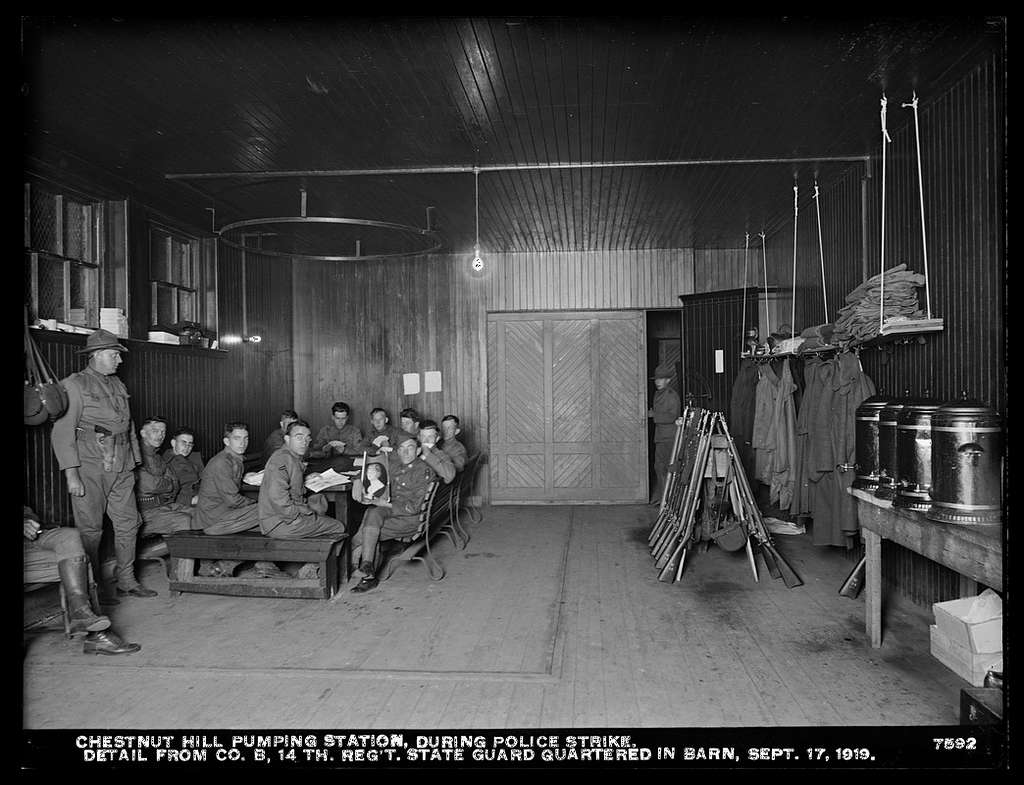
This new arrangement collapsed almost instantly when an AFL-affiliated police union in Boston launched a strike in 1919. Repression was swift: Massachusetts Governor Calvin Coolidge brought in National Guard troops as strikebreakers, fired all the strikers, and broke their union. Although the strike was quelled within days, it prompted a panic in national media and among elected officials. “The logical sequence of unionizing the police,” warned Montana Senator Henry Lee Myers, “will be the unionizing of the army and navy.” Other senators echoed these concerns, expressing what one newspaper called “fears…of a concerted radical movement to sovietize the American Government.” The delusion that police might be the leading edge of American bolshevism showed just how deeply elected officials feared police unionism and police strikes.
Reactions from the rest of organized labor were mixed. Striking police received a surprising degree of support from the local labor movement. Boston’s Central Labor Council backed the police strike, and individual union locals financially supported the striking police. But the national AFL leadership condemned the strike and withdrew all police union charters. Abandoned by all but their most local supporters in labor, the Boston officers could not sustain their strike.
The outcome of the Boston Police Strike all but severed the relationship between police unions and the national labor movement. The memory of Boston would hang over any attempt to unionize the police for decades. The future of police unionism now lay with independent police associations that carefully kept other unions at arms’ length. One of the most important vehicles for this model of unionism was the aforementioned Fraternal Order of Police.
Established in 1915 by two Pittsburgh patrolmen, the FOP has always been decentralized and heterogeneous, comprising individual local (and later, state) “lodges” whose members elected the officers of a “national” or “grand” lodge. Local lodges have always had considerable autonomy from the national lodge, and many never took on advocacy or union roles. Nonetheless, workplace issues often provided the impetus to charter a new lodge. That said, after the Boston strike fiasco, the FOP’s national leader notified all lodges of their members’ absolute responsibility “to uphold and enforce the laws of the Nation, State and municipality at this time of unrest.” The organization’s founders in Pittsburgh promised the mayor that they were not forming a union and that the “word strike is completely ruled out,” given officers’ duty “to protect life and property.” This rhetoric attempted to paint the FOP as unthreatening and, in the words of one reporter, “the very opposite of the attitude shown in the Boston police strike.” Nevertheless, mayors, governors, and legislators feared the FOP would undermine internal discipline and compromise the impartiality of the police in upholding the law. Their more immediate concern, however, was that police would become partial to labor.
While Philadelphia police could claim a police benevolent society dating to the 1800s and had made an abortive effort to form an AFL-affiliated police union in 1917, the city had never otherwise seen a police union. The FOP, which had organized every major city in Pennsylvania except Philadelphia and Johnstown by 1919, would take another twenty years to establish a Philadelphia lodge. The Great Depression changed everything. Devastated city finances meant that the city’s Republican political machine could no longer easily reward political support with patronage. Attuned to shifting political winds and the encroaching threat of the Democratic Party, Philadelphia’s mayor repealed the ban on police affiliation with outside groups in late 1937. Eighteen months later the FOP announced its new campaign in Philadelphia—FOP Lodge No. 5—and by the end of the decade the FOP could claim 3400 of the department’s 4100 officers.
In the early 1940s, FOP Lodge No. 5 scored a few notable victories. As in all major cities, the Philadelphia police lacked collective bargaining rights, and as a result they had to rely on political lobbying, letter-writing campaigns, and other forms of political demonstration and agitation. In these early years, their efforts often paid off, not least because the tight labor markets during World War II gave the FOP leverage. In 1943, the city granted officers a 48-hour work week, down from an average of nearly 53 hours. When the city was unwilling or unable to spend more on pay or pension funding, the city and state lodges often appealed to Harrisburg, a precedent that many municipal police unions around the country would emulate.
During the 1940s and 1950s, an alliance of business leaders and Democratic liberal reformers led a successful campaign to break Philadelphia’s corrupt Republican machine and overhaul city governance along more transparent, accountable, and centralized lines. During the same period, civil rights activists led efforts on behalf of Black residents to curtail police brutality and to ensure that the police provide adequate protection to African American lives and property. These two projects were mostly independent, but the majority of leaders and members of Lodge No. 5 perceived them as conjoined threats to the lodge’s hard-earned autonomy, job security, and modest political power. The fight against these reform projects would influence the FOP more than any event since the Boston police strike. It reshaped Lodge No. 5’s understandings of its interests and priorities, driving it to repudiate its earlier pledges of political neutrality and to move toward advocacy and occasional public protests.
By the late 1950s, police unions across the country found themselves in a precarious but promising position. On the one hand, their mere presence was a profound victory for a police union movement that had struggled for sixty years to find firm footing in U.S. cities. On the other hand, they increasingly found themselves on the defensive against various reform movements. Mayors and police chiefs did not want groups that checked their managerial prerogative, and they spent a decade framing police unions as an obstacle to efficiency, professionalism, and reform. Often, they succeeded.
The country was on the cusp of upheaval as the push for civil rights and the demand to end police brutality began to reshape city after city. In Philadelphia, the FOP found itself for the first time aligned with white, propertied Philadelphians, who now feared anything that would hamstring the police would jeopardize their own safety, power, and standing. Good government would now mean less an emphasis on rooting out corruption and promoting efficiency than assuring law and order. In the late 1960s and early 1970s, Lodge No. 5 would help shut down police oversight reforms and elevate the brutal and racist Frank Rizzo as police commissioner and later as mayor. The PBA would undertake similar efforts in New York City, as would countless other police unions around the country.
In these campaigns, police union leaders took an increasingly prominent role in this law-and-order movement, linking their fight for power in the workplace to the counterstrike against Black freedom struggles. This strategy would win them popular support for the first time, positioning them to win unprecedented visibility, labor rights, and political power in Philadelphia and across the country. While police unionists would never stop contending with the brass and elected officials over pay and working conditions, police unions became an accepted part of the landscape. City officials came to see solidaristic police unions as intolerable, but independent police unions hostile to Black freedom struggles as entities they could live with—or even ally with.
Image: Digital Public Library of America, via PICRYL. The photo shows Company B, 14th Regiment, State Guard, at Chestnut Hill Pumping Station during the Boston police strike, September 17, 1919.