Zohran Mamdani’s election as mayor of New York City last year surprised and captivated millions. Here was a self-identified Democratic Socialist who had, amid the tumultuous uprisings of 2020, called for defunding the police. He labeled the New York Police Department a “rogue agency.” Now, he would be in charge of it. Running a city and running a social media account are different tasks, of course, but part of Mamdani’s appeal to many voters was the multifaceted critique of police power found in his platform, as part of an ambitious effort to reimagine municipal governance.
Mamdani has proceeded cautiously, however. He repudiated past calls for defunding the police. Despite his criticisms of the NYPD gang database and the department’s special tactical unit (the Strategic Response Group), both remain intact nearly a year into his mayoralty. And a centerpiece of his platform, a new Department of Community Safety designed to reduce police encounters with people struggling with addiction or mental-health crises, remains embryonic.
Supporters await more tangible transformations, while advocates of more abolitionist approaches have registered disappointment. Crime is way down, but “quality-of-life” enforcement initiatives, begun under Mamdani’s predecessor, continue to target the socially marginalized and economically disfranchised. The first public criticism of the mayor leveled against him by his own party, the New York City Democratic Socialists of America (DSA), concerned his approach to the NYPD. Evidence that Mamdani has heard these pleas includes his reversal of a controversial pledge to add 580 officers to the NYPD’s already massive approved headcount of 35,000, but not much else has changed.
Is Mamdani’s slow approach to challenging the police based on fears that the NYPD could actively derail his administration? He signaled an interest in preserving the status quo by keeping the prior mayor’s last commissioner, Jessica Tisch, scion of one of the city’s wealthiest families, and rejecting recent demands from the New York City DSA to fire her after the shooting and detention of Oscar Belgal by Immigration and Customs Enforcement and the pension-eligible retirement of an NYPD officer who killed Win Rozario before he could be punished. But he also made a point, when questioned about his prior criticisms of police, of naming “rank-and-file officers” in his apologies. In this way, Mamdani seemed to attempt to placate the two most powerful forces in the police department: at top, the commissioner, deputy commissioners, and the brass who answer directly to the chief of department, and at the bottom, the rank and file and the union that represents them, the Police Benevolent Association. All the while, he is able to tout low crime rates, as every mayor hopes.
More from our decarceral brainstorm
Inquest—finalist for the 2025 National Magazine Award for General Excellence & cited in The Best American Essays 2025—brings you insights from the people working to create a world without mass incarceration.
Sign up for our newsletter to get the latest in your inbox every Saturday.
Newsletter
As I recount in my new book Blue Power: How Police Organized to Protect and Serve Themselves, Mayor Bill de Blasio experienced a revolt by the rank and file of the NYPD beginning in late 2014—and some of his closest aides now work for or have advised the Mamdani administration. De Blasio too appointed a technocratic police commissioner popular with tough-on-crime voters and elites, William Bratton. But his critiques of police abuse and racist stop-and-frisk practices incited implacable anger among the leaders of the city’s two largest police unions. It is perhaps no great surprise that a mayor with the goal of transforming city government does not wish to have his chances kneecapped by a recalcitrant police department.
Yet recognizing that the police maintain political power, including the power to intimidate a mayor elected with a nearly unprecedented mandate, only raises broader questions: Where did this political leverage originate? How is it organized? And has it always been this way?
Blue Power is my attempt to answer these questions by looking at the history of political organizing by police since the 1960s. To help think through how Blue Power speaks to this topic, I am pleased to launch a conversation with three of my longstanding interlocutors, hosted by Inquest, on the political power of police. Blue Power—a term I draw from advocates and critical analysts of police mobilizations for political sway going back to the late 1960s—is a project of self-interested political organizing. Blue Power also refers to the unique tactical repertoire for gaining political power that is available to police. Unlike other public-sector workers, police can use their operational routines—protest suppression, ticketing, arrest, and more—to gain political advantage, and they protect their power with the impunity that has been one of the primary boons of their political organizing. Blue Power has inward and outward faces.
The essays in this roundtable deepen our collective understanding of both the inner workings of police in politics and their larger goals. Aaron Bekemeyer, Imani Naiema Radney, and Aaron Stagoff-Belfort dig into how police mobilize politically in three cities, covering three different periods, revealing how what I have called Blue Power was built and has been deployed. Understanding how the political tactics of police have developed and changed over time is important today, particularly for making sense of the contours of the predicament facing progressive elected officials such as Mamdani or another recently elected democratic socialist, incoming Los Angeles Mayor Nithya Raman. The cities they lead and the police departments they oversee are not the same as they were, for example, in the 1990s when violent crime rates peaked in many parts of the country. Police chiefs gained political leverage to increase budgets as crime rates went up, and police unions participated in fearmongering campaigns about public safety, hoping to shore up their own position among public-sector workers. But we can ask whether the old playbook will still work, as the composition of the electorate changes, and many cities are seeing unprecedented low rates of violent crime. As these three essays indicate, the political machinations of police have not prioritized crime control, even as the arguments police make about their need for strong compensation and protections from accountability are framed in an idiom of public safety.
The political schemes and intrigue enacted by police at the city, state, and federal levels since the 1960s remain remarkably underappreciated by scholars of history and politics. This has been a grave detriment, leaving us with incomplete understandings, particularly when it comes to urban politics and the politics of crime and criminal justice.
An obvious answer to why so few scholars have examined police unions, or police in politics more broadly, is that police departments and police unions are opaque and closed to outsiders. Yet the history of police political maneuvering is also an open secret. Almost every city has a litany of examples of police interfering with politicians’ plans or of trying to capitalize on problems like rising crime. Newspapers have recorded these events. Yet this history has rarely been at the center of either the urban history literature or the study of urban sociology and urban politics. When it has been studied, it tends to be episodic, treated either as a peculiar or fraught moment in time or as the particular misfortune of a single locale. In contrast, the three essays in this roundtable begin to show how pervasive the pattern across space and time has been. This series illustrates how police unions have emerged and persisted as uniquely adroit political actors in the United States.
The neglect of police unionism in standard accounts of urban history and politics has distorted both scholarly and popular understandings of the history of the past sixty years, a period of both great hopes for urban liberalism—and the dashing of those hopes by the intertwined challenges of fiscal crisis, racism, and suburbanization. Further, given that this was the period of the wars on crime and drugs, as well as the rise of the prison–industrial complex or mass incarceration, the lack of attention to the self-interested role of police (and prison guard) unions in this expansion seems ripe for study.
Before discussing the three essays in this forum, let me briefly explain three approaches to critically reassessing our history with Blue Power.
Most germane to Inquest, scholars have, of course, developed strong and sophisticated analyses of the drivers of penal expansion and greater investment in policing, surveillance, jails, and prisons, including law and order politics, “frontlash,” transformations of Black politics, the rise of the New Right, and so on. But scholars have paid insufficient attention to actors and interests inside the carceral state, preferring to focus on those outside of it: voters, politicians, intellectuals, etc. This makes sense, of course, but without paying sufficient attention to prosecutors, police, and prison guards—and their political mobilizations—our understanding is skewed. All of these actors, particularly through their professional organizations, have driven carceral expansion by instrumentalizing crime talk, shaping political discourse on public safety, and pressuring elected officials. Although scholars have rightly looked at voters, politicians, and economic forces, these foci have come at the expense of examining the people who benefit directly from carceral expansion.
Second, in terms of urban history and social science, reigning paradigms for understanding the transformations of the past fifty years do not fully account for police union activism and mobilization. Many scholars point to reductions in union density and the hollowing out of the state. These trends are real, but police unions have managed to buck them. Further, we might reconsider the relationship between cause and effect, or symptom versus underlying syndrome, in line with Heather Ann Thompson’s canonical call to historicize the “criminalization of urban space” as cause rather than effect of urban crisis. Spatial reconfiguration and suburbanization, changing expectations of public-service delivery, and political demobilization of working-class people with winnowing union density could all be rethought in light of the success of police unions in the zero-sum environment of municipal finances. This rethinking does not require disregarding widespread accounts of urban restructuring, neoliberalization, or the changing politics of urban denizens. But centering police as political actors can alert us to the beneficiaries of transformation, to those who capitalized on crisis. This research requires, as the essays here do, that analysts reject the common-sense view that police unions are just like any other public-sector union.
Finally, the history of mass incarceration has become intertwined with the movement history of Black freedom struggles over recent decades. Repression by police is a pillar of our understanding of the decline of many radical movements of the twentieth century. Still, scholars disagree as to whether mass incarceration should be seen as a repressive response to radical movements. Looking at police unions, however, there’s little question that Blue Power was a direct reaction to Black Power. Police unions—or militant factions within them—directly targeted both moderate civil rights organizations and more radical groups such as the Black Panthers. Moreover, organizations including the Panthers and the Nation of Islam were keenly aware of this antagonism; in their newspapers, they analyzed and even ridiculed police unions regularly. This dynamic of political and rhetorical battle between activists and police unions, even aside from the more well-known forms of political repression that scholars have analyzed, demands greater attention. These examples point toward how the study of police as political actors can fortify our understanding of the carceral state.
In the essays that follow, Bekemeyer, Radney, and Stagoff-Belfort emphasize how police unions differentiated themselves from the labor movement in the past and the consequences in the present.
Bekemeyer looks at the development of the Fraternal Order of Police in Philadelphia, which would come to be one of the most important and effective chapters of that organization by the 1960s. Bekemeyer notes how the police unionization effort in Philadelphia, dating to the 1930s, was not yet at odds with the rest of organized labor, as later police union organizing would be. Instead, resistance to police unionization went hand in hand with resistance to organized labor more generally, and when the police did unionize, they did so by allying with the dominant Republican political machine. In this way, the distinction between police unions and other unions that arose later, and the widespread contemporary police union opposition to city hall, were not inevitable. Instead, Bekemeyer’s history of the Fraternal Order of Police challenges us to imagine a moment when police shied away from engaging in politics, seeing the most self-interested approach as being to work within the status quo.
Radney’s 1970s history of the Patrolmen’s Benevolent Association in New York City, by contrast, shows a police union attacking the status quo, and unabashed in its rejection of solidarity with other public-sector workers. In a moment of deep fiscal crisis, this police union went on the attack, demanding to be treated differently, rewarded while other city workers were sacrificed. The angry approach the union adopted would shape the type of politics it engaged in for many years afterward, though as Radney points out, it is not clear that the association’s divisiveness was as beneficial as it claimed. This research uncovers an alarming history of aggression and enmity among police for fellow city workers, which should give pause to anyone who entertains the notion that police could become reliable partners in a labor movement oriented toward social justice.
Finally, Stagoff-Belfort examines the recent history of the Fraternal Order of Police in Chicago, showing how even a police union leader who challenged his predecessors and worked to modernize the organization could nevertheless steer it toward uncompromising militancy. After the police killing of Laquan McDonald ushered in new accountability measures, the Fraternal Order of Police has resisted them at every turn. Disciplinary processes have ground to a standstill under union resistance, while union leadership has also aligned itself with Donald Trump and the MAGA movement. The union marries preexisting repertoires for resisting accountability and discipline with a contemporary verve for impunity that is shaping the political culture across the country. This analysis shows how the earlier histories that Bekemeyer and Radney investigate created the foundation for the recalcitrant and angry police unions of today, while the right-wing political atmosphere is invigorating their ongoing resistance to democratic authority and control over police practice.
This roundtable began as a panel at the Carceral Political Economy conference at The New School in March 2026. I would like to extend my gratitude to Eric Seligman and Dion Nania for helping to organize the panel, as well as Adam McGee and Inquest for support and feedback on these essays.
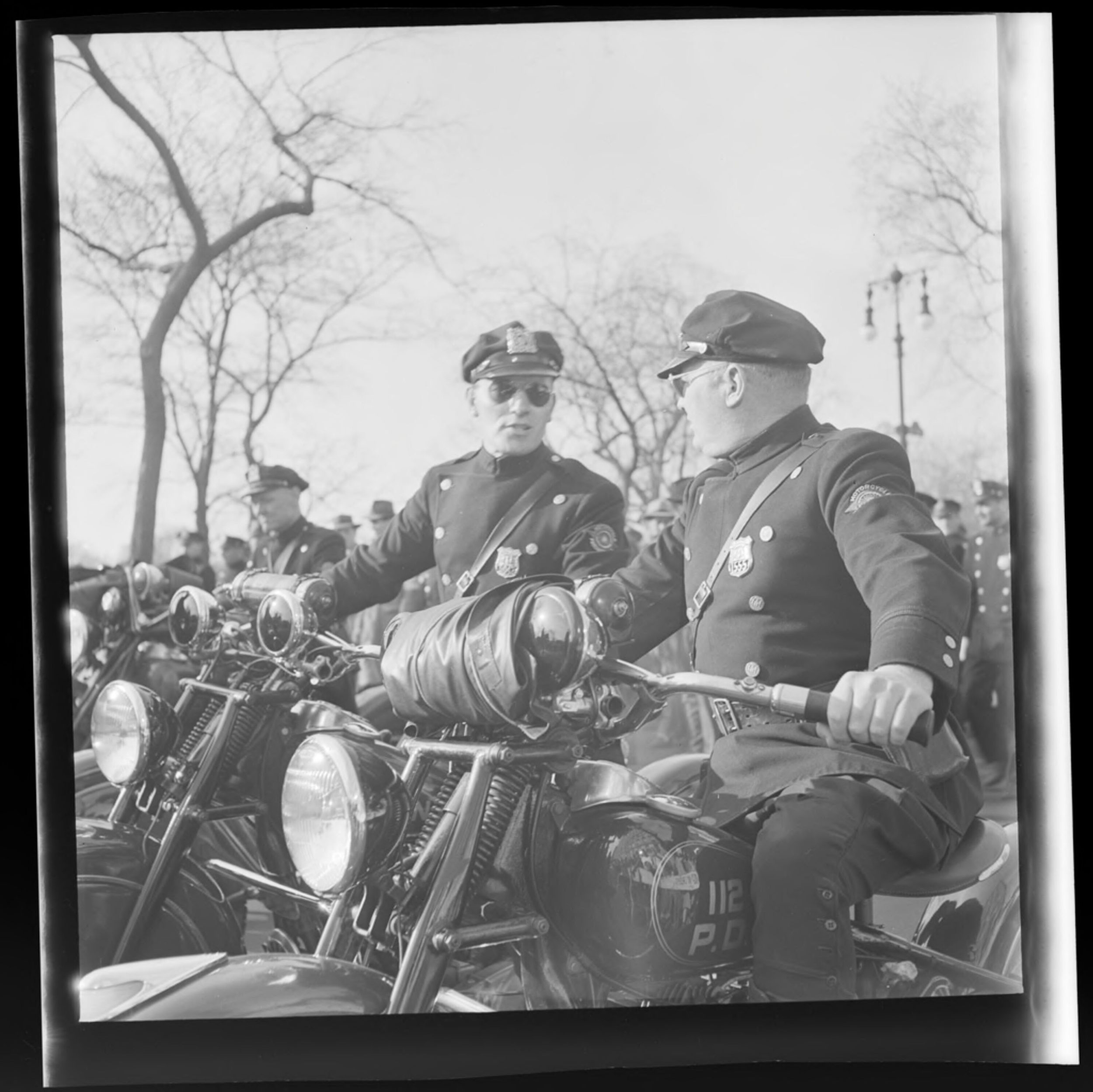
Image credit: Untitled (two police officers riding motorcycles), Jack Gould, Harvard Art Museums/Fogg Museum, Transfer from the Carpenter Center for the Visual Arts, American Professional Photographers Collection.
