White block letters on a black background spelled out an unmistakable message: “Police–Sanitation Parity? Garbage!” So read eight billboards scattered across New York City in early 1974. Shocking for their blunt rejection of the very concept of solidarity between police and other city workers, the billboards were the tip of the spear in the NYPD Patrolmen’s Benevolent Association’s (PBA) campaign to eliminate pay parity with other public employees. For decades, the city’s policy of pay parity had guaranteed firefighters, corrections officers, and housing and transit police officers the same base pay as NYPD patrol officers; it granted sanitation workers 90 percent of those wages. Yet, despite their place atop the municipal pay structure, the NYPD PBA clamored for an ever-greater share of the city’s budget at the explicit expense of other public workers. Union leaders demanded the city dispense with this policy that ensured the PBA’s salary gains did not outpace those of other unions.
Like police unions across the country during the 1970s, the PBA spearheaded several political campaigns that aimed to carve out a special status in society for police—one that was distinct from and superior to all other public servants. As they disavowed equitable compensation with other workers, even those in other uniformed services, the PBA advanced a chauvinist ethos premised on the unrivaled importance of police in urban society, a principle that continues to shape and even dictate American political life to this day. Indeed, in spite of many setbacks, the union’s crusade against the city’s commitment to the ethic of equity was part of this larger political project of cultivating social and political hegemony for police.
Pay parity between police and fire departments had existed in New York since the end of the nineteenth century. But by the late 1960s, the fact that members of other uniformed unions received compensation so close to that of police had emerged as a key issue within the NYPD PBA. To be clear, this was not merely a case of cops sticking together: union leaders decried that transit and housing police officers, which were separate from the NYPD at the time, made as much money as their members. Claims to unparalleled compensation weren’t concerned, in other words, with honoring the sanctity and superiority of all police work, but rather with securing the best deal for PBA members alone. This strategy of publicly disparaging the premise that public workers, including members of other police forces, deserved equal pay was a startling declaration of NYPD officers’ entitlement to a special, superior status among civil servants. And they would pursue this position ruthlessly.
While negotiations were not without animosity, between 1966 and 1972 no New York City municipal unions received more favorable contracts than the NYPD PBA and the Uniformed Firemen’s Association (UFA), the firefighters’ union. Yet this de facto largesse was not enough for the PBA. In September 1973, just as the city began to navigate increasingly dire financial straits, union leaders issued a resolution to formally end pay parity among uniformed workers. According to reporting from the New York Times, PBA delegates who supported the resolution to end pay parity declared that “no other city in the world so equates a garbageman with a police officer.” Less than two weeks later, the PBA president officially proposed an increase to police salaries above those of firefighters as well as an increase specifically in the disparity between the salaries paid to police and sanitation workers. With this proposal, the war on parity launched into a new phase. It marked the beginning of years of acrimonious negotiations between the PBA and City Hall, all unfolding against the backdrop of the city teetering on the brink of financial insolvency.
More from our decarceral brainstorm
Inquest—finalist for the 2025 National Magazine Award for General Excellence & cited in The Best American Essays 2025—brings you insights from the people working to create a world without mass incarceration.
Sign up for our newsletter to get the latest in your inbox every Saturday.
Newsletter
In the summer of 1974, Mayor Abraham Beame’s comptroller released a scathing report on the city’s finances that alleged that years of dependence on debt to finance city expenditures had combined with financial sleight-of-hand and shoddy accounting strategies to obscure a multi-billion-dollar gap in the city’s budget. Under pressure from rising interest rates for city bonds and increasingly vocal elected officials, Beame proposed laying off nearly 4,000 municipal employees and cutting tens of millions of dollars from city services at the end of the year.
The city’s looming insolvency took on mounting urgency over the course of 1975. In April, after months of trading barbs with City Hall, Chase Manhattan Bank, First National City Bank, and other major banks pulled out of the city’s bond markets. Mayor Beame announced waves of budget cuts and layoffs throughout the spring. In May, he proposed further cuts that would eliminate 30,000 jobs, and shutter libraries and educational programs. New York’s 338,000 public workers would not take the proposed evisceration of their jobs and the services they relied on laying down. A coalition of public unions protested Beame’s austerity budget and the banks’ abandonment of the municipal bond markets at a massive rally of 10,000 protesters on June 4. Some carried signs that read “Down with the Banks” and “First National City Short Changes New York City.” The PBA participated in this powerful expression of working-class opposition to austerity, but this solidarity would prove short-lived.
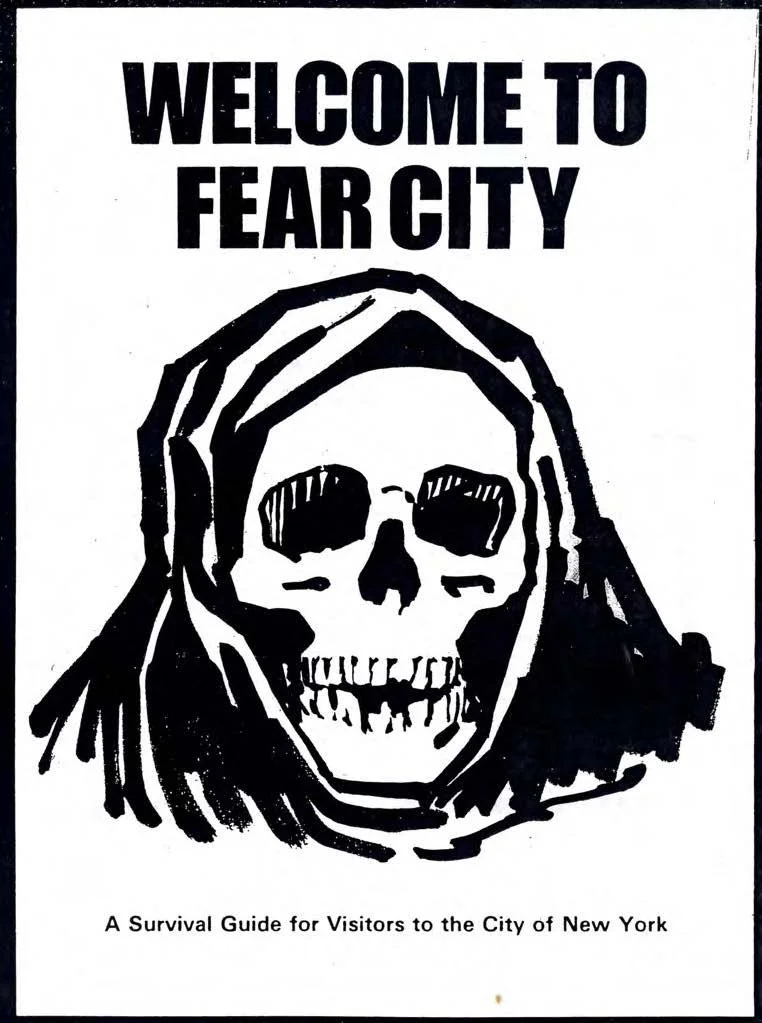
In the weeks after the rally, police, fire, and corrections unions worked to prioritize the protection of their own jobs ahead of the larger collective of municipal employees. They formed an alliance called the Council for Public Safety and printed a pamphlet titled “Welcome to Fear City: A Survival Guide for Visitors to the City of New York.” The pamphlet featured an image of the grim reaper’s hooded skull on the cover and warned tourists to avoid the hazards caused by the cuts to their respective departments. The group reportedly printed a million “Fear City” pamphlets, which it intended to distribute at local airports, bus terminals, and hotels. On the day the “Fear City” pamphlets were supposed to be distributed, a thousand members of police and fire unions protested the proposed layoffs at City Hall. PBA President Ken McFeeley donned a placard that read “Lives not Dollars — Firefighters and Police Come First.” Because the “Fear City” campaign was designed to obtain a special exemption for law enforcement and fire services, it essentially constituted another front of the PBA’s struggle against parity with other unions.
Neither the “Fear City” campaign, nor weeks of protests, student walkouts, school boycotts, and a brief strike by hundreds of sanitation workers could prevent Beame’s severe budget cuts from going into effect on July 1, 1975. Still, as far-ranging and calamitous as they were, New York City remained on the edge of bankruptcy throughout the summer and autumn of 1975. Ultimately, organized labor emerged as the city’s savior. In late November, the trustees of five large municipal pension funds (including the Police Pension Fund) agreed to invest billions of dollars in bonds to stave off default. This $2.5 billion bond purchase was a crucial component of the deal between the city, state, and the Ford White House that prevented the city’s bankruptcy.
Even with the worst-case scenario avoided, New York was devastated by the fiscal crisis. Between 1975 and 1977, the municipal workforce lost more than 60,000 workers. Layoffs accounted for almost half of these losses. Budget cuts hollowed out the city’s public health and hospital infrastructure, libraries, transportation services, and school system. Amid this carnage, the police department did relatively well compared to other agencies. In the year and a half following July 1, 1975, the police department shrank by 17.2 percent while the whole municipal workforce decreased by 19.9 percent. Some sectors saw job losses nearly twice as high.
Despite the police department’s relative advantage, the predominantly white male membership of the NYPD PBA spent the rest of the 1970s continuing its pursuit of superior compensation. When the union and the city could not reach an agreement on pay increases, work schedules, and other work conditions in 1976, a new PBA president authorized a wave of station house protests on September 24. What began as hundreds of off-duty officers picketing outside of almost all the city’s seventy-three precincts quickly devolved into rowdy, late-night demonstrations near Gracie Mansion (the official residence of New York’s mayor) and the NYPD commissioner’s home in Queens. Nearly a thousand officers blew whistles, yelled, and clanged garbage cans. Reporting suggested some officers engaged in a ticket-writing slowdown and jammed police radios to complement the street demonstrations. In less than a week, demonstrations against the city would take the shape of a thousand off-duty officers and hundreds of their uniformed colleagues refusing to intervene as “more than a thousand marauding youth ran rampant in and around Yankee Stadium . . . robbing people and roughing up fans” while Muhammad Ali and Ken Norton III battled for the heavyweight championship inside.
A week after thousands of off-duty officers and their families held a loud but mostly orderly protest at City Hall, tensions seemed to hit a fever pitch at another unruly demonstration outside of the Rangers season opener at Madison Square Garden on October 6. A thousand off-duty officers chanted and whistled outside of the Garden. Eventually, a small group of about twenty officers veered away from the designated protest area. The arrests of the two officers who led this small contingent for blocking traffic and disorderly conduct marked the first arrests associated with the contract protest campaign. Two more officers were arrested on similar charges and immediately suspended; they also faced departmental charges for using force against superiors. Police protesters surged uptown toward the Seventeenth Precinct (near the Waldorf Astoria hotel in eastern Midtown), where the arrestees were being held. For hours, they yelled, blew their whistles, and demanded the release of the arrested officers. At one point, hundreds of the protesting officers almost rushed into the precinct to retrieve them.
Amid the night’s chaos, officers seemed to coalesce around the position that their arrested peers should not face punishment—either legal or professional—for their behavior during demonstrations. Shortly after the first arrests at the Garden, the PBA president suggested the possibility of a police general strike if the two suspended officers were not reinstated. In the following months, PBA delegates unanimously rejected two tentative contract offers because they did not include amnesty for the nearly two dozen officers facing departmental charges in connection with their behavior during the protests. Amnesty was emotionally potent enough to rouse the union’s rabble through the spring of 1977, but when the PBA ratified a contract for the 1976–78 period in August after months of negotiations and arbitration, the agreement included salary raises for 1977–78 but did not include amnesty.
Unfazed by these setbacks, NYPD PBA leadership continued its struggle against parity. The PBA left the Municipal Labor Committee (MLC)—an umbrella organization of New York public-sector labor unions—in February 1978 in the hopes of winning its members the highest police salaries in the country during the upcoming negotiations for a contract for 1978–80. In the days after the union’s leadership rejected the contract package the MLC unions approved, the PBA president insisted that he and his membership “cannot live with this” settlement and that “the police officer who puts his life on the line every day cannot be treated like a clerk.” He asserted that his officers deserved salaries equivalent to those tendered in the suburbs of Long Island, an increase that would have been more than double the salary increases that the other municipal unions received. Although this cleaving from the MLC did not win the PBA the unparalleled wages it had sought, the PBA’s lead negotiator suggested the solo strategy provided a kind of psychological wage, noting its “positive effect on the morale on the membership.”
The PBA continued to pursue superior wages throughout the 1980s—first in a coalition with the other uniformed unions and then, in 1987, on its own. Again, the PBA sought to attain the highest salaries in the nation. During this campaign, police leaders openly flouted equality with one of their closest institutional allies: the fire department. In doing so, they reaffirmed their commitment to the notion that no public employees, not even workers with dangerous jobs like firefighters, deserved to share an equal status with police. While the mayor eventually refused to break parity between the PBA and UFA, PBA leaders’ public insistence on a zero-sum relation with other unions, both for social status and compensation, fundamentally rejected acknowledging the fire department as legitimate peers, worthy of equitable compensation.
Undeterred by years of failure, the NYPD PBA reignited its scorched-earth crusade against pay parity with other public employees during the Giuliani years of the late 1990s. As they had in the past, union leaders and rank-and-file members contended that police officers were entitled to unparalleled compensation because they performed an unparalleled social function. Notably, several of the men who led the union during this later campaign served as delegates or held other union leadership positions during the 1970s.
NYPD PBA leaders’ sustained efforts to secure higher wages than their peers in the public sector dovetailed with their contemporaneous push to attain impunity for use of force and workplace misconduct. These aims—which together embody a social status characterized by dominance—reflected the core objectives of the surging Blue Power movement. Rather than accountability or oversight, police in New York City and around the country broadly promoted public engagement in the form of uncritical obedience and abundant material support.
Image: Front cover of “Welcome to Fear City” pamphlet (1975), Safety vertical files collection, Courtesy of the Municipal Library, City of New York.