To tell a story about the anti-rape movement, I ask us to deliberately feel the discomfort of returning to our past. Like advocacy, sharing the story of the anti-rape movement is both an emotional and a technical undertaking, for its histories are multiple, complex, and always in the making.
The dominant narratives of the anti-rape movement in the United States—that it either spawned from legal reform and institutional progress, or the grassroots activism of 1970s radical feminists—have long ignored or suppressed marginalized voices. To make the task at hand more difficult, large swathes of relevant histories have been scrubbed from our textbooks, erased as though they were never there in the first place. This is murder of another kind. White men smothered subjugated voices in pursuit of cohesive linearity—that one event led to the next, and so on—to control where we understand our roots to lie and cut us off from generations of knowledge trees.
Such challenges have eroded our memories, and rescripting the frayed ends of the anti-rape movement story is not an easy task. But feminist scholars have shown us how to reconstruct slippery pasts, looking underneath matter to identify the marginal. Though we cannot resurrect past advocates nor victims to share their stories in their own words, we can imagine how resistance fighters figured in historical accounts that were preserved.
More from our decarceral brainstorm
Inquest—finalist for the 2025 National Magazine Award for General Excellence & cited in The Best American Essays 2025—brings you insights from the people working to create a world without mass incarceration.
Sign up for our newsletter to get the latest in your inbox every Saturday.
Newsletter
Saidiya Hartman describes this method as “critical fabulation” and writes, in application to enslaved voices, “The intent of this practice is not to give voice to the slave, but rather to imagine what cannot be verified . . . It is a narrative of what might have been or could have been; it is a history written with and against the archive.” Rewriting anti-rape advocacy stories—the focus of my scholarly work—involves imagination of what is not here as well as what could have been done.
In other words, we must imagine what it must have felt like to do advocacy in diverse sociohistorical spaces, in order to position us as the captains of the movement once more. The tactic of destabilization asks us to read against the archive’s “bias grain.” That is, what we might think of as “advocacy” might not be advocacy at all, and what we neglect might offer a new interpretation of advocacy. This collective imagination—between advocate participants, myself, and readers—stretches the limits of anti-rape work well past beyond criminal legal affairs. It helps us enter the world in which we currently survive, as advocates, survivors, and radical abolitionists.
In order to develop a more composite portrait of anti-rape organizing, we must examine rape through the many institutions that have enabled it throughout history, despite those institutions not being “about” rape necessarily. These include, of course, colonization and enslavement.
For example, during the eighteenth century Spanish conquest of Alta, California, soldiers and settlers subjected Indigenous women and girls to severe sexual violence. As Tejana-born feminist historian Antonia I. Castañeda reported using Spanish records, soldiers repeatedly gang-raped, abducted, and murdered Indigenous women. They often targeted women at night by assaulting them in their villages or hunting them down on their way home from harsh compulsory labor. Some women were forced into coercive marriages marked by sexual exploitation; others had to survive the murders of their husbands, killed by Spanish soldiers in efforts to take the Indigenous women for themselves.
Seeing rape as an impediment to their ongoing mission building—part of what they came to Alta to do—military commanders and Catholic priests passed numerous ordinances to prohibit sexual violence, which were largely ineffective. But in response to the rampant violence waged against them, Indigenous people in Alta and elsewhere took matters into their own hands. They reclaimed their lands and defended their bodies, planning and leading attacks on Spanish missions, burning settlers’ homes and murdering Spanish soldiers. Some women, like Toypurina, a spiritual leader from the Japchivit ranchería, participated in and helped organize resistance to the Spanish missions, including the planned 1785 uprising against Mission San Gabriel. In the words of Castañeda, Indigenous people “were neither docile nor passive in the face of repeated assaults.”
Analyzing this example, I ask, is raiding not anti-rape advocacy? This question prompts us to think about whatadvocacy is, if not raiding.
Raiding was certainly not the only response taken by Indigenous people to colonial rape. Some Indigenous women invested in spiritual reclamation, ingesting herbal medicine and sweating to renew their bodies after sexual assault. Another few escaped to surrounding tribes, such as the Apache and Diné (Navajo) communities, where it was presumably safer. The high variation in rape responses indicates that early development of decolonial anti-rape advocacy was messy; there was no one “right” way to do advocacy, no “first” tactic that fully helped victims, only budding attempts to remedy colonial violence. Through this messiness, however, we see that there was not one “real” anti-rape movement but a spectrum of activities that supported rape victims—raiding, murder, banishment, and spiritual reclamation.
That we contemporary advocates should go out and conduct raids to be “radical” decolonial activists is not the lesson we must learn. Instead, by thinking about anti-rape advocacy not connected to state services, not directly about rape but about colonial conquest, we can reimagine advocacy as the multiplicity of actions taken in the aftermath of violence.
This critical historicization of not anti-rape advocacy, with the humbling reminder that we have not always done right by victims, helps us to identify past strategies that could be used to support rape victims now, beyond the binary between rape law reform and non- or extralegal anti-rape justice. It allows us to realize that present day advocates need not necessarily think about their work in relation to criminal legal professionals or see themselves as mediators of the state, refusing or neglecting to intervene in public, political ways. It also reminds us of the inherent intersectional ties between the US state and rape, and why we must protest beyond interpersonal help.
In the early nineteenth century, formerly enslaved Black women ran away from white male masters who raped them to create “maroon communities,” fugitive sanctuaries that connected the anti-enslavement abolitionist movement with Indigenous sovereignty movements. Perhaps drawing on guerilla tactics from their southwestern Indigenous and Caribbean counterparts, some maroon communities raided plantations and settlements, burning buildings, poisoning supplies, and killing slaveholders. Through the armed defense of kin, and unlike our contemporary ideas of a peaceful proto-advocate, marooners created safe interracial communities away from the horrors of colonial rape; their raids empowered survivors through active resistance. In the post–Civil War years, the famed Black liberationist Ida B. Wells would echo calls for armed “self-help,” famously stating that a Winchester rifle should have a place of honor in every Black home.
Here again, contemporary advocates might generate knowledge. Just as past survivor-advocates escaped their prisons of enslavement through active armed defense, contemporary advocates might empower ourselves out of the neoliberal prison by creating our own marooning sanctuaries today, escaping to transformative justice organizations armed by mutual aid practices instead of nonprofit rape crisis centers funded by the neoliberal state. The process of critical fabulation and subsequent analysis thus allows us to identify the power of transformative advocacy for marginalized survivors even in practices we might initially reject.
Rather than limit us to legal reform or nonlegal resistance, radical advocacy has always lived in gray spaces and therefore offers much more than one strategy or set of strategies. Raiding and marooning demonstrate that we have many tactics in our toolkit that can prevent rape and support victims, if only we hold onto the same values of abolitionism.
Indeed, by asking ourselves what is not anti-rape resistance, we remove ourselves from the dominant gaze and find anti-rape advocacy’s purpose: to support rape survivors, and abolish all forms of interlocking violence that lead to and are rape. As exemplified by the Indigenous and Black women who took up arms in self-defense of their lands and bodies, advocacy has always been about supporting people in the ways that they need. This advocacy is just as much about resisting social and institutional secondary violence through visible and invisible activist protest as it is about resisting interpersonal sexual assault through social services.
In deconstructing the dominant histories of the anti-rape movement, we also smash the dominant story and its control over our movement building. Any number of threads might argue that advocacy only began in 1994, 1972, or 1612. These threads might serve good intentions, to honor specific individuals or collectives who came before us. But there is no “real” anti-rape movement history. There are multiple realities, multiple agendas, and thus multiple possibilities to make a world without violence.
The anti-rape movement’s genealogies are always in the abolitionist now. The abolition of rape means the abolition of racism, sexism, classism, and all the other -isms that oppress us, going backwards and forwards, sideways and otherwise in a subversion of a dominant story. This movement is messy, and through its messiness, we escape to an immortal temporal plane unbound to the normative state. Analyzing the messiness of nonlinear, asynchronous historical threads helps us to feel again, to understand the complex emotions—some shame, some guilt, some joy, and some rage—of working in and out of the state. We are made to look at our hauntings and the disturbing attachments we still hold. Though sticky to navigate, our relationships refute simple or dichotomous answers to carve another future, on the horizon of change.
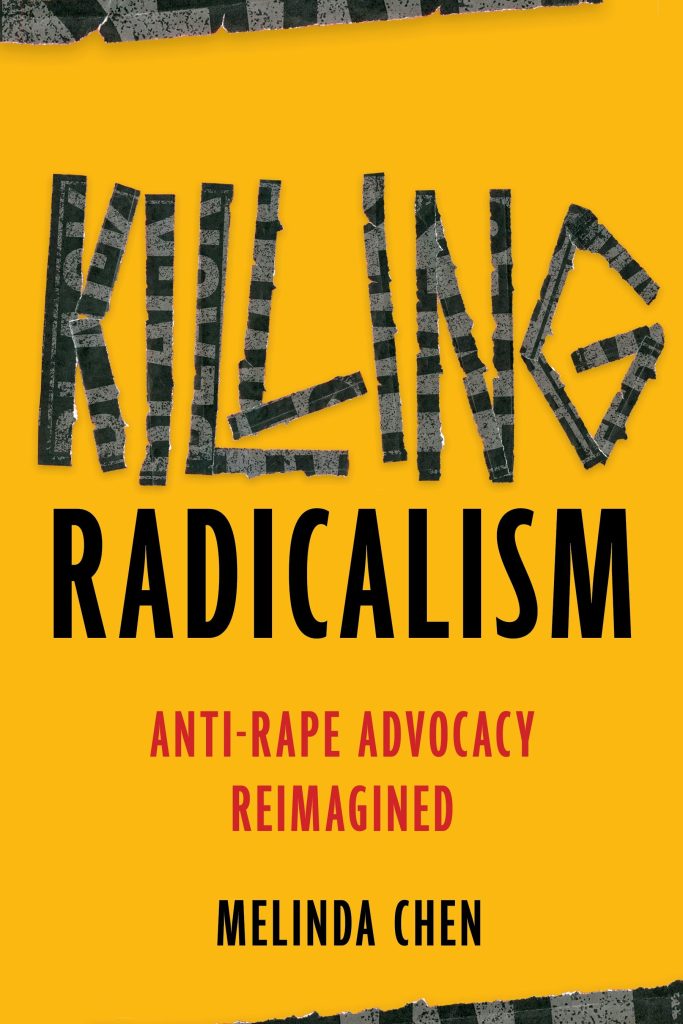
Adapted from Killing Radicalism: Anti-Rape Advocacy Reimagined by Melinda Chen (NYU Press), reprinted with permission from NYU Press.
Image: Abstraktne motiiv by Ülo Sooster, Tartu Art Museum, Estonia