During the 1980s and early 1990s, a wave of hysteria swept across the United States. Sensationalist media coverage and tabloid covers fueled wide-spread public fears that children were being sexually abused in Satanic rituals at the hands of their caretakers. In several high-profile cases, dozens of day care providers were criminally charged, sometimes facing hundreds of counts of sexual abuse.
The so-called Satanic Panic did not emerge in a vacuum. It coincided with a rise in conservative political and social influence and a broader backlash against feminism and LGBTQ+ rights. In the 1960s and 1970s, more women joined the workforce, increasing reliance on day care. At the same time, queer identities became more visible amid gradual legal and cultural shifts. These developments were widely perceived by social conservatives as threats to traditional family and sexual norms. Conservative Christian media figures in the 1980s—often described as “moral entrepreneurs”—helped amplify fears of satanic ritual abuse.
Many Satanic Panic cases had core similarities: the use of junk science to “prove” evidence of abuse, the employment of coercive interrogations that led to false accusations or confessions, and, sometimes, the weaponization of bias against women and queer people. One of the most visible extensions of this pattern appeared in the early 1990s in the case of the San Antonio Four, in which four women faced allegations that they had molested two young girls in a satanic ritual.
At the time, the four young women—Kristie Mayhugh, Cassandra Rivera, Elizabeth Ramirez, and Anna Vasquez—had recently come out as gay to their families. All four were Latina, and Ramirez was the aunt of the two girls who made the accusations. Although all four women were eventually indicted, Ramirez, who was pregnant at the time, was prosecuted first and portrayed as the ringleader, with the others tried later. The pediatrician who examined her nieces, Dr. Nancy Kellogg, insisted that a scar on one of the girl’s hymens indicated that sexual abuse had occurred. In her notes, she speculated that the case “could be satanic-related.”
In 1997 Ramirez went to trial, where her sexuality became a focal point. Prosecutors emphasized that she was a lesbian, telling the jury that Ramirez’s identity as a lesbian was “only important in the sense that that activity is generally consistent with the activity alleged in the indictment.” This rhetoric relied on a dangerous subtext: that the sexual deviance of being a lesbian correlated with being a violent rapist of children. Prosecutors further dramatized the proceedings by casting one niece as a “sacrificial lamb” offered to Ramirez’s friends and describing the children involved as innocent victims “sacrificed on the altar of lust.”
The jury convicted Ramirez of aggravated sexual assault of a child, and the judge sentenced her to thirty-seven-and-a-half years in prison. At a separate trial in 1998, a jury convicted Mayhugh, Vasquez, and Rivera of the same charges, and each was sentenced to fifteen years in prison.
More from our decarceral brainstorm
Inquest—finalist for the 2025 National Magazine Award for General Excellence & cited in The Best American Essays 2025—brings you insights from the people working to create a world without mass incarceration.
Sign up for our newsletter to get the latest in your inbox every Saturday.
Newsletter
Innocent people in the LGBTQ+ community have long been wrongly arrested, criminally charged, and even convicted because of discrimination tied to their identities. Over two decades ago, Leslie Feinberg reflected on her own arrest in the book Trans Liberation: Beyond Pink or Blue, writing: “The reality of why I was arrested was as cold as the cell’s cement floor: I am considered a masculine female. That’s a gender violation.”
Queer and trans women in particular have suffered violence and criminalization for their “deviant” sexual behavior and gender performance. They have lost custody of their children for coming out as lesbians, and their writing has been criminalized as obscenity. In 1925 Eve Adams, a Jewish woman originally from Poland, self-published Lesbian Love, an ethnographic account of lesbian life in the United States. She was later arrested in a police sting, convicted on “obscenity” charges related to her book, and sentenced to prison before being deported. She was ultimately murdered at Auschwitz in 1943.
In 2010 the San Antonio Express-News reexamined the case of the San Antonio Four, highlighting faulty medical evidence presented at trial, inconsistencies and changes in the girls’ testimony, and the statistically slim likelihood of the defendants being gang sexual assailants. The article quoted a professor of gender and sexuality, who noted anti-gay stereotypes in the trial, including misconceptions linking lesbianism to child abuse. Around this time, filmmaker Deborah S. Esquenazi learned about the case and began developing the documentary project that would become Southwest of Salem: The Story of the San Antonio Four.
Ramirez’s two nieces were first interviewed by investigators in the 1990s, when the allegations emerged. Years later, as adults, they were interviewed again during post-conviction proceedings, including for appeals, defense investigations, and documentary coverage.
According to the appellate record, the allegations first arose when the girls’ grandmother saw them and their cousin playing a game of kissing, which they said mimicked behavior they had witnessed their father, Javier Limon, engage in with other women in front of them. At that point, Limon blamed their behavior on Ramirez. He pressured the girls to make allegations against her—Ramirez had rejected his romantic advances in the past—and her friends. He coached the girls on what to say and struck them if they parroted the story back incorrectly.
It further came to light that Limon had made false sexual assault allegations in the past to manipulate custody disputes involving his children. His younger daughter, Stephanie Limon, recanted her childhood testimony as an adult. She said that her father was abusive, and that he had threatened her before she recanted her story, telling her she could go to prison. This corroborated her account that Limon had threatened her into making the original sexual assault allegations against her aunt in the first place.
Additionally, attorneys for the four women obtained the photographs that the pediatrician, Dr. Kellogg, relied on at trial and showed them to independent experts, who concluded there was no physical evidence of any trauma. Ultimately, Dr. Kellogg herself signed a sworn affidavit saying that, had she known then what she later learned about sexual-abuse forensics, she would not have testified to physical signs of molestation.
Southwest of Salem captured these developments on film, building toward and culminating in the San Antonio Four’s post-conviction hearing in 2015. At the end of the documentary, viewers watch the deciding judge, who had presided over one of the original trials in 1998, reject their claims of innocence and deny relief.
A year later, Southwest of Salem debuted at Tribeca Film Festival while the women’s case was on appeal. The film received critical acclaim and won awards including a Peabody Award and a GLAAD Media Award for Outstanding Documentary. Tens of thousands of viewers signed a #freetheSA4 petition on Change.org and urged the Bexar County District Attorney’s Office to declare actual innocence and exonerate the four women.
About seven months later, the Texas Court of Criminal Appeals ordered the convictions of the San Antonio Four vacated. The opinion started in an unusual manner, referencing Southwest of Salem and the cascade of coverage that followed from Rolling Stone, the New York Times, and the Texas Tribune. The court acknowledged, “whether it is in articles or a documentary, these cases involving ‘The San Antonio Four’ have been well dissected in popular media.” The court continued: “We are asked to decide whether the newly available evidence of innocence undermines the legally sufficient, but hard-to-believe version of events that led to the convictions of these four women. We hold that it does and that these four women have unquestionably established that they are innocent of these charges.”
Nearly two decades after their convictions, the San Antonio Four were exonerated.
The San Antonio Four were convicted because of homophobia and false scientific evidence. The often-outlandish claims made in their case were bolstered by a broader narrative that cast queer people as inherently suspicious, violent, and sexually deviant. As a result, the four women spent nearly fifteen years in prison.
Exonerations in Satanic Panic–era cases were notoriously difficult to secure, often requiring years or even decades of legal challenges. This case was no exception; like many others, it was only resolved after prolonged appeals, with some comparable cases lingering unresolved until as recently as 2022.
Today, baseless claims of child sexual abuse against LGBTQ+ adults are rising again, fueled by conservative Christian politics. A 2025 survey from the Public Religion Research Institute found that a majority of Republicans qualify as Christian nationalists, either as adherents or sympathizers to a belief system where gender roles are rigid, gender identity is fixed at birth and binary, and homosexuality is wrong. Extremist Republican politicians such as Representative Lauren Boebert regularly and intentionally post slurs on social media that queer people are groomers. The first transgender person to serve in Congress, Sarah McBride, was quickly and baselessly accused by fellow Congressional Representative Nancy Mace of “grooming young children.”
That rhetoric is increasingly translating into institutional pressure. Extremists push libraries and public school classrooms to remove books with queer characters. University professors are fired, under pressure from government officials, for discussing gender identity in the classroom. LGBTQ+ people struggle to receive gender-affirming care, are denied accurate identification documents, are subjected to heightened scrutiny in airports when their IDs do not align with their gender, and are increasingly restricted from accessing bathrooms.
And as anti-LGBTQ+ narratives based on populist fear and emotion sweep the United States—drawing comparisons in the media to the Satanic Panic and fueling legislation targeting queer people—false stereotypes once again risk resulting in real criminalization. As the case of the San Antonio Four exemplifies, media can be a powerful tool to debunk—or perpetuate—these false narratives and challenge the current moral panic against queer people.
Too many innocent women have spent years in prison for crimes that never occurred. Now, the legal system is increasingly being used to target pregnant and new mothers, as well as queer people—raising the risk of wrongful convictions driven by identity and stigma. History has already shown where that path leads.
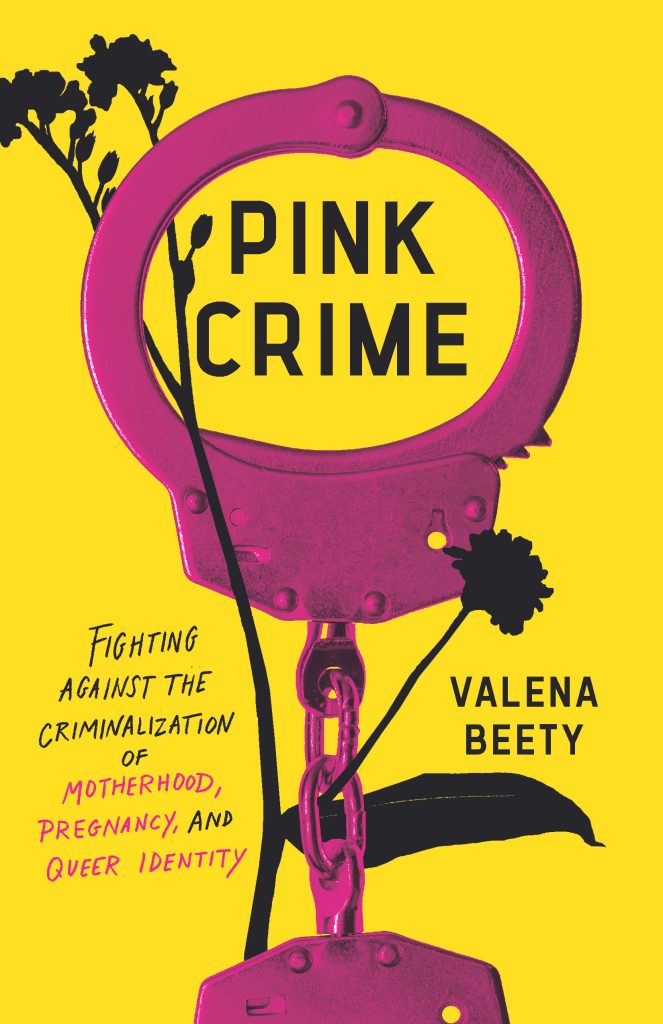
Copyright © 2026 by Valena E. Beety. This excerpt is adapted from Pink Crime: Fighting Against the Criminalization of Motherhood, Pregnancy, and Queer Identity, published by The New Press. Reprinted here with permission.
Source images: Ashley Levinson / Unsplash & Steve A Johnson / Unsplash