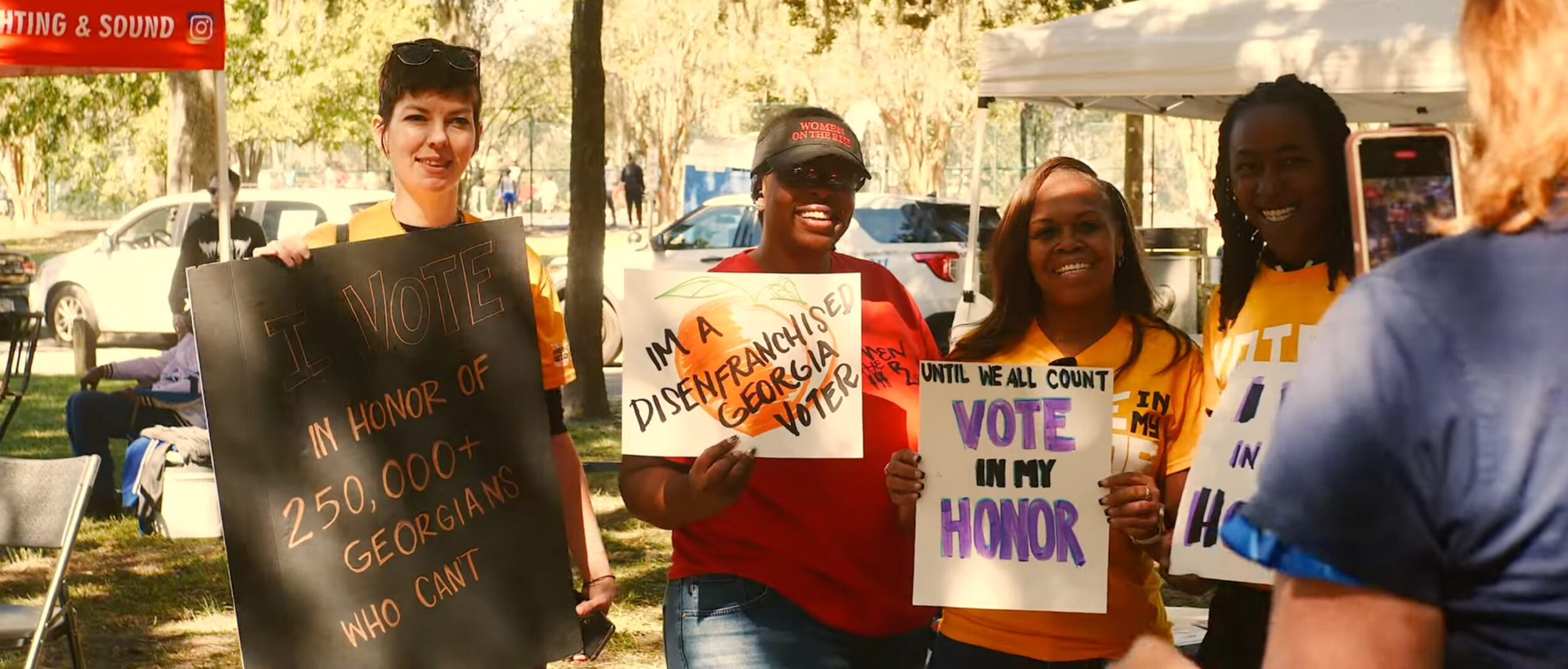
In Georgia, hundreds of thousands of people cannot vote because of a felony conviction. Until We All Count, a short film produced by Page Dukes and Represent Justice, explores the deleterious effects of felony disenfranchisement while highlighting the work of formerly incarcerated Georgians to win back their rights.
Watch the film below and then continue scrolling to read the short Q & A with Dukes and Inquest managing editor Adam McGee.
Adam McGee: How did you learn filmmaking? And how did you come to think of film as something that could play an integral role in campaigns to create social change?
Page Dukes: I’m still learning filmmaking. I’ve had some great mentors. Mordecai Lecky shot this film “run and gun” style with us on the road to Savannah for a Vote in My Honor rally back in 2022. Gretel Truong mentored me at Represent Justice, where, along with other formerly incarcerated leaders, I was encouraged to learn the craft to support campaigns in our many movement spaces.
Now, as Comms Organizer with Atlanta Community Support Project, I utilize film to support our collaborative policy efforts, like the Survivor Justice Act. I continue to make films to support our collective work because I want to do what I can to make sure our truths are told whole. It takes trust and accountability to share and honor each other’s stories without perpetuating the extractive and exploitative practices, intentional or unintentional, we all experience working with conventional news media.
AM: What has the experience been like to screen a film in which your own life story is so central? What was the process like of deciding not only to engage in decarceral activism, but to do so in a way that makes your own story so public?
PD: I have been sharing my story openly since I got out over eight years ago. I have always been an “open book” about my past, because I see the opportunity to use my experience to impact change and to empower others. Over time I learned to discern which parts of my lore were relevant to the conversation at hand, and to drop parts that were influenced by someone else’s ideas of redemption. I also now openly address my whiteness, along with my experience in a system that was not designed for me. We are all oppressed by structural racism, and it is important to be aware of and explicit about that, certainly when talking about the roots of felony disenfranchisement.
AM: What is the current status of the campaign to end felony disenfranchisement in Georgia? Has there been any progress since you completed the film?
PD: Georgia has more people under correctional control—either in prison or on parole or probation—than any other state. It is one of twenty-seven states where voting rights are not immediately restored upon release from prison. As of 2024, nearly 250,000 Georgians were unable to vote because of a felony conviction; 400,000 have had our right to vote restored, but many of us still don’t vote because of the confusion, suppression, and intimidation created by our felony disenfranchisement law.
We have come a long way since 2019, when I first went to Georgia’s capitol to speak to lawmakers who were discussing my life and my rights. We formed a coalition, the Rights Restoration Coalition of Georgia, led by people impacted by this policy, who agreed to lead with conviction—not to settle for less or throw our values or our people under the bus. Coalition partners work together to educate, organize, and engage our communities to show up, speak out, and lead the conversation at committee hearings. Because, as Kareemah says in the film, those of us who fully understand the implications of felony disenfranchisement—because we have been the most deeply affected—should be the ones formulating and analyzing proposed policy solutions.
This past legislative session, SR 429 created a senate study committee with the purpose of studying our state constitution “to explore possible reforms that would promote public safety by removing barriers to civic participation for individuals released from incarceration and ensure that Georgia’s election laws are in alignment with the principles of justice and equality.” We have not seen any movement on this yet, and are asking folks to put pressure on lawmakers. As I say in the film, let them know “this is important to you, and it should be important to them, too.”
While we are working to change the law, we are also resourcing and supporting those of us who are self-advocating to have our rights restored by whatever means possible. And pushing the boundaries of what we have been told is possible, and what we are collectively capable of achieving.
More from our decarceral brainstorm
Inquest—finalist for the 2025 National Magazine Award for General Excellence & cited in The Best American Essays 2025—brings you insights from the people working to create a world without mass incarceration.
Sign up for our newsletter to get the latest in your inbox every Saturday.
Newsletter
Image: Still from Until We All Count, courtesy of filmmaker.