Martin Sostre was one of the first political prisoners of the Black Power era, sentenced to thirty-one to forty-one years in 1968. Convicted by an all-white jury for allegedly purchasing a fifteen-dollar bag of heroin, he was actually criminalized for making revolutionary ideas accessible. Nearly sixty years later, Sostre’s sentence parallels the virtual life sentences handed down last week to eight of the Prairieland defendants, in total over a dozen people facing life-changing sentences for participating in a noise demonstration in solidarity with ICE detainees last July 4, during which a police officer was shot. There is much we can learn from their shared struggles against state violence.
In both, the dissemination of revolutionary ideas and threat of confrontational direct action lay at the heart of the state’s repression. In both, the state attempted to neutralize spontaneous direct action through conspiracy theories and caricatures of “terrorists” and “outside agitators.” Organizers were then scapegoated with virtual life sentences meant to send a chilling effect across resistance movements then and now. Perhaps most importantly, the state’s escalating multipronged attack through controlled media, law, force, and intimidation across time once again lays bare the necessity of intensified, dynamic struggle in response.
Sostre arrived in Buffalo in 1964 already a radical organizer. He was released from Attica Prison having spent twelve years inside, with the last five in solitary confinement for his activism and lawsuits against the state. He quickly established the Afro-Asian Bookshop, one of the country’s first Black-owned revolutionary bookstores. Sostre carried the speeches and writings of Puerto Rican independentista Pedro Albizu Campos and Cuban revolutionary Fidel Castro. Mao’s Little Red Book and the autobiography of Ho Chi Minh lined the windows. Sostre described the bookstore as a “community center” where people could use the phone, borrow money, or leave their children while running errands on the bustling Jefferson Avenue of the city’s east side.
He sold pamphlets about Malcolm X for twenty-five cents—equivalent to the “zines” of today that the state mobilized as evidence of a terrorist plot in the Prairieland case. Sostre described them as his most popular item, “introductory manuals into revolutionary thought.” Through trial and error, he transformed his fledgling store (and several others) in just a few years into what he called a “power base of revolutionary political philosophy.”
Like the Prairieland defendants, Sostre was targeted for spreading revolutionary thought. In the weeks before the 1967 rebellion in Buffalo, he had purchased a Gestetner duplicating machine (a predecessor to the modern-day photocopier) and planned to produce and disseminate a grassroots community newspaper called the Afro Freedom Fighter. Throughout the week of revolt that summer, Sostre’s bookstore stayed open until 3 a.m., becoming a site of politicization and a refuge from police violence in the streets outside. Sostre later remembered a Black teenager running into the store from a cop he had called a “pig.” Outnumbered by the twenty or so people inside the store, the officer simply shook his fist and yelled at him, “I hope you’re proud of this.” As Sostre prepared to launch his newspaper and recruit local teens to sell it within the community, the state clearly recognized the threat this posed. In the Prairieland case, the FBI used book club membership and a “printing press” found during a raid of the home of Liz and Ines Soto as evidence of “material support to terrorists.”
While there is much to be learned from the connections between these two stories of resistance and repression, there is one noteworthy difference between Sostre’s case and the Prairieland defendants today. In 1968 the state used drugs as a cover to destroy Sostre’s bookstore and criminalize the circulation of radical ideas. Rather than fight an openly political trial about censorship and the suppression of thought, they planted drugs. Today we see that the state no longer feels cover is needed. Its open targets are the tools of revolutionary struggle itself: the zine, the printing press, and the gun.
Despite his frame-up and the destruction of his bookstore, Sostre remained focused on the lasting effect of political education. While awaiting trial, he wrote to his supporters, “the burden of a long sentence would be lightened by the satisfaction of knowing that the mission set out for me, that of helping my people free themselves from the oppressor, is being accomplished.” Sostre continued to organize and develop his political thinking inside prison. He established radical study groups and lending libraries, published several revolutionary newspapers, organized chapters of the Black Panther Party, and fought for the rights of incarcerated workers. Sostre also fought legal battles through the courts and refused to submit to state-sanctioned sexual assault in the form of searches by guards, for which he was beaten nearly a dozen times.
In the early 1970s, Sostre reconfigured his defense campaign from a single committee in Buffalo to a decentralized network of autonomous groups that could work to secure his release from prison while acting as revolutionary bases for future-oriented struggle. Instead of organizing solely around the issue of his release, Sostre envisioned this cross-wall coalition as an opportunity to build tangible counter-structures for multidimensional struggle. “I saw my defense committees as a structure for the future,” he explained, a “microcosm of the society that we’re trying to build. Something concrete to show the people instead of just rhetoric.”
Throughout his life, including during his long incarceration, Sostre was a prolific writer, and he was read extensively by many contemporary organizers on the left. But much of his writing has been inaccessible for years. The following speech, “Follow the Principles that Won My Freedom,” was delivered by Sostre in 1976 shortly after his release from prison and offers a message of revolutionary optimism about how collective action can succeed—as it did for him—in freeing political prisoners and building a new egalitarian society. It is a message that feels as urgent today as it did then.
—Garrett Felber
More from our decarceral brainstorm
Inquest—finalist for the 2025 National Magazine Award for General Excellence & cited in The Best American Essays 2025—brings you insights from the people working to create a world without mass incarceration.
Sign up for our newsletter to get the latest in your inbox every Saturday.
Newsletter
Follow the Same Principles that Won My Freedom (1976)
Martin Sostre
It is a great pleasure to be here after being in prison for nine years. I was the victim of a frame-up because I fought for human rights and because I had the only bookstore in Buffalo, New York, that was disseminating socialist and political literature—literature dealing with the struggle for Black liberation here in this country, the struggle for Puerto Rican independence, literature against the war in Vietnam, and all progressive literature. That bookstore in Buffalo became a center for persons of conscience, for youths who were seeking guidance, for college students.
Naturally, the power structure did not like this, and as a result I was framed. And this is what happened in all of the Black ghettos, especially during the 1960s, and is still happening now.
As a political prisoner and a person of conscience, I suffered eleven beatings in solitary confinement. After one of those beatings I was framed by the same guards who assaulted me. They claimed I was the one who jumped the goon squad of seven that assaulted me. This resulted in another conviction and another four years to run consecutively with the savage sentence I was already serving.
This is how they operate in this country. They make everything legal. That’s how this country can claim that there aren’t any political prisoners, because they use the law to repress. I don’t have to tell you about all of the scandals. It is in the press even today about the FBI agents who are burglars, the CIA agents who are murderers. All the disclosures show that this whole country—from the chief executive in the White House down to the little corrupt cop on the beat who shakes down drug peddlers and frames them when they don’t pay—this entire system is corrupt, racist, and repressive. As a former political prisoner, I consider Mustafa as well as other political prisoners throughout the world my brothers because I can really identify with political frame-up and repression of persons of conscience who fought for human rights and dignity. And I oppose all regimes who oppress and silence the opposition.
But the very fact that I am here now, after being given forty-one years and then four consecutive years on top of that, is proof positive that even the most repressive state can be forced to disgorge its political prisoners and victims of its oppression.
Why did they release me after giving me forty-one years and then four years? Certainly they didn’t have a change of heart all of a sudden.
My case is the classic case of what can be done to free a political prisoner. The only reason they released me, or were forced to release me, was because of pressure. That is the only thing that repressive governments understand. Massive pressure, using all means necessary.
There were about eight defense committees throughout this country that were formed in my behalf. In addition to that, many political groups and individuals joined with my defense committees in picketing and demonstrations, sit-ins, letter-writing campaigns, and petitions. We flooded them with thousands upon thousands of letters.
My defense committee went to Albany and picketed Governor Rockefeller right at the state office building. We gave him no rest. Father Dan Berrigan and his crew sat in at [New York] Governor Carey’s office and forced him to have a meeting with them.
Amnesty International in Germany, which was the group that adopted my case in that country, sent contingents to the American ambassador demanding my release. In Holland also, the American ambassador was confronted by delegations of persons from Amnesty International demanding that they release Martin Sostre.
Placards, posters, that’s the only language they understand. You have to put a fire to their butts.
My being here is a victory of the people. Of course, I served nine years, but I had forty-one years and four years consecutive. So actually, I’m not supposed to be here. When they gave me that forty-one years, I was not a kid; I was forty-four years old then. That sentence meant that I would never see daylight again. It was the equivalent of a death sentence. And yet here I am in the struggle, and they know that they have a staunch revolutionary against them because they never succeeded in breaking my spirit despite the eleven beatings, despite the years in solitary confinement, despite the tear gassings, despite being taken out-of-doors in subfreezing weather buck naked to try to destroy my health. And they will do everything in order to break spirits and obtain complete obedience to their repression. That I could never submit to. Not even the threat of death could force me to do that.
As a matter of fact, in the combined eight years that I spent in solitary confinement I have lost that fear of death. Because I have been through hell, and I know how to fight the devil.
So these are the tactics that we have to use to release Mustafa and all other political prisoners.
This is the most repressive country in the world, oppressive on a world scale. It is a colonialist country that still has colonies like Puerto Rico, a country that, along with South Africa, is one of the most racist regimes in the world. It is a country whose very foundations are on slavery and genocide. The slaughter of the Indians, the enslavement and importation of Blacks, who at this very moment are still maintained in segregated communities. And our president has proclaimed that he will try to do everything possible in order to continue the forced segregation of schoolchildren.
This country claims to celebrate a bicentennial based on liberty. And yet the very founding fathers—George Washington and the rest of them—were slaveowners. The only liberty they were talking about was the liberty to oppress and exploit their slaves and not share the profits with the British.
So, if victory can be achieved here, as repressive and hypocritical as this country is, it can be achieved elsewhere too.
I was a person with no funds. No celebrities came to my help, except at the very end. Only when [Andrei] Sakharov spoke from Russia in my behalf did I get any widespread publicity. And yet it was groups like this one, of persons of conscience in many parts of this country, small but determined groups, not only in this country but in Germany, in Japan, in Holland, and other places where there are Amnesty International branches. It was a cumulative effort of all of these people of conscience, thousands all over the world that have won my freedom, and I am living proof of it. And this is what we are going to do for all political prisoners. All we have to do is to follow the same principles that have won my freedom. Put on the pressure and embarrass repressive regimes that try to pass themselves off as being democratic. By giving them the lie, they will be forced to release the political prisoners in order to maintain the image of a civilized country.
So I urge you to intensify your efforts in every way, physically and financially, because it costs money, leaflets have to be printed, halls have to be rented, telephone bills have to be paid. Put your body on the line when picketing is needed. Help to send letters and petitions. Use all means necessary.
The balance of power in this world is on our side. We will have the egalitarian society that we all seek, a society where we will be able to enjoy all of our human rights and dignities and where we can all share the wealth of the world—and there is plenty here for everyone. The greedy ruling class who monopolizes the wealth must be replaced by humanity, who will share the wealth in common.
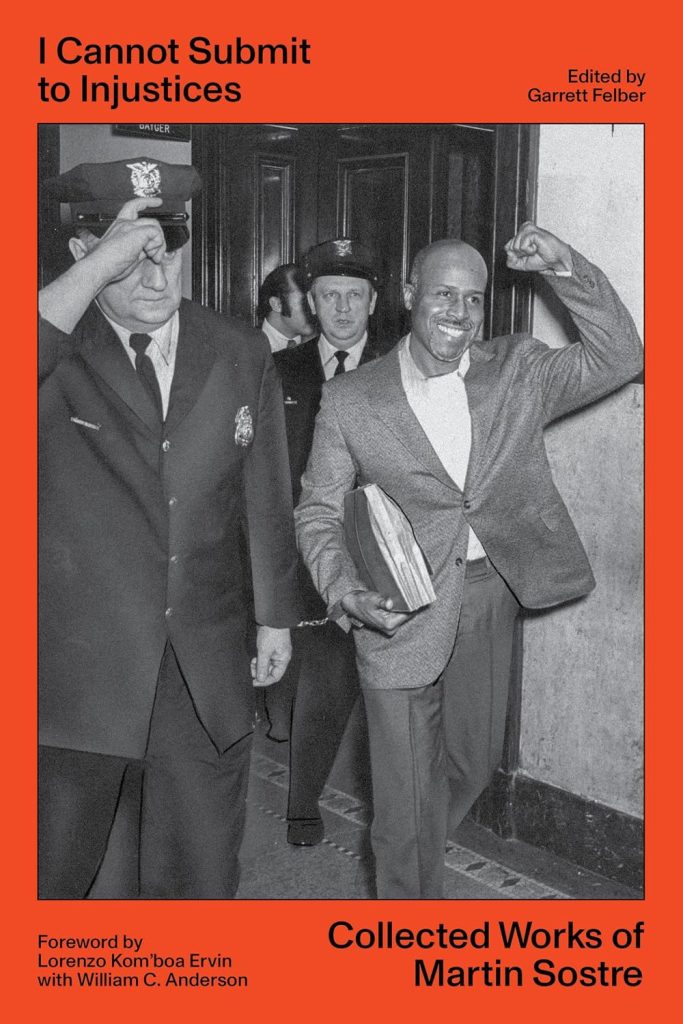
“Follow the Same Principles that Won My Freedom” by Martin Sostre is excerpted from I Cannot Submit to Injustices: Collected Works of Martin Sostre, edited by Garrett Felber and published by AK Press, reproduced with permission of Felber and AK Press.
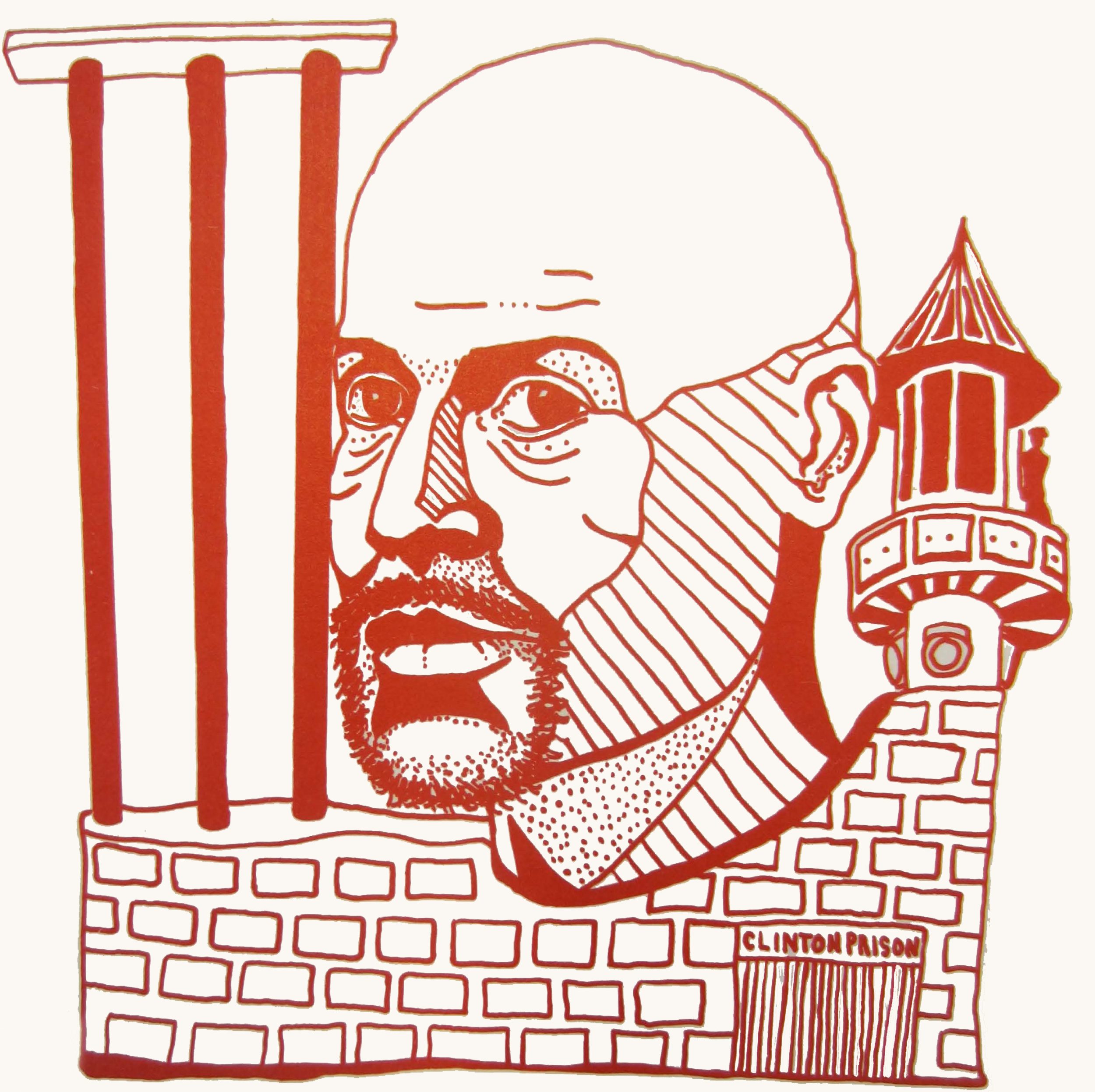
Image: Cover illustration from Martin Sostre’s self-published booklet “The New Prisoner” (1973).
Contributors