Writing for the American Poetry Review in 1977, Etheridge Knight reflected on his tenure as a columnist for the Lakeshore Outlook, the official prison newspaper of Indiana State Prison. By then a well-known Black Arts Movement poet, Knight—who was incarcerated from 1960 to 1968—described the process of publishing his first column. He recounted the array of responses to his writing on poetry and prison life, including a “hostile letter” from a disgruntled reader: a young Black incarcerated man in solitary confinement whose words, Knight wrote, prompted him to “do a great deal of soul-searching and head-scratching.”
The criticism was perhaps as old as journalism itself. The reader demanded to know whom Knight was speaking to, and whom he was speaking for. In his reply Knight conveyed the “complications” of writing for a prison newspaper. “One says a poem or writes a column here in with the warden’s eyeballs hovering/over one’s left shoulder, and with the Commissioner of Correction’s eyeballs glaring only a few inches/above the warden’s, and finally with the Governor’s eyeballs hanging like twin light bulbs from the ceiling of the whole prison,” he wrote. Knight, like other journalists in this series have attested, described how the threat of retaliation and state-sanctioned violence constantly hovered over the writer’s shoulder as a haunting, even embodied presence.
Here, Knight captures the prison journalist’s longstanding dilemma. The very act of writing is marked by control mechanisms—censorship, surveillance, and repression. Indeed, the words “prison newspaper” read as both paradoxical and, to many, unfamiliar. As a genre of print, newspapers are premised on the ideals of free expression, knowledge exchange, and holding power accountable. But for a time throughout the twentieth century, it was commonplace for federal and state prisons to have newspapers or magazines, often printed at each prison’s print shop. The historic prison publications of the mid- to late- twentieth century rarely feature in histories of the carceral state, though the 2021 release of JSTOR and Reveal Digital’s open-access collection American Prison Newspapers 1880-2020 has made many of them available to the public.
These publications were run by incarcerated writers, editors, and artists. But the prison was their publishing house and, accordingly, their censor. As Knight wrote in his letter, while these platforms opened up certain possibilities for expression, they were inextricable from prison administrators’ tactics of control and counterinsurgency.
More from our decarceral brainstorm
Inquest—finalist for the 2025 National Magazine Award for General Excellence & cited in The Best American Essays 2025—brings you insights from the people working to create a world without mass incarceration.
Sign up for our newsletter to get the latest in your inbox every Saturday.
Newsletter
The first journalistic enterprise in prison is widely recognized as Forlorn Hope, which published its inaugural issue on March 24, 1800. Working inside a New York debtors’ prison, William Keteltas founded the weekly newspaper to advance his individual case for release and a wider campaign to end imprisonment for debt. Reform-minded activists took notice and, as a result, Keteltas sustained the paper independently through subscriptions that cost $3 a year. But Forlorn Hope ran for just six months, with its last known edition being published in September 1800.
Because of its independence, “prison newspaper” is a slight misnomer for Forlorn Hope. That invention emerged about seventy years later, according to biographer and journalist James McGrath Morris, author of the seminal text Jailhouse Journalism: The Fourth Estate Behind Bars (1998). At the inaugural American Prison Congress in 1870, penologists and prison reformers discussed whether newspapers could be used as a technology of discipline and reform. Newspapers in the free world were deemed unsuitable reading material for prison populations, given their coverage of crime and violence. Philadelphia-based reformer Joseph Chandler, a former newspaper publisher, proposed the idea for a prison newspaper, asking: “Can a newspaper, specially designed for the use of prisoners, be made of considerable moral use?”
Under this model, prison newspapers would be regulated by prison officials and oftentimes chaplains toward this purpose. Zebulon Reed Brockaway, a leading nineteenth-century reformer, put this into practice upon becoming the warden of New York’s Elmira Reformatory, establishing both a print shop and a paper called the Summary in 1883. As Morris describes, the Summary contained sanitized news from the outside world, flattering coverage of activities inside the prison, and encouraging letters from men on parole—all produced under the eye of Elmira’s leadership.
Between 1880 and 1890, prisons in more than twelve states, including Connecticut, Massachusetts, Illinois, and Texas followed Elmira’s example and established prison newspapers following this model. These newspapers, Morris writes, created an impression that “prison life was often pleasant, invigorating, and improving” which was “an image that Brockway [and his contemporaries] wanted to convey” despite all evidence to the contrary.
The administration-initiated newspaper was not the only model of “prison newspaper” in circulation. In other places, incarcerated people fundraised to establish prison newspapers. At Minnesota Correctional Facility–Stillwater, a group of incarcerated men raised $200 to establish the Prison Mirror in 1887.
Once approved by the warden, the Prison Mirror initially published without much interference from the administration. This relative freedom, however, ended as administrations changed: by the 1890s, wardens and officials were reviewing proofs of the paper before publication. One of few still-running prison newspapers today, the Prison Mirror remains censored, which, as its staff members told NPR in 2024, limits coverage and the extent to which staff can be critical of the facility.
In the twentieth century, the Prison Mirror was joined by a host of prison newspapers that proliferated across the country—from coast to coast and even in Hawaii. Although histories of prison journalism mostly focus on publications produced in men’s prisons, women’s prison newspapers began appearing in the 1930s. According to Morris, two of the earliest were the Eagle, established at the Federal Industrial Institution for Women in Alderson, West Virginia, in 1933, and the Reflector, established at The State Reformatory for Women in Shakopee, Minnesota, in 1935.
In 1959, TIME magazine reported that promoting rehabilitation and vocational training was a primary goal of these newspapers, which were published by “willing wardens.” TIME wrote: “Convict journalists have responded to the qualified freedom they enjoy by turning out respectable papers and—in increasing numbers—respectable workmen.” This assessment underscores the paradox of the prison newspaper and, indeed, of what many activists, abolitionist practitioners, and scholars such as Angela Davis and Ruth Wilson Gilmore caution about reform itself: that it has the capacity to strengthen and legitimize institutions of social control.
Many of these newspapers loosely belonged to a network called the “Penal Press.” Despite its capital letters, the “Penal Press” had no central organizing structure. According to journalism professor Russell N. Baird’s The Penal Press (1967)—the first book-length study of prison journalism—it was an affiliation that allowed for the exchange and reprinting of articles across prison newspapers and magazines. While they varied in size and frequency, these publications might be understood as highly-mediated local newspapers, circulating essays, articles, and creative work as well as reports on prison life and announcements from each prison’s administration.
By 1967, there were an estimated 222 prison publications in circulation, many of which were part of this loosely organized Penal Press. Around the same time, Southern Illinois University’s journalism department founded the recently-revived American Penal Press Contest, a national competition recognizing the work of confined journalists. In his book, Baird found the total reported circulation of prison publications to be approximately 240,346 with 80,416 of those copies being sent to outside subscribers. Their content varied across prisons, and it was often not entirely clear whether they were mouthpieces for prison administrators, platforms for incarcerated writers to express themselves, or both. Amid these debates, many prison journalists produced counternarratives that dispelled dehumanizing perceptions of people behind bars and helped mobilize public advocacy.
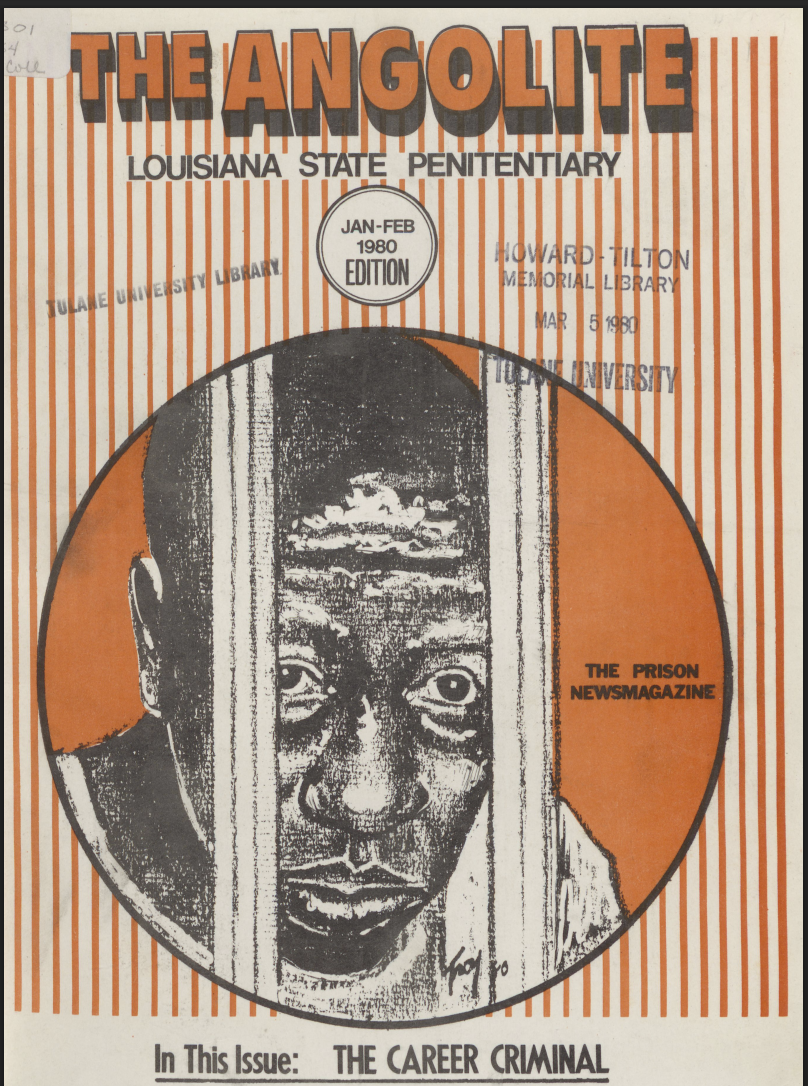
This was especially true amid the rise of mass incarceration in the 1970s. Writing in 1979 from Louisiana State Penitentiary, Wilbert Rideau and his co-editor at the Angolite, Billy W. Sinclair described the paper as one of the “few instruments left through which to convey realities and to chip away at the monstrous image the public has conceived of us.”
Along with the Menard Time of Illinois State Penitentiary and the Prison Mirror, the Angolite became one of the most acclaimed prison newspapers in history. But the Angola-based newspaper occupied a unique position: beginning in 1976, it operated as an “uncensored” publication, based on an informal “handshake” agreement between the prison’s warden, C. Paul Phelps, and its newly appointed editor, Rideau. At that time, Rideau—who was the paper’s first Black editor—had a rising journalistic profile in Louisiana that, as incarcerated journalist John J. Lennon said in a 2024 interview with Rideau, meant the prison had to “contain” him. In his 2010 memoir, In the Place of Justice, Rideau framed Phelps’s agreement as especially surprising given that “censorship was the official religion of penal authorities everywhere.”
The absence of formal censorship did not constitute a blank check for Angolite staffers to publish anything they wanted without consequence. Editors carefully considered what could get the paper shut down, Kerry Myers—who succeeded Rideau as Angolite editor in 2001—told me in a June 2025 interview. Like editors of other prison newspapers, they walked a delicate tightrope between prison administrators and the incarcerated population they were part of. But the Angolite’s unprecedented editorial latitude enabled it to produce more critical, investigative journalism on Louisiana’s carceral state.
The Angolite won awards for landmark stories, including “The Sexual Jungle” (1979), a nearly 30-page exposé of sexual violence in Louisiana’s prison system, and “Conversations with the Dead” (1978), an in-depth investigation into “forgotten prisoners” who had effectively been lost in Louisiana’s parole and clemency system, exposing the bureaucratic failures that kept them behind bars. The Angolite became one of the most decorated prison newspapers in the country, winning multiple American Penal Press Contest awards. By 1993, it had also been nominated for the National Magazine Award seven times. Myers, who is now the deputy director at the Louisiana Parole Project, said that the Angolite’s journalism offered “context, depth and perspective that no one else has.”
As editor of the Prison Mirror in the 1980s, Robert Taliaferro pursued a similar goal of changing narratives about people behind bars. In a 2023 podcast interview, he described how the Prison Mirror could reach people’s families and a wider public, thus facilitating communication and relation despite physical separation. “These guys were like, oh my picture’s in the newspaper. And they could share it with their moms, or their dads or their kids. But I wanted to modernize people’s ideas of what prisoners were about. So one of the things I did was making sure—giving the prisoners a human face,” Taliaferro said.
In a piece for the Prison Journalism Project, Taliaferro reflected on competing against his peers for the American Penal Press Awards each year, writing “we were a small community of editors, yet we all knew the importance of what we were doing. Though we competed with each other for the honors, we all shared pride in each other’s successes.” He remembers those years as the “golden age of prison journalism.” By the 1990s, however, prison newspapers declined significantly.
In addition to these sanctioned publications, there was also a rich network of unsanctioned and uncensored prison-centered media during this time, especially with the rise of prison organizing in the 1970s. These publications used underground networks and inside-out collaborators to print and distribute content within and outside prison walls. For instance, roughly a year after the 1971 Attica Rebellion, Muhammad Speaks, then the Nation of Islam’s official newspaper, began running a column called “Prison News in Black.” In doing so, the NOI—a central pillar of Black prison organizing—would keep readers abreast of “cases which develop [sic] around Black prisoners and prison life.” Feminist publications on the outside, such as off our backs, the Lesbian Tide, and Big Mama Rag, also reported on events and updates affecting women’s prisons, according to historian Emily Thuma.
As Thuma argues in her study of independent women’s prison periodicals such as No More Cages and Through the Looking Glass, unsanctioned publications comprise an “unauthorized archive” of incarcerated people’s ideas and organizing toward the end of the carceral state.
During this time, prison administrations began to crack down on both sanctioned and unsanctioned journalism, realizing that such publications attracted public attention and could help unify and organize people inside prisons. Additionally, the rise of mass incarceration brought law-and-order policies and punitive sentencing laws that disproportionately affected Black and brown people in the United States. This reflected a larger national divestment from social services as prisons ceased to serve the function of rehabilitation, instead focusing on warehousing and incapacitating those inside.
In other words, as the American carceral state expanded, prison newspapers contracted. Notably, in the late 1970s, incarcerated writers also confronted a new wave of legislation and landmark Supreme Court rulings that, in practice, heavily restricted prison journalism—often justified in the name of “security.” Increasingly, prison officials did not want to lose control of the narrative. Even the Angolite became subject to more oversight. As its associate editor, John Corley, wrote in a November 2024 essay, “the current administration prefers to limit the influx of research information and be involved in editorial decisions.”
Amid this decline, Prison Legal News emerged, founded by Paul Wright and Ed Mead at Washington State Penitentiary in 1990. In a 2010 piece on PLN’s history, Wright called it a “magazine of struggle, whether in the courts or elsewhere” writing that “at a time when the prisoner movement was overcome by defeatism and demoralization, we thought it important to report the struggles and the victories as they occurred to let activists know theirs was not a solitary struggle.” From the start, PLN relied on an inside-out model: incarcerated writers produced most of the content, while volunteers and later staff on the outside typed, laid out, printed, and mailed its monthly print (and now digital) issues to readers both inside and outside prisons. Today, it is widely regarded as the nation’s longest-running independent, uncensored prisoners’ rights publication, though it is censored and even banned in many prisons.
Apart from PLN, many other organizations such as Black & Pink and All of Us or None use print media to circulate information and maintain networks across prison walls, drawing on a long history of feminist and queer organizing. The newsletter of the California Coalition for Women Prisoners, the Fire Inside, published its first issue in June 1996 and is currently the “longest published newsletter by, for, and about people in women’s prison in the U.S.,” according to its website.
Exemplars of independent, uncensored journalism such as Mumia Abu-Jamal’s broadcasts for Prison Radio and PLN have inspired many writers behind bars. This includes Ghostwrite Mike, an anonymized journalist incarcerated in California who co-founded the Carceral Studies Journalism Guild (CSJG). Ghost described the CSJG as an “insurgent community of captive intellectuals” that produces uncensored print and audiovisual content for audiences inside. The CSJG works in collaboration with academics and journalists (including myself) as part of the Justice for Everybody movement. “We need to seize the time for real, in my view,” Ghost said in a March interview. “What we’re building…represents a futurity that rejects the controlled speech model of unfreedom.”
As one recent profile put it, prison journalism is having a “renaissance,” and Rahsaan Thomas—journalist and co-founder of Empowerment Avenue, a nonprofit that connects journalists inside with mainstream publications—is one of its central champions. Incarcerated writers such as Lennon, Robert Lee Williams, Kwaneta Harris, Ivan Kilgore, and Christopher Blackwell have been instrumental in this shift, publishing reported essays and commentary in outlets such as the Marshall Project, Prison Journalism Project, and Inquest, as well as mainstream publications such at the New York Times, Rolling Stone, and Slate. The risks of doing this work are further exemplified by the 2025 documentary The Alabama Solution, in which incarcerated men used contraband cell phones to conduct a six-year investigation into Alabama’s prison system.
Prison-sanctioned media has also been making a comeback with roughly three dozen prison newspapers operating today. This pales in comparison to the hundreds that once existed, and some of these surviving papers work closely with nonprofits such as Pollen and the Prison Journalism Project for support and amplification. In 2008, the legacy prison newspaper San Quentin News began publishing after a 20-year hiatus. In 2017, the acclaimed podcast “Ear Hustle”—a Pulitzer Prize finalist originally created and produced inside San Quentin State Prison—launched its first season. It continues to release new episodes today. The second year of the revived American Penal Press Contest is currently underway.
Many of these prison-sanctioned publications mirror their historically censored predecessors; as Ivan Kilgore writes for this series, they are “newspapers restricted to presenting the views of the administration” that rarely contain substantial critiques of prisons themselves. Unlike the work of the CSJG or other independent journalists, they are heavily mediated venues of expression that can also function as technologies of control—not unlike the first prison newspapers of the late nineteenth century. For those writing for these outlets, it is difficult to pursue what Phillip Vance Smith II proposed in this series is journalism’s fundamental responsibility: to “inform, challenge, and hold society accountable.” As many have already written, this charge is antithetical to the prison itself.
Today’s resurging yet complicated ecosystem of journalism and its storied past underscores how writing in prison—journalistic or otherwise—is a contested site of power. Narrative has been a critical counterinsurgent device for the making of the American carceral state. It is also vital for anti-prison movements. We might return to Etheridge Knight’s words from 1977 to understand the continued challenges journalists inside confront as well as the modes of expression they cultivate. Knight writes:
Did you ever/wonder why a dude in here needs a pass to/go from one Cellhouse to the other? or why the guards make/us disperse if more than three or four of us get to/gether on the ‘yard’? ’Ever wonder why Blacks in South Africa need a ‘pass’ to/go from one part of the city to the other? or why they/are/not allowed to assemble? peacefully? Same-o, same-o. The ability to move, and to talk, makes for communication, and communication makes for FREEDOM. (By ‘communication’, I mean communion, communing, community—something like/that,—not just that transmitting of data from person A to Person B—that’s dictating, or dictatorship.)
Knight’s dispatch reminds us that communication, communing, and community poses a threat to the carceral apparatuses that seek to fracture relations and exercise control within and beyond prison walls. Its power lies in the insistence that the work of communicating and communing is—and has always been—the work of making freedom.
Image: Cover of the Angolite, January–February 1980. Published by Louisiana State Penitentiary, Angola, Louisiana. From the American Prison Newspapers collection, JSTOR (CC-BY-NC-ND).